
1. The Berlin operation
Avro Lancaster Mk III JA860, code AR-C2, served with No. 460 Squadron RAAF in RAF Bomber Command. It took off from RAF Binbrook at 17:35 on 27 January 1944 for Berlin. Of 530 bombers dispatched, 481 attacked. Australian squadrons sent 49 Lancasters; 48 reached the target area and six were lost.
A long route across the North Sea, a diversion against Heligoland and false markers dropped by Mosquitos were intended to delay interception. German night fighters nevertheless waited over Berlin. The bomber stream bunched, while a sharp turn on the withdrawal route increased collision risk.
No further message was received after take-off. JA860 failed to return.
2. Attack by two night fighters
In his later statement, wireless operator Reginald James Rofe said that two fighters attacked at about 21,000 feet. Fire disabled the rear turret and intercom. The order to abandon aircraft apparently did not reach every crew member. Flight engineer William Murray was wounded in the leg.
Rofe, Warwick Jonas and Reginald White bailed out. Rofe left at approximately 8,000-10,000 feet, when the Lancaster was diving out of control. McLachlan, Yates, Jones and Murray remained aboard. Rofe was captured the following day.
3. The seven crewmen
- William Robertson McLachlan (414947)pilot · RAAF · killed, aged 23.
- Ronald Charles Yates (1577128)navigator · RAFVR · killed, aged 22.
- James Michael Jones (1384281)bomb aimer · RAFVR · killed.
- William Valentine Murray (1607910)flight engineer · RAFVR · wounded, killed, aged 22.
- Reginald James Rofe (413143)wireless operator/air gunner · RAAF · bailed out, prisoner of war.
- Warwick Atherton Jonas (424189)mid-upper gunner · RAAF · bailed out, prisoner of war.
- Reginald Duncan White (1890676)rear gunner · RAFVR · bailed out, prisoner of war.
4. Aircraft and representative crew
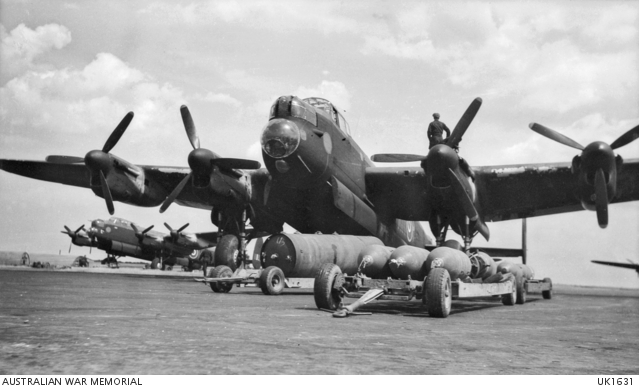
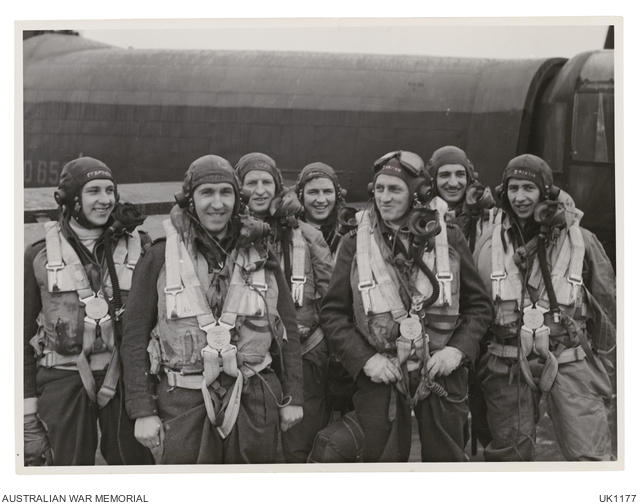
A Lancaster normally carried a pilot, navigator, wireless operator, bomb aimer, flight engineer, mid-upper gunner and rear gunner. The loss of the intercom aboard JA860 was therefore critical.
5. Nieder-Jeser and post-war burial
The crash site is associated with Nieder-Jeser, near present-day Zasieki. Graves Concentration Report BAOR/EG&P/161, dated 12 March 1949, records that the four dead were moved on 8 October 1948 to the British cemetery in Poznań. The historical document lists collective grave 6.D.12; later registers may use different numbering, and the Foundation has requested a full explanation.
The transfer did not answer every question: how much of the site was searched in 1948, how identification was established, what objects were recovered, and whether all human remains were removed.
6. Foundation discovery and IPN exhumation
During field investigation the Rokita Foundation team found cockpit remains and human remains at the crash site. The appropriate authorities were notified, after which the Polish Institute of National Remembrance (IPN) exhumed the remaining human remains. No individual identification is claimed without final official findings.
The Foundation is assembling records, cooperating with Polish, British and Australian institutions, and seeking the families of all seven airmen through voluntary, privacy-respecting channels.
Sources
- Aviation Heritage Museum: McLachlan and JA860
- Australian War Memorial, AWM64 1/305
- Australian War Memorial: No. 460 Squadron history
- AWM UK1177: representative crew photograph
- National Archives of Australia, series A705, control symbol 166/26/353.
- CWGC records for McLachlan, Yates, Jones and Murray; Graves Concentration Report BAOR/EG&P/161 and Graves Registration Report.
- ANU Archives: Warwick Atherton Jonas
- Rokita Foundation records: field investigation, cockpit and recovery documentation, and correspondence with IPN and overseas institutions.
Identification of the recovered remains and the precise post-war sequence remain subject to final official documentation.