
1588“von Scheune”
1765Neißhammer inventory
1841/43/46population lists
1913–15Sommer drawings
495 → 8081933 / 1939
1945Scheuno becomes Brożek
Documentation
Scheuno in documents, maps and photographs
These images are evidence rather than decoration. Each one links to a specific source and adds context about the village, its inhabitants or the landscape along the Neisse.

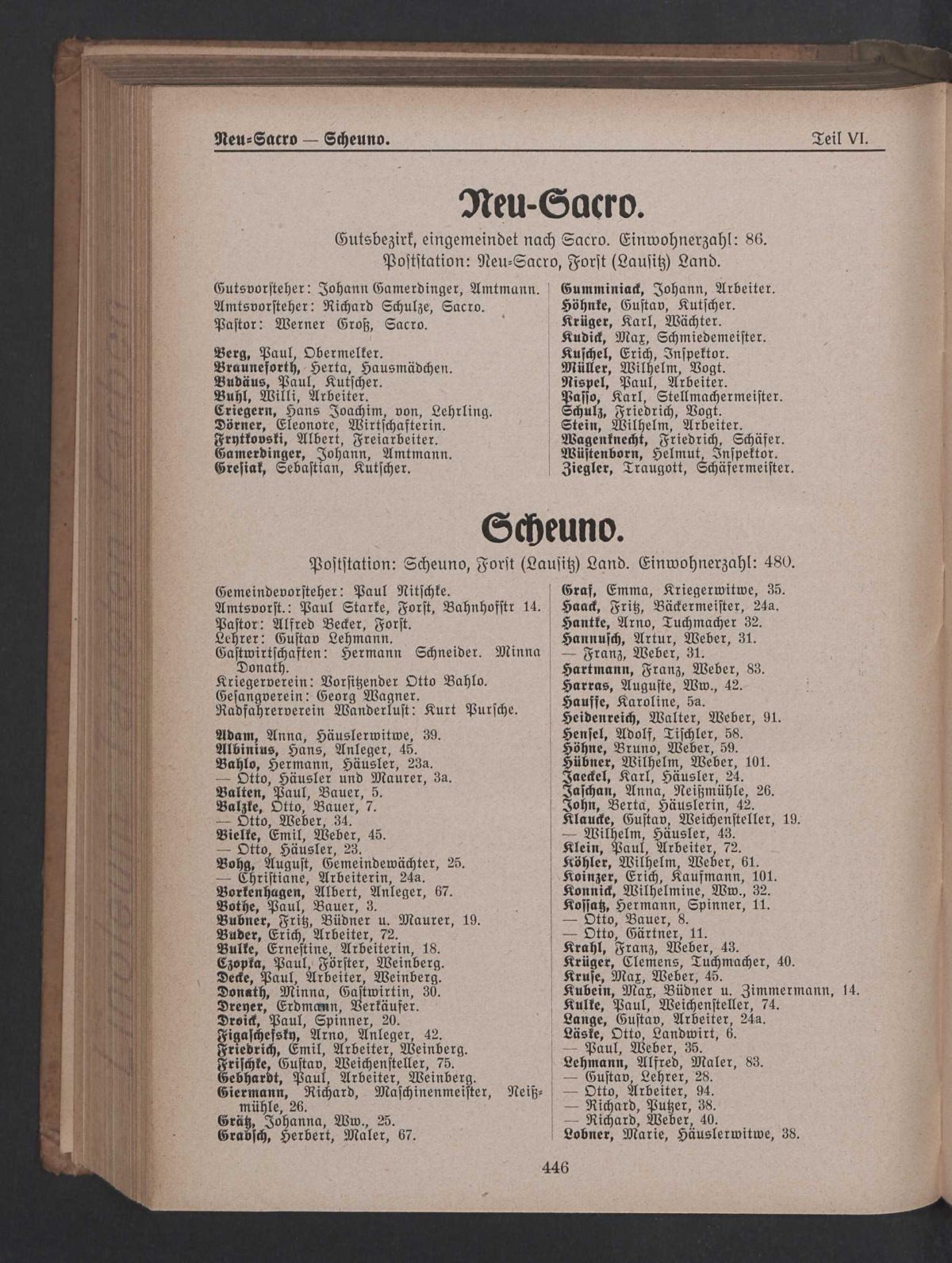
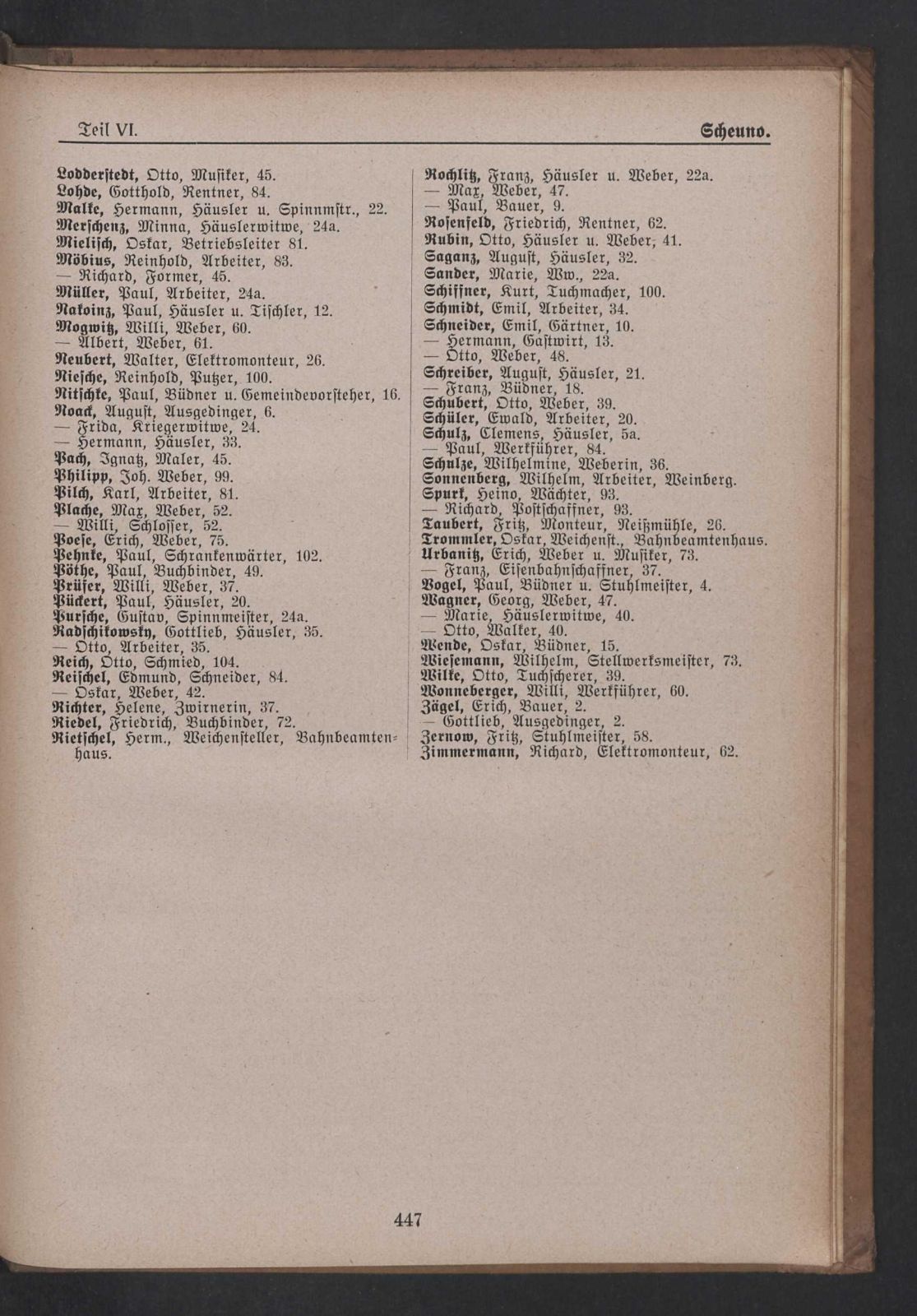


Voices from the sources
“Scheuno, 1588 von Scheune”
Walter Wenzel, onomastic study; the earliest reference currently identified.
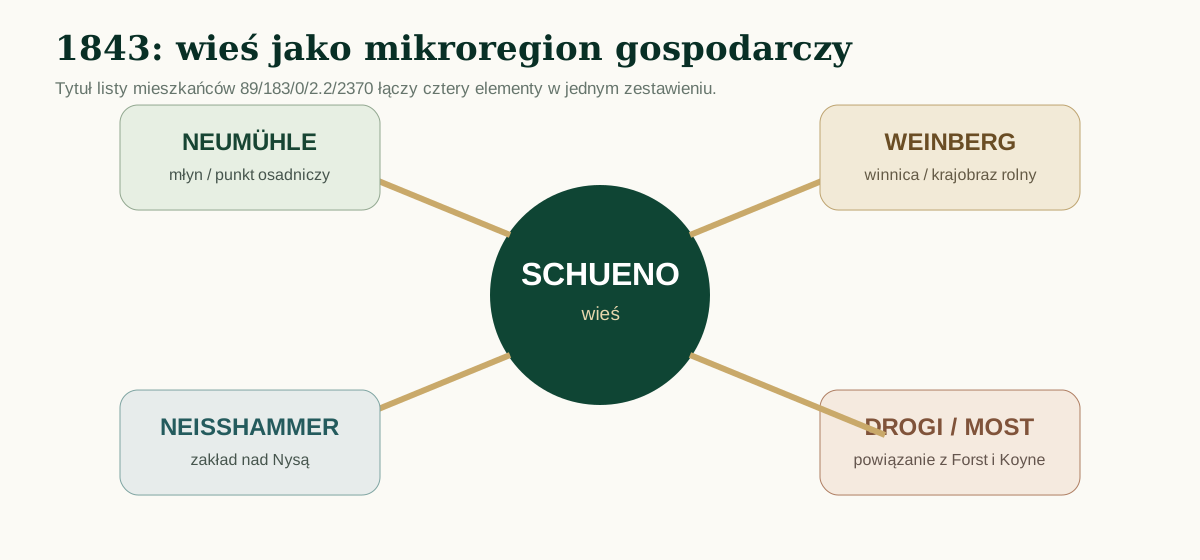
“Schueno mit Neumühle, Neisshammer und Weinberg”
Title of the 1843 inhabitants list, State Archives in Zielona Góra, 89/183/0/2.2/2370.
“Inventar des Neißhammers”
1765 catalogue description, Saxon State Archives, 10047 Amt Dresden, no. 3541.
“Scheuno-Dorf über Forst (Lausitz), Scheunoer Str. 75”
Address printed in Börsenblatt on 12 August 1943, SLUB Dresden.
Chronology
Earliest currently verified name reference: “von Scheune”.
The Neißhammer inventory is recorded in the Dresden administrative files.
The file “Weinberg zu Scheuno” documents the vineyard as a specific place.
The inhabitants list names “Schueno mit Neumühle, Neisshammer und Weinberg”.
Wilhelm Sommer records the vineyard, Waldschlösschen, Neisse mill and Scheuno bridge.
Scheuno is incorporated into Forst (Lausitz).
The new Neisse border breaks the former local network; Scheuno becomes Brożek.
Source first, interpretation second
This version follows the research method used for the Foundation's “Lower Lusatia” page: parallel searches across name variants, archives, maps, literature, newspapers, images and local catalogues. Historical Scheuno is treated as a village with its own history, not as a synonym for the later Deutsche Sprengchemie complex.
A · sourceArchives and official recordsreference codes, censuses, cadastral plans, land registers.
B · researchScholarly literatureonomastics, archaeology, regional and economic history.
C · leadLocal material / OCR variantsuseful for discovery, but not automatically historical fact.
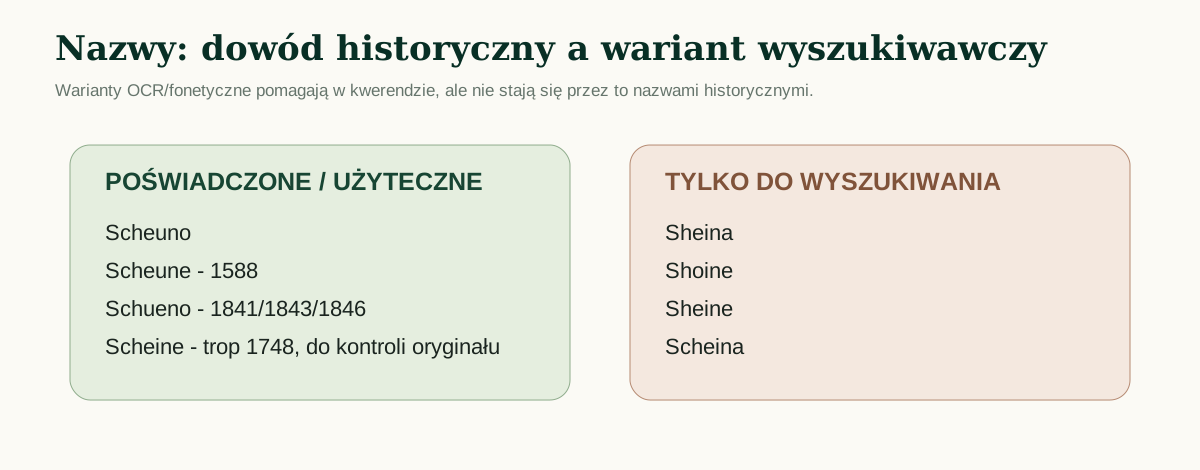
Sheina, Shoine, Sheine and Scheina remain search variants only. No reliable local source has yet been found that would justify presenting them as historic names of Scheuno.
1. The name: Scheune, Schueno, Scheuno
Walter Wenzel records “Scheuno, 1588 von Scheune” while discussing neighbouring Keune. The Forst marriage index independently uses “von Scheune [Scheuno]”. Schueno appears in official estate-file titles in 1841, 1843 and 1846. The form Scheine is a credible 1748 lead but still needs comparison with the original printed source.
2. Forst-Pförten: estate, people and settlement structure
The Forst-Pförten estate records in the State Archive in Zielona Góra are the central source base. They document duties, leases, surveys, school matters, roads and economic activity along the Neisse.
1827
89/183/0/3.1/6105 explicitly lists “Weinberg zu Scheuno”.
1841
2369: list of all civilian inhabitants of Schueno.
1843
2370: Schueno with Neumühle, Neisshammer and Weinberg.
1846
2371 and 2404: population list and statistical table with Neißhammer / Neu-Mühle.
3. Vineyard, Neißhammer and the river economy
The vineyard is directly documented: an 1827 file names “Weinberg zu Scheuno”. A major new archival lead is Saxon State Archive file 10047 Amt Dresden, Nr. 3541 (1765), whose catalogue description explicitly includes an “Inventar des Neißhammers”. Zielona Góra also preserves a Neißhammer repair file from 1828-1832.
4. What did Scheuno look like before the armaments plant?
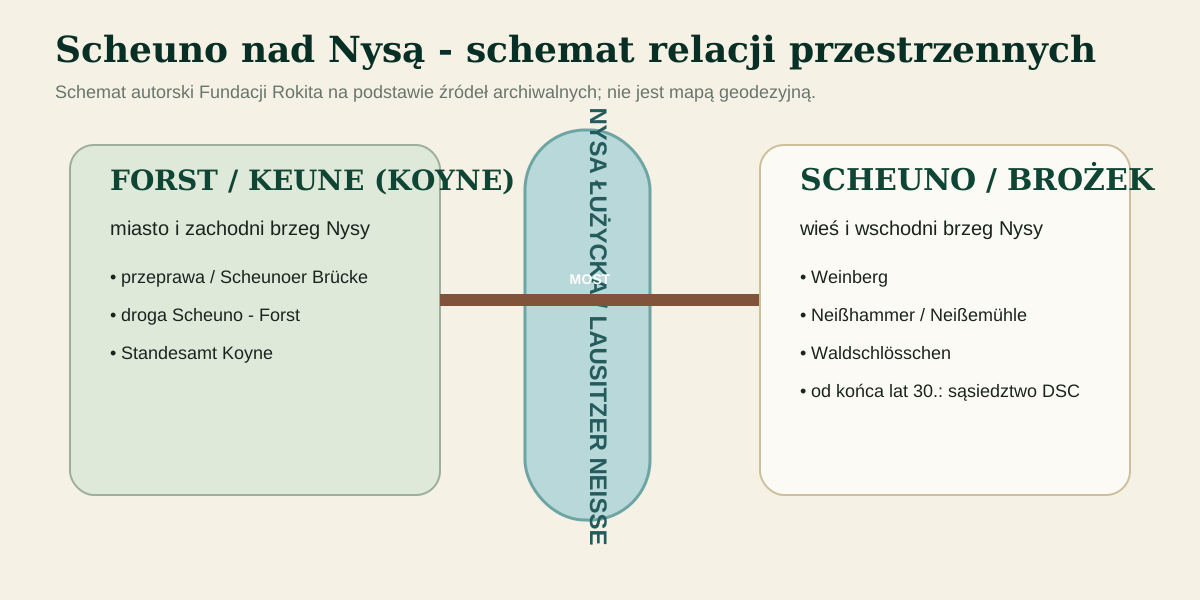
FoSG 283 in the Spree-Neisse District Archive lists Wilhelm Sommer drawings from 1913-1915: Scheunoer Weg, the Neisse valley from Berglehne Scheuno, a barn in the village, Weinberg, the Waldschlösschen inn, Neißemühle, Scheunoer Brücke and a view of Forst from the bridge. We do not generate substitute images for reproductions that have not yet been obtained.
The same file includes “Sonntagsmorgen auf dem Weinberge” and “Der Franzosenschatz”. The latter is a concrete lead for a local legend, but its story should not be retold until the original text has been reproduced and read.
5. Maps, school and everyday life
Cadastral series 89/2089/0/3.105 contains units 1043-1047, covering valuation and survey material from 1871-1945. Estate files also preserve the new school building file (4774), teacher appointment file (4776), burial-ground records for Scheuno and Berge (4775), and improvement of the Scheuno-Forst road (2599).
6. Population and the 1940 boundary change
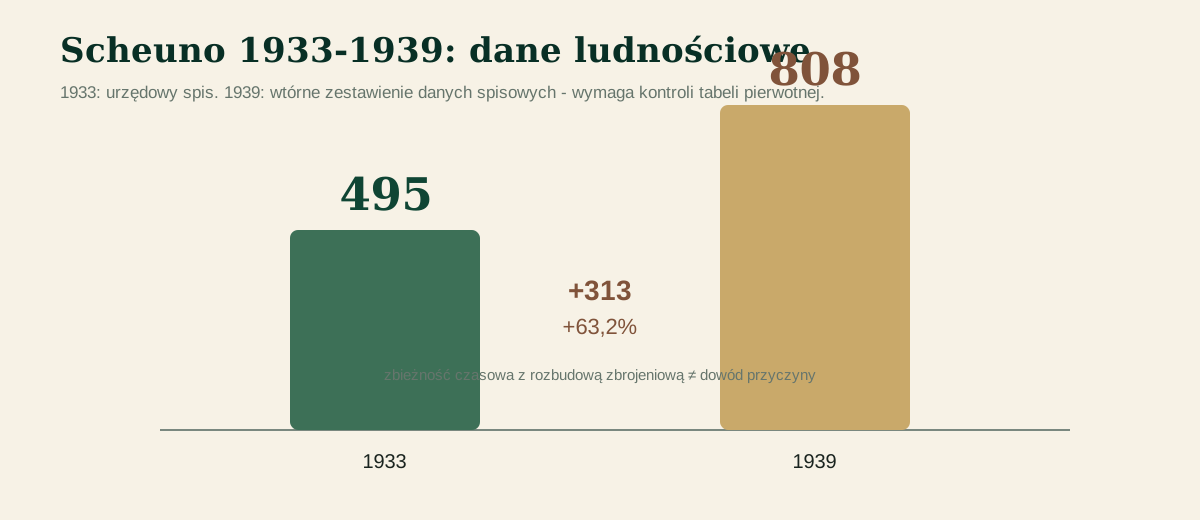
The official 1933 municipal register records 495 inhabitants. A secondary compilation of 1939 census data gives 808. The rise coincides with nearby armaments investment, but timing alone does not prove causation. On 1 April 1940 Scheuno was incorporated into Forst only “teilweise” - partly.
7. Archaeology: the ram's-head object
Klaus Raddatz published “Ein skythischer Fund aus Scheuno, Kr. Sorau” in 1951. A Brandenburg museum publication independently records a carved “Widderköpfchen” found in Scheuno. We do not assign a more precise findspot without field documentation.
8. Scheuno and Deutsche Sprengchemie Forst-Scheuno
The village, armaments plant, camps and workers' housing are separate historical layers. The 1995 G.E.O.S. report is used here only for spatial and chronological context; the factory's detailed history belongs to the DSC Forst section.
9. 1945: Scheuno becomes Brożek
With the new state border along the Lusatian Neisse, Scheuno became part of Poland and is now Brożek. Historic links to Forst and Keune were cut, while the surviving records became divided between Polish and German repositories.
Sources and further research
The principal findings are based on archival records, contemporary publications and institutional catalogues. OCR variants are not presented as historical place names.