
Open source
Sorau sheet, 1893
The region before the expansion of Forst-Berge and the Skurum settlement.
Wikimedia Commons / David Rumsey, public domain.
Open source → Fundacja RokitaHome
 Discover Brody Municipality
Two distinct histories on the east bank of the Neisse: Berge as a village and later district of Forst; Skuren/Skurum primarily as a sheep farm and estate outpost from which a settlement developed in the 1930s. The r20 version separates names and levels of evidence.
Historic maps show Berge and Skurum as distinct settlement layers. Open the source to enlarge the image.
The region before the expansion of Forst-Berge and the Skurum settlement.
Wikimedia Commons / David Rumsey, public domain.
Open source →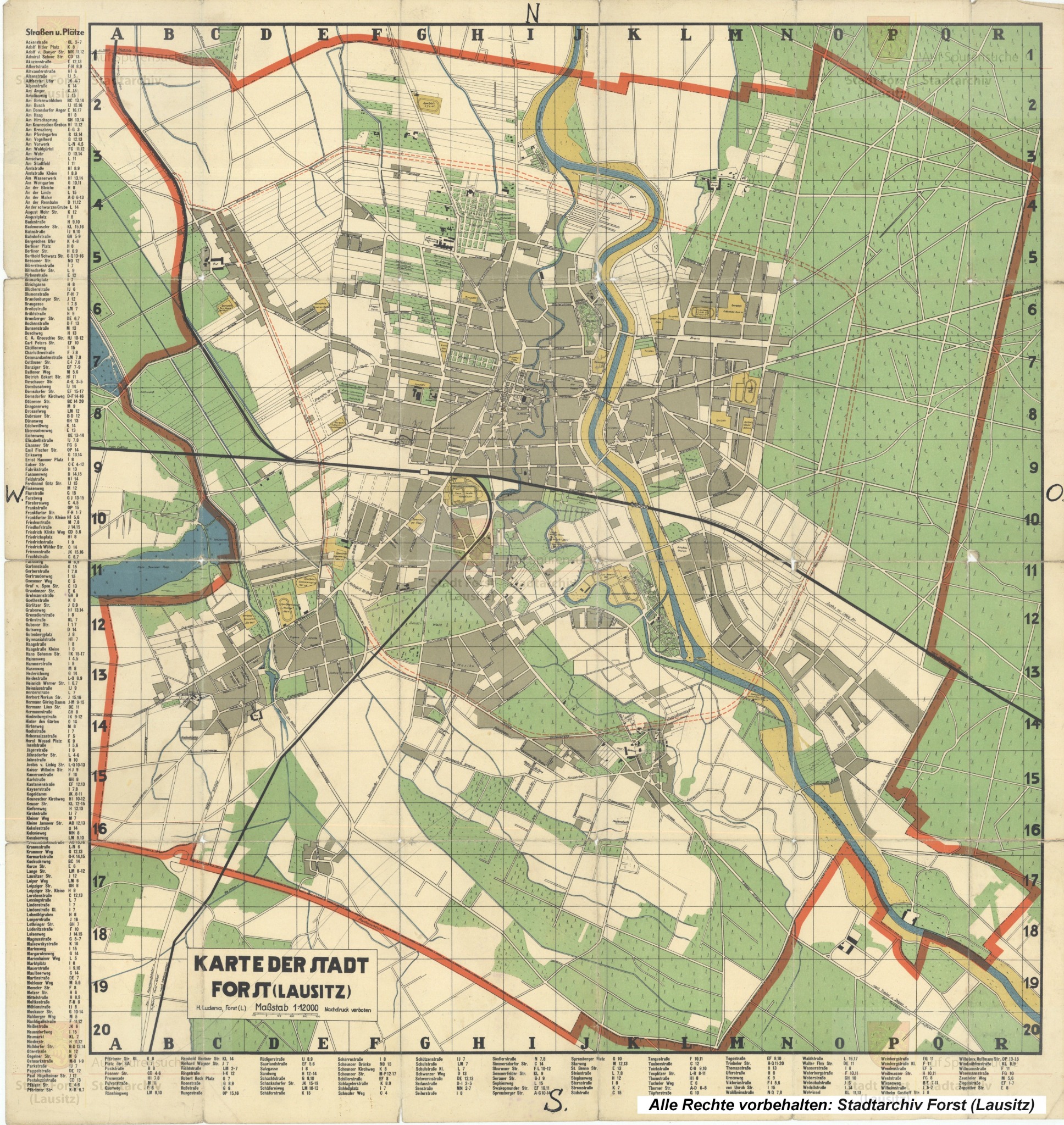
The town and its area east of the Neisse before 1945.
Copy supplied to the Foundation; source caption: Stadtarchiv Forst (Lausitz).
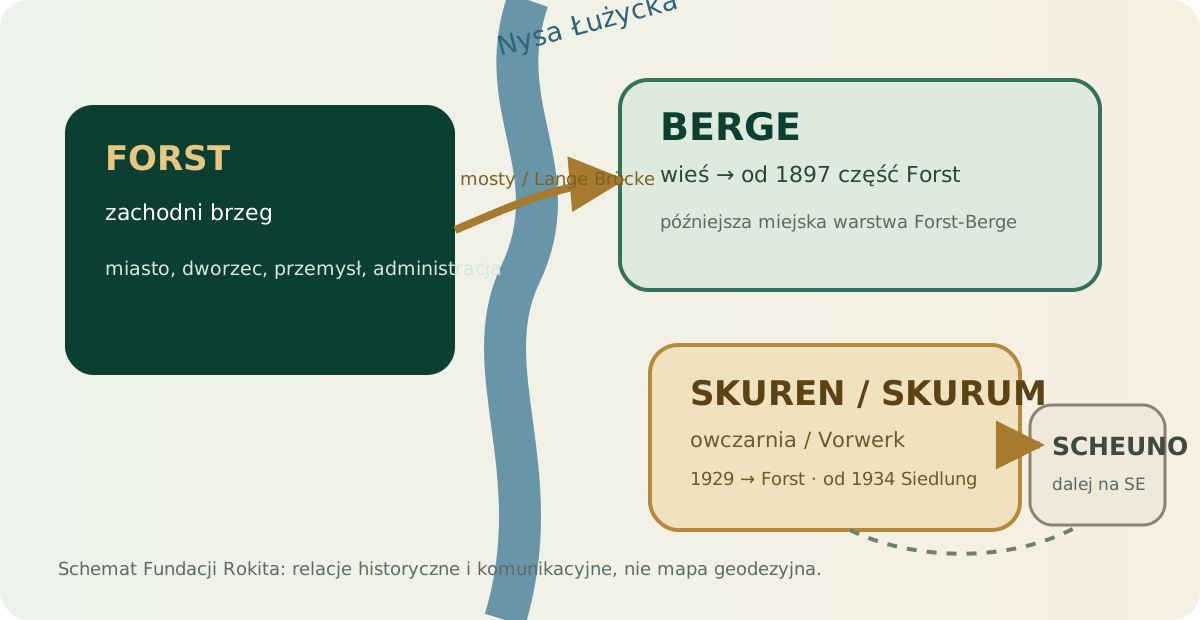
Open source →Several historical layers overlap within present-day Zasieki. Berge was a real village/community on the eastern bank of the Lusatian Neisse, documented by resident lists from 1841, 1843 and 1846 and by estate records from Forst-Pförten. It was incorporated into Forst in 1897, after which Forst-Berge also became the name of the expanding eastern urban district.
Skuren / Skurum / Skurim has a different origin. Archival catalogue records from 1813-1816 identify a “Skuren: Schäferei” (sheep farm), and an 1827 file again lists “Schaefereÿ Skuren”. Forst City Archive describes Skurum as a sheep farm, sometimes called Vorwerk Skurum, and explicitly says it remains uncertain whether a village settlement had existed there earlier.
The Forst and Pförten estate fonds in the State Archive in Zielona Góra contain three lists of all civilian inhabitants of Berge from 1841, 1843 and 1846. Other files concern woodland rights and leases in Berge (1831-1870), the redemption of real burdens by 13 house owners (1853-1856), and the Amtsbezirk Berge in Kreis Sorau and its dissolution (1876-1897). This is strong catalogue-level evidence for Berge as a historical community.
The often-repeated date 1627 is not used as a confirmed beginning here because the underlying primary document has not yet been identified in the present research.
An official Forst publication gives 1 April 1897 as the date when Berge was incorporated into the city. Berge's volunteer fire brigade became Forst's second fire unit. During the major Neisse flood of 31 July/1 August 1897 both units worked together to defend dikes and rescue residents.
In the 1920s the east bank was reshaped as part of the modern city. The Lange Brücke was built in 1921-1923. Kreisarchiv Spree-Neiße catalogue entry FoSG 383 records 1926 plans for the eastern bridgehead in Forst-Berge, credited to Rudolf Kühn, Felix Müller and Walter Schwalbe. The city of Forst still describes Zasieki as “ehemals Forst-Berge” in its present-day architectural route.
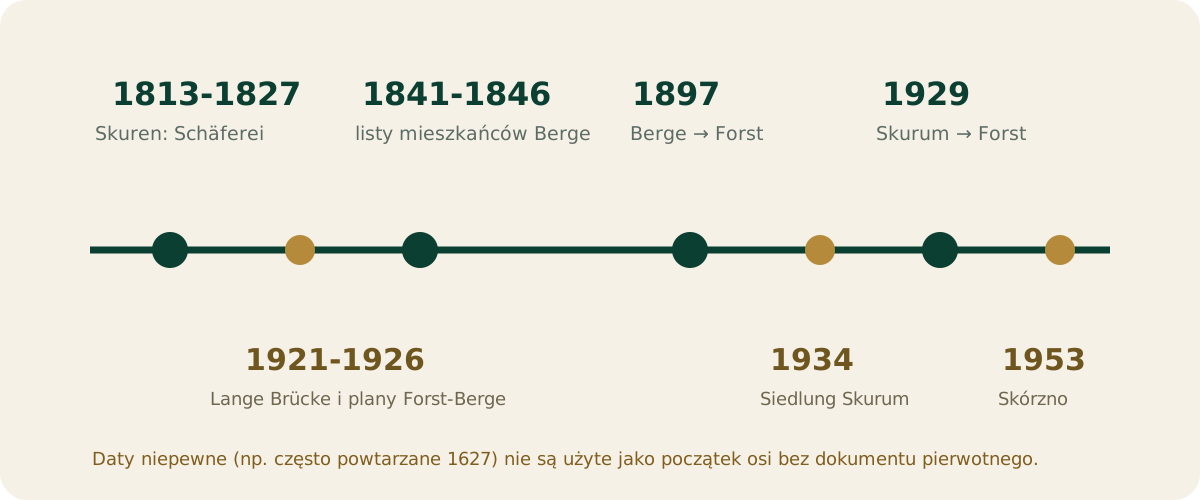
Records from 1813-1816 and 1827 identify Skuren as a sheep farm within the estate economy. According to Forst City Archive, it belonged to the Neues Vorwerk until the First World War. In 1929 Skurum and the remaining domain lands were incorporated into Forst. From 1934 the magistrate operated the farm municipally; the wooden bridge was renewed and building around the farm began, creating Siedlung Skurum. The City Archive notes that some of those houses still survive in today's Zasieki.
Forst City Archive records the spellings Skurum, Skuren and Skurim and links the name to a Sorbian word associated with “Aufrauchen” / “zu Rauch werden”. This page labels that as a local archival interpretation because no independent linguistic study confirming it was found in the present search.
Skaren is separately attested in official German-language border documents: the 1993 list and the German text of an agreement published in 2004 use “Forst - Skaren (Zasieki)”. That proves official usage in a border context, but does not by itself prove an etymological identity with Skurum/Skuren.
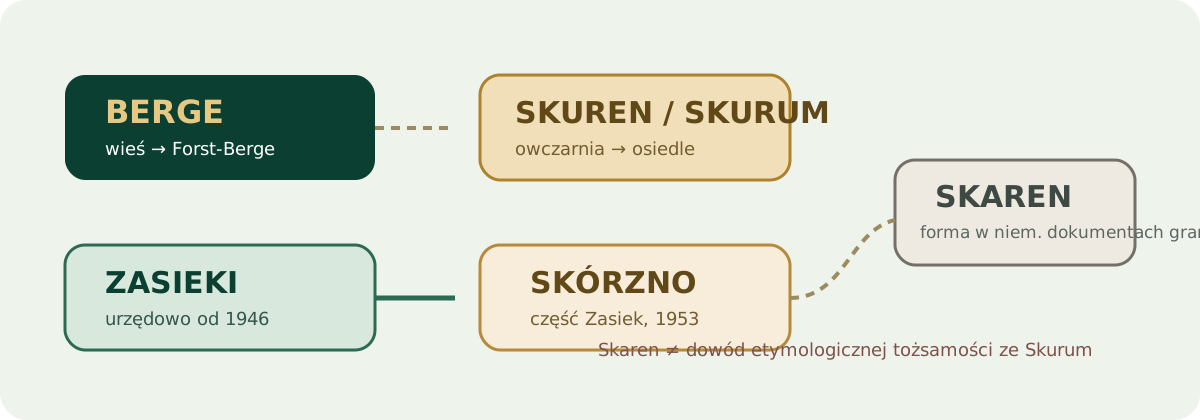
After 1945 the Neisse became the state border. In 1946 Zasieki was established as the official Polish name for the former Forst area on the Polish side. In 1953 the former “Skurum (Skuren)” was officially named Skórzno and defined as part of Zasieki.
| Name | Meaning / status |
|---|---|
| Berge | historical village/community; in Forst from 1897 |
| Forst-Berge | eastern urban district |
| Skuren/Skurum/Skurim | sheep farm/outlying estate, later settlement; earlier village status uncertain |
| Skórzno | official Polish name for former Skurum area, 1953 |
| Skaren | German form used for Zasieki in border documents |
| Zasieki | official Polish place name from 1946 |
The 1995 G.E.O.S. study describes the main road access to the DSC complex through Scheuno from Forst-Berge, connected across the Lange Brücke to western Forst. Forst-Berge therefore formed an important urban gateway between Forst, Scheuno and the armaments complex, without itself being part of the factory grounds.
The Polish version provides the full annotated source list. The same source hierarchy is applied here: official evidence and archival catalogue records are separated from local interpretations and unresolved questions.