
Historical outline: Forst and the surrounding area in 1945
At the beginning of 1945 Forst (Lausitz) was still a rear-area city, but the front was approaching rapidly. East of the Neisse, beyond Berge and Scheuno, the large Deutsche Sprengchemie Forst-Scheuno armaments complex was still operating. The 1995 G.E.O.S. study records more than 6,200 tonnes of powder production between September 1944 and January 1945, showing that war production continued almost until the front arrived. During January, refugee columns passed through Forst and its eastern districts.
The Lower Silesian Offensive of the 1st Ukrainian Front began on 8 February. A publication by the City of Forst records that on 14 February three Soviet tanks were already on the east bank of the Neisse between Jähnsdorf and the bridge at Sacro. The bridge was destroyed and there were fatalities. German operational documentation also survives: German Docs in Russia holds War Diary No. 14 of Grenadier Regiment 698 for 19-28 February 1945, explicitly described as covering fighting in the Forst/Lausitz area and including a map of Forst.
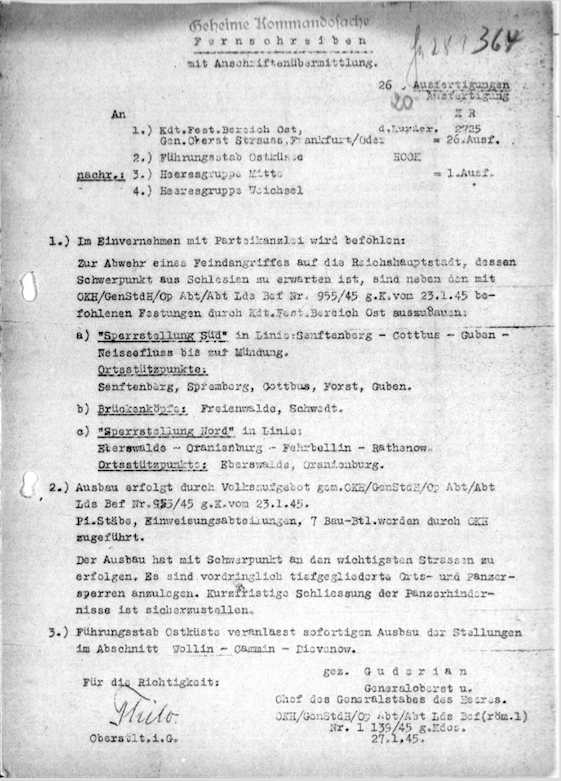
Once the Red Army reached the Neisse, a river that had connected Forst with Berge, Scheuno and the roads eastward became a front line. From late February to mid-April the fighting was largely positional, with reconnaissance, artillery fire, defensive preparations and preparations for river crossings. Civilians were evacuated. Post-war literature states that the Wehrmacht declared Forst a “fortress” in late March. In Jeannette Michelmann’s academic study this statement is traced to Ihlo/Scholze (1972), however; no original Wehrmacht fortress order has been located in the present research. For that reason “Festung Forst” remains in quotation marks on the Foundation’s website.
The Berlin Offensive began on 16 April. The 3rd Guards Army of the 1st Ukrainian Front operated in the Forst sector. A Soviet combat journal available through Pamyat Naroda states that by 08:00 the first echelons had completed the Neisse crossing and secured bridgeheads on the western bank; by 10:30 the defence had been penetrated several kilometres, allowing the main forces to develop the attack. Forst itself nevertheless remained a separate strongpoint.
Another key source is an extract from the 76th Rifle Corps combat journal titled “Assault on Forst and crossing of the Neisse”. It describes German troops being pushed out of the first trench line, resistance in urban blocks prepared for defence, and a failed crossing attempt under heavy machine-gun, artillery and mortar fire. Michelmann dates the principal fighting in the city to 16-18 April. Later Soviet and Russian syntheses describe 18 April as the capture of Forst after hard street fighting; for detailed chronology, however, the combat journals should take precedence.
The consequences were severe. Michelmann cites about 38 per cent of buildings completely destroyed and around half partly damaged. The Polish archival description of the Municipality of Forst particularly stresses the heavy destruction of right-bank Berge. After the war the Neisse became the state border. The western bank remained in Germany, while the eastern bank, including former Forst-Berge, became Polish territory and was later named Zasieki.
Forst in 1945 therefore has to be reconstructed from German, Soviet and Polish sources together. The nine subpages below separate the chronology, operational history, combat journals and personal memories. Where evidence comes only from later literature, local memory or uncertain photo captions, this is stated explicitly.
Nine subpages
The calm before the storm
January to mid-February: production, refugees and the approaching front.
Read → 02February 1945
Lower Silesian Offensive, the Neisse line and Gren.Rgt. 698’s war diary.
Read → 03Positional fighting until 16 April
The Neisse as front line, evacuation and review of the “fortress” label.
Read → 04Berlin Offensive
Crossing the Neisse, fighting on 16-18 April and the advance westward.
Read → 05Combat journals
German and Soviet operational records and how to compare them.
Read → 06Memories
Civilian memory, evacuation, return attempts and critical photo dating.
Read → NEW SUBPAGE 07106th Guards Rifle Division
Positions on the Neisse, reconnaissance and preparations for the offensive.
→ NEW SUBPAGE 08121st Guards Rifle Division
Benau, Scheuno, DSC and Forst in the division records.
→ NEW SUBPAGE09Fighting from the German perspective
The 342nd Infantry Division, Lieutenant General Heinrich Nickel, Berge and Scheuno in a concise translation of source material.
Read →Sources and source criticism
Combat journals and archival metadata take priority. Academic literature is used for synthesis, while memories and local chronologies are identified as a separate source layer.
Pamyat Naroda - Berlin Offensive and combat journals Russian Ministry of Defence portal. Used here for excerpts from the 76th Rifle Corps and 3rd Guards Army combat journals concerning Forst and the Neisse crossing.
Pamyat Naroda - Lower Silesian Offensive Operational context for February 1945: the 1st Ukrainian Front advancing to the Neisse line.
German Docs in Russia - War diary, Grenadier Regiment 698 TsAMO, collection 500, inventory 12482, file 190. War diary No. 14, 19-28 Feb 1945, fighting in the Forst/Lausitz area, 9 leaves and a map of Forst.
City of Forst (Lausitz) - “Grenzrose” material Municipal source: on 14 Feb 1945 Soviet tanks were on the east bank between Jähnsdorf and the Sacro bridge; on 16 Apr the major offensive began and the Neisse was crossed north of the memorial site.
Jeannette Michelmann - dissertation on local government and the 1945 transition Academic secondary source: Neisse front from mid-February, evacuation, fighting on 16-18 Apr and destruction. Its statement that Forst was declared a “fortress” in late March relies on later literature (Ihlo/Scholze 1972), not on a primary Wehrmacht order located in this research.
Polish State Archives - Municipality of Forst Polish archival description noting severe destruction of right-bank Berge in the 1945 fighting and the post-war border change.
Polish Geological Institute - Zasieki sheet Polish institutional source: Zasieki as the former eastern suburb of Forst and the 1945 destruction.
Zeitzeugen Forst - local chronology “Als der Krieg nach Forst kam” Local memory and photo chronology covering refugees, late-February shelling, the St Nikolai fire and destruction of the Lange Brücke. Treated as a local source, not equivalent to a war diary.
Zeitzeugen Forst - “Mein Vater und meine Mutter Forst 1945” Family memory about evacuation and an attempted return to the city in early April. Clearly labelled as personal recollection.
Zeitzeugen Forst - discussion of the dating of combat photographs Example of a source-critical issue: a well-known Soviet photograph from Forst circulates with different dates. A caption is not treated as proof of date without corroboration.