
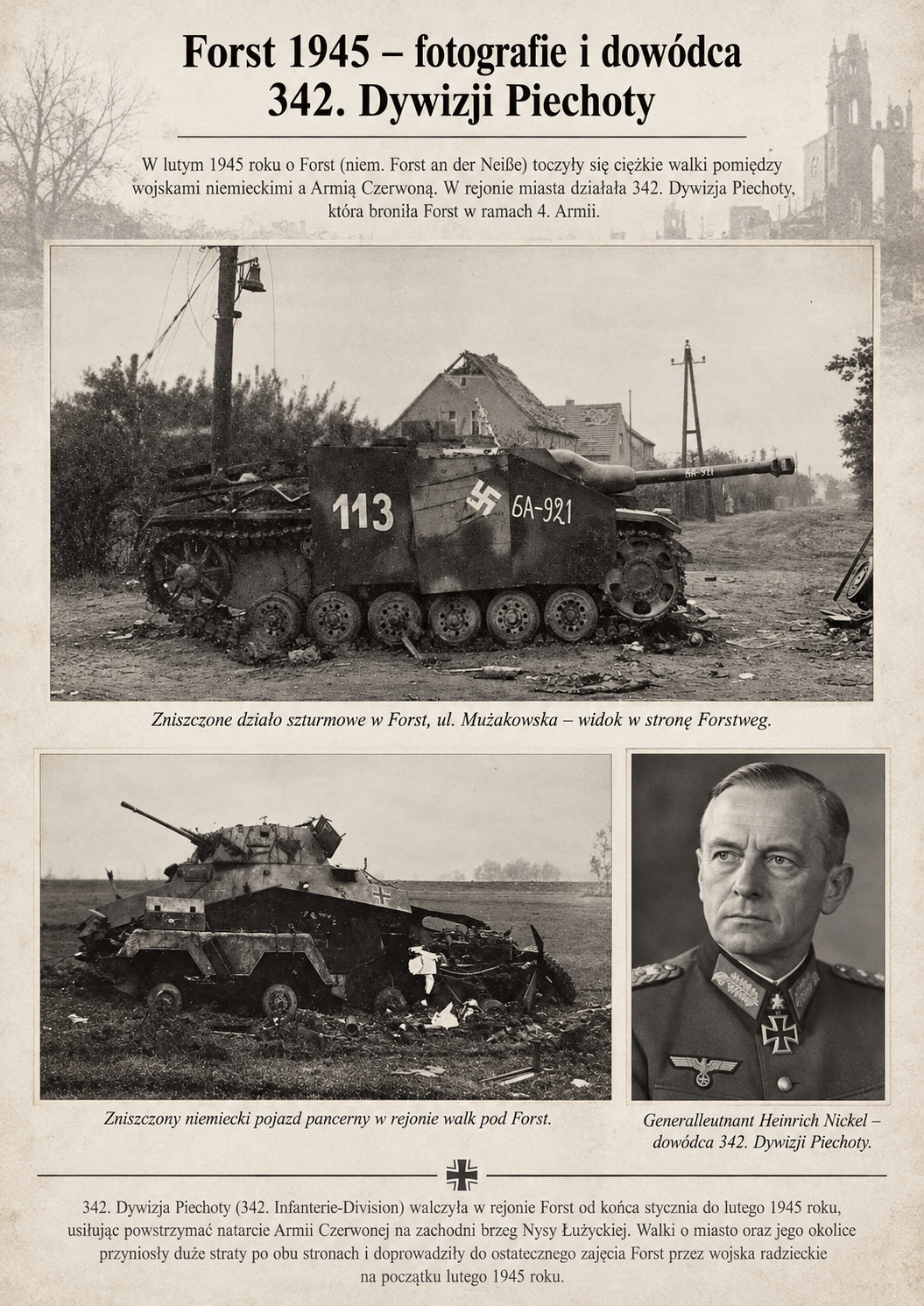
1. Forst prepares for defence
In autumn 1944 the war approached the Reich's borders. The decree of 25 September 1944 created the Volkssturm from men able to bear arms between 16 and 60. In Mark Brandenburg, food ration cards for men born in 1884-1924 were tied to proof of Volkssturm service, exemption or membership of an excluded group.
Town and rural guard companies were absorbed into the Volkssturm. Organisation remained chaotic: weapons, ammunition, uniforms and reliable communications were scarce. Many Forst Volkssturm men fought in civilian clothing with an armband. Rifle pits, tree obstacles, anti-tank barriers and road blocks were built at Nahberg. Armoured MG 34 posts were also delivered; two were recovered near Kegeldamm in 2013.
Forst remained an industrial centre. Textile plants were closed or converted to war production, while firms were relocated from bomb-threatened Berlin. Workshops, transport, field post, ammunition and food points formed the rear infrastructure of the Neisse front.
2. Glase and the 342nd Infantry Division
Lieutenant Colonel Willi Georg Glase became defence commander of Forst on 2 February 1945. The available records do not confirm a formal declaration of fortress status. On 21 February he was subordinated to Grenadier Regiment 698 as bridgehead commander; Lieutenant Colonel Stegmann replaced him the following day. Glase's later fate remains unresolved.
Lieutenant General Heinrich Nickel's 342nd Infantry Division reached Forst after a costly retreat through Glogau and Guben. Having lost heavy weapons and personnel, it functioned largely as a battle group. Grenadier Regiments 554, 697 and 698, fusilier, engineer, artillery, anti-tank, signals, supply and medical units were supplemented by Volkssturm battalions, returning leave personnel, stragglers and fortress anti-tank companies.
3. 20-28 February 1945
20-21 February
Grenadier Regiment 698 reached Kerkwitz and received an immediate night order for Forst. Its combat echelon travelled by rail and unloaded at 14:00. The regiment took over the Forst bridgehead and the Neisse line from Scheunoer Brücke to the sewage works, with battalions around Keune, Noßdorf and the river.
22 February
Strong Soviet artillery fire preceded penetrations of the line. The Jähnsdorf bridgehead was lost, while Soviet troops crossed south of Scheuno. German engineers and assault guns retook Jähnsdorf; parts of the 16th Panzer Division eliminated the crossing near Scheuno. Captain Koch was killed and First Lieutenant Schuchardt assumed command of his battalion.
23-25 February
Soviet troops seized the Berge estate and broke in near Pfortenerstraße. Counterattacks recovered individual positions, but the poorly armed Volkssturm could not hold the full line. Aircraft, tanks, artillery and rocket launchers supported the assaults. Artillery diaries list fire missions against Scheuno, Gut Berge, Breite Straße, the sports ground, bridges and approaches. On 25 February reports described Forst as burning while civilians were still present.
26 February
After fire preparation, three German assault groups attacked. Friendly anti-tank fire mistakenly disabled two assault guns. The Schuchardt, Wilde and Czechowsky groups reached portions of the railway, cemetery, Pfortenerstraße and sports-ground area but stalled with heavy losses. Soviet tank-supported counterattacks retook streets; school buildings and the suspension bridge changed hands. The Soviet 106th Rifle Division diary records its simultaneous regrouping before Forst and Scheuno.
27-28 February
On 27 February Stegmann reported more than 300 casualties in 36 hours and demanded reinforcements. Heavy-weapons ammunition was critically short. The 106th Rifle Division took over the eastern Forst-Scheuno sector. On 28 February renewed attacks were repelled, but a mortar hit triggered demolition charges on the Long Bridge. Two centre spans collapsed, and supply and casualty evacuation depended temporarily on a pontoon bridge.
4. March: positional warfare and exhaustion
Patrols, harassing fire, reconnaissance, mine laying and trench construction dominated March. Soviet regiments rotated between Sakrow, Jähnsdorf, Gut Berge, the bridgehead and Scheuno. German units maintained opposing positions with runners and forward posts.
Orders reveal the army's condition: graves and effects of the dead had to be registered, while men were transferred between depleted regiments. Reports describe guard failures, desertions by Upper Silesian soldiers seeking their families, and severe psychological strain. Men over 60 could request discharge even as elderly Volkssturm members remained in service. A rest centre and saddlery workshop opened at Klinge; rail traffic from Forst apparently still operated in late March.
On 27 March a five-kilometre front zone was closed to civilians. Orders warned of hostile agents and demanded fire against low-flying aircraft with every available infantry weapon. Such records document both routine warfare and the progressive collapse of discipline and supply.
5. April and the final breakthrough
On 1 April tank-hunter teams were trained and the seven-man “Bär” raiding party conducted a close-combat mission. A looting incident in Forst on 2 April ended with a sergeant being shot by a Wehrmacht patrol.
From 8 April the German command openly expected a major offensive. Reports of 13-15 April identified Soviet concentrations between Muskau and Forst, dense artillery positions and armour movements. Reserves including the 21st Panzer Division were brought to the Roggosen area.
On 16 April, after roughly two hours of massive artillery fire and heavy air support, the 1st Ukrainian Front attacked across the Neisse. Rifle armies, the 4th Tank Army and 3rd Guards Tank Army pushed west. German counterattacks could throw back local spearheads but could no longer reverse the operational situation.
Fighting continued on 17 April in the town, on approaches and withdrawal routes. Forst did not fall in February: the defence finally broke on the evening of 17 April, and surviving formations withdrew west and north-west.
6. Soldiers, civilians and source criticism
Military entries also expose civilian suffering: incomplete evacuation, fires, shelling, requisitioned buildings, supply failure and forced clearance of the front zone. Casualty notices show the official language used to report deaths to families.
War diaries are not neutral overviews. German and Soviet records describe the same events from opposing viewpoints; claims for tanks destroyed or enemy casualties remain contemporary reports until independently verified. This study therefore marks uncertainty and separates documented sequences from judgement and propaganda.
Sources
Main source: Christoph Malcherowitz, 1945 - Kampf an der Lausitzer Neiße, Nation & Wissen Verlag, Riesa 2025, ISBN 978-3-944580-65-4. The Foundation used its own Polish working translation of sections concerning Forst, Berge and Scheuno. This article is an extensive paraphrase, not a republication.
- Historischer Verein zu Peitz - book announcement
- Bibliographic record
- German war diaries: KTB No. 14, Grenadier Regiment 698; KTB No. 10, I and II Battalions, Artillery Regiment 342; records of II/Grenadier Regiment 697 and other 342nd Division units, as reproduced in the book.
- Soviet combat journals, particularly the 106th Rifle Division and other opposing divisions, as assembled by the author.
- Army Group Centre daily reports, 13-16 April 1945.
- Rokita Foundation sources: photographs, field documentation, historical map and place-name comparison, and research on Scheuno/Brożek and DSC Forst “Wald”.