
Enter at least 3 characters.
Source page 1 / 151
Compare with the original PDF →
1. Introduction
The variety of regional and company histories dealing with forced labour has by now become almost impossible to survey.1 Why add yet another study?
The deployment of foreigners during the war years remains abstract for most people until it can be traced in their own surroundings. At the start of the research, which began with a term paper cautiously described as a “search for traces”,2 it became clear that nobody had undertaken a scholarly investigation of the fate of foreign workers in the former textile-industry town of Forst during the preceding six decades. Information about the deployment of foreigners was generally limited to personal experiences or accounts of them. The actual extent of foreign labour in Forst remained hidden from individual residents.
Geographically, this study is confined to the deployment of foreigners from 1939 to 1945 within the present boundaries of the town of Forst (Lausitz).3 Forst lies in south-eastern Brandenburg on the Lusatian Neisse and is now the administrative centre of the Spree-Neiße district (SPN). With the onset of industrialisation, Forst became the dominant textile centre in Lusatia. In 1897 it became an independent urban district, surrounded by the district of Sorau. Administratively, both territorial authorities belonged to the Frankfurt/Oder administrative region and thus to the province of Brandenburg. In 1939 the urban district of Forst had almost 38,000 inhabitants.4 The incorporation of the villages of Eulo, Noßdorf, Keune, Domsdorf and Scheuno in 1940 increased its area by approximately 2,700 hectares to 4,200 hectares, with a population of 44,635. Today the town covers almost three times that area (about 110 square kilometres), including the “new” districts of Bohrau, Briesnig, Sacro, Mulknitz and Naundorf to the north, Groß Bademeusel and Klein Bademeusel to the south, and Groß Jamno and Klein Jamno to the west. Its present population is approximately 24,000. As a result of the border being drawn along the Neisse after the Second World War, the former Forst districts of
Notes
1. Spoerer, Mark: Zwangsarbeit unter dem Hakenkreuz – Ausländische Zivilarbeiter, Kriegsgefangene und Häftlinge im Deutschen Reich und im besetzten Europa 1939–1945, Stuttgart/Munich 2001, p. 9.
2. The term paper, written in the summer semester of 2001 as part of the continuing-education programme at the Institute of Media and Communication Studies of the Free University of Berlin, Journalistenkolleg course, was entitled “Zwangsarbeiter und Kriegsgefangene in der Stadt Forst (Lausitz) und Umgebung – eine Spurensuche”.
3. Further details are provided in Appendix A.
4. Hübner, Peter: “Durchhalten” und “Durchkommen” – Niederlausitzer Industriearbeiter im Jahre 1945, in: Stang, Werner (ed.) and Arlt, Kurt: Brandenburg im Jahr 1945, Potsdam 1995, p. 140. Hübner gives a population of 37,975 in 1939. Referring to the census of 17 May 1943, Hartmut Ritschel gives a population of 37,868; in: Ritschel, Hartmut: Zeitreise durch die Geschichte der Stadt Forst (Lausitz) – Eine Chronik in Daten, Forst 1999, p. 27.
Translator's note: “today” and “present” refer to the time when this study was written (2004). The census date “17 May 1943” has been retained as printed in the original.
Source page 2 / 151
Compare with the original PDF →
Scheuno and Berge now lie on Polish territory and are called Brożek and Zasieki. Both places are included in this study because what was probably the largest camp for foreigners in the urban district of Forst stood near Scheuno, at the Deutsche Sprengchemie works. Berge contained a camp for families of eastern workers, to which I shall return.
This study also draws on data from the former district of Sorau. The reasons lie principally in the generally poor survival of source material and in the position of the urban district of Forst as an enclave within the district of Sorau, from which several places were incorporated into Forst in April 1940. To take account of the extent of foreign labour in agriculture, it would not have been enough to concentrate solely on the industrial town. A further reason is the jurisdiction of the Forst Labour Office, which was responsible for placing foreign workers both in the urban district of Forst and in the district of Sorau.5
Given the scarcity of sources, which will be discussed in greater detail below, it was necessary at certain points to take eyewitness testimony into account in order to locate foreigners' camps and workplaces or clarify particular details.6 Otherwise there would have been a risk that, following the maxim “Quod non est in actis, non est in mundo”,7 a continuous reconstruction of events would have been impossible or could not, in places, have been filled out. However, a crucial source for one of this study's main objectives—establishing the actual living conditions of foreigners in Forst during the war—is missing: recollections from the victims' perspective. Unfortunately, it has not yet been possible to obtain statements from former forced labourers.8
Notes
5. StadtA Forst, 3145, fol. 10 ff. According to a list dated 6 November 1928, the Forst Labour Office district included the local court districts of Forst, Sorau, Pförten, Triebel and Sommerfeld. Nothing is known of a subsequent territorial reorganisation. See the map of labour-office districts from BArch-MA Freiburg in the appendix.
6. Following an appeal in an article in the Forst local edition of the daily newspaper Lausitzer Rundschau, five eyewitnesses came forward, all of them women. Some other eyewitnesses declined interviews. Because sources are scarce, the study occasionally refers to testimony already published elsewhere, although most such accounts mentioned foreign colleagues or other foreigners with whom the witnesses had contact only in passing.
7. Wolfgang Wippermann discusses the absence of relevant and accessible sources for a complete reconstruction of historical events in “Kirche im Krieg”, in: Schuppan, Erich (ed.): Bekenntnis in Not. Die Evangelische Kirche Berlin-Brandenburg im Konflikt mit dem totalen Staat (1933–1945), Berlin 2000, p. 326. [The Latin maxim means “What is not in the records does not exist in the world”—translator's note.]
8. An enquiry to the International Tracing Service (ITS) in Bad Arolsen had not yet received a reply. The extent to which eyewitness testimony may still be held by refugee, prisoner-of-war, forced-labour or Jewish institutions must remain an open question here.
Source page 3 / 151
Compare with the original PDF →
This study will examine a total of seven propositions:
- Because of its industrial structure and the construction of the Deutsche Sprengchemie powder factory, Forst was a centre of foreign-labour deployment in south-eastern Brandenburg.
- As a result of the political and moral directives prevailing in the GDR,9 the deployment of foreigners was not critically investigated in Forst. The associated attitudes continued to have an effect after German reunification.
- The absence of detailed primary sources and the declining number of eyewitnesses make it more difficult to investigate the circumstances of foreign-labour deployment in Forst.
- Ulrich Herbert advanced the proposition that foreign workers' living conditions depended, among other things, on the size of the locality and the enterprise and on the scope for action available to local rulers and institutions.10 Mark Spoerer also included the population's attitudes as a factor explaining differences in the treatment of foreign workers.11 On the basis of both propositions, Forst, as a relatively rural industrial area with a population shaped by bourgeois and social-democratic/communist traditions, ought to have offered forced labourers more favourable conditions and better chances of survival.
- Foreigners in Forst undertook acts of resistance that went beyond the attempt to survive.
- Drawing on Polish publications, the study investigates the proposition that more than 2,000 foreigners died in the Deutsche Sprengchemie Forst complex alone.
- After the fighting ended, the western part of Forst was a central assembly point for “displaced persons” in the Soviet occupation zone.
Notes
9. Demps, Laurenz: Das Thema Zwangs- und Fremdarbeit in der DDR-Historiographie – Eine Skizze, in: Scholze-Irrlitz, Leonore and Noack, Karoline (eds.): Arbeit für den Feind – Zwangsarbeiter-Alltag in Berlin und Brandenburg (1939–1945), Berlin 1998, p. 142.
10. At regional level, Herbert includes Gauleiter, armaments commands and business associations; at local level, local peasant leaders, factory officials responsible for foreigners, the heads of Gestapo offices, mayors, NSDAP district leaders, and heads of local economic administrations or associations. Within enterprises, this scope for individual influence could extend down to the foreman. Herbert, Ulrich: Zwangsarbeit im Dritten Reich. Kenntnisstand, offene Fragen, Forschungsprobleme, in: Reininghaus, Wilfried / Reimann, Norbert (eds.): Zwangsarbeit in Deutschland 1939–1945: Archiv- und Sammlungsgut, Topographie und Erschließungsstrategien, Bielefeld 2001, pp. 20 ff.
11. Spoerer, Mark: Zwangsarbeit unter dem Hakenkreuz – Ausländische Zivilarbeiter, Kriegsgefangene und Häftlinge im Deutschen Reich und im besetzten Europa 1939–1945, Stuttgart/Munich 2001.
Translator's note: these are propositions to be investigated, not the author's final findings. This applies especially to the figure of more than 2,000 deaths mentioned in point 6.
Source page 4 / 151
Compare with the original PDF →
2. State of research
2.1. The deployment of foreigners for labour in the German Reich, 1939–1945
Research into forced-labour deployment began relatively early, particularly among GDR historians. A major work is the survey Geschichte der deutschen Kriegswirtschaft,12 in which Dietrich Eichholtz, beginning in the 1960s, nevertheless adopted an ideologically charged interpretation of a war waged by German finance capital, whose interests supposedly determined the use of foreign forced labour. “Monopoly capital” was said to have sought to extract “the very last measure of labour output” from foreign workers while providing the most inadequate accommodation, pay and food;13 fascism had made this possible.14
West German historical scholarship did not devote intensive attention to the subject until the 1980s, when Ulrich Herbert presented his fundamental study.15 Unlike Eichholtz, however, Herbert argues that the course towards comprehensive foreign-labour deployment was set at the desk-officer level of the National Socialist apparatus of power and constituted “one of the essential preconditions for the war Germany waged for almost six years”. The German economy “had no alternative to relying on the employment of foreign forced labourers”, but forced labourers would not have been employed without initiatives by individual enterprises: this is Herbert's assessment of the German economy's general share of responsibility.16 Spoerer likewise regards the German state as principally responsible for forced-labour deployment and its accompanying circumstances, because it largely laid down the framework without outside influence. Nevertheless, enterprises and other local users of labour must share responsibility for the forced labourers' living conditions.17
Ideological influences also produced contradictory explanations concerning the assessment of living conditions, responsibility and forms of resistance. According to Eichholtz, slowing down work or
Notes
12. Eichholtz, Dietrich: Geschichte der deutschen Kriegswirtschaft 1939–1945, vol. II, part 1, Munich 1999, p. 237.
13. Ibid., p. 268.
14. Ibid., p. 287.
15. Herbert, Ulrich: Fremdarbeiter – Politik und Praxis des Ausländer-Einsatzes in der Kriegswirtschaft des Dritten Reiches, based on the 1985 dissertation entitled “Der Feind als Kollege”; cited here from the new edition published in 1999.
16. Ibid., p. 431.
17. Spoerer, Mark: Zwangsarbeit unter dem Hakenkreuz – Ausländische Zivilarbeiter, Kriegsgefangene und Häftlinge im Deutschen Reich und im besetzten Europa 1939–1945, Stuttgart/Munich 2001, pp. 234 ff.
Source page 5 / 151
Compare with the original PDF →
refusing to work were at most covered up by prisoners of war and officers of prisoner-of-war camp guards against “the armaments corporations”.18 On the basis of political and moral directives, GDR historical scholarship overemphasised the role of the economy, partly to demonstrate a dangerous closeness between industry and politics that was supposed to extend from the Nazi period into the Federal Republic's present.19 Even when the image of a common struggle by German and foreign workers was increasingly abandoned, this did not become the subject of broad public discussion.20
Eichholtz relies primarily on incriminating sources from the Reich and party apparatus used by the prosecution at the Nuremberg trials.21 In Herbert's view, this is insufficient, because, particularly from 1942 onwards, foreigners' living and working conditions were substantially influenced by several factors that manifested themselves differently at regional and company level. Conditions ranged from “adequate circumstances and positively friendly relationships” in the countryside to “catastrophic conditions resembling those in concentration camps”, for example in large industrial enterprises, and were or could be influenced by regional and local officials and business representatives.22 Spoerer accepts the existence of an urban–rural divide,23 but also observes at regional level a “mixture of inherited hostility towards foreigners and the pursuit of material self-interest”, which must be taken into account as differentiating factors in the treatment of foreign workers.24
Whereas Eichholtz sees confirmation of the proposition that the mass deployment of Poles had been planned before the outbreak of war in a statement made by Hermann Göring before the Reich Defence Council
Notes
18. Eichholtz, Dietrich: Geschichte der deutschen Kriegswirtschaft 1939–1945, vol. II, part 1, Munich 1999, p. 289.
19. Demps, Laurenz: Das Thema Zwangs- und Fremdarbeit in der DDR-Historiographie – Eine Skizze, in: Scholze-Irrlitz, Leonore and Noack, Karoline (eds.): Arbeit für den Feind – Zwangsarbeiter-Alltag in Berlin und Brandenburg (1939–1945), Berlin 1998, p. 142.
20. Ibid., p. 143.
21. See also Radandt, Hans (ed.): Fall 6 – Ausgewählte Dokumente und Urteil des IG-Farben-Prozesses, Berlin 1970, who sought to demonstrate industry's responsibility particularly by drawing on prosecution materials.
22. Herbert, Ulrich: Fremdarbeiter – Politik und Praxis des Ausländer-Einsatzes in der Kriegswirtschaft des Dritten Reiches, Bonn 1999, pp. 418 ff.
23. Spoerer, Mark: Zwangsarbeit unter dem Hakenkreuz – Ausländische Zivilarbeiter, Kriegsgefangene und Häftlinge im Deutschen Reich und im besetzten Europa 1939–1945, Stuttgart/Munich 2001, p. 258.
24. Ibid., p. 261.
Source page 6 / 151
Compare with the original PDF →
on 23 June 1943,25 West German historians such as Herbert point to the absence of evidence for large-scale preparations.26 Herbert sees the ease with which civilian workers, as well as prisoners of war, could be recruited following the invasion of Poland as the actual starting point of a dynamic, but not long-term-planned, process of foreign-labour deployment.27
Attempts to quantify foreign-labour deployment produce relatively similar results. Eichholtz assumes that around 14 million foreign workers and prisoners of war came to Germany during the war.28 Herbert considers approximately 9.5–10 million foreign civilian workers and prisoners of war a realistic figure, while the number of concentration-camp prisoners employed—almost every one of whom was subjected to forced labour for a shorter or longer period—can scarcely be estimated reliably. They would constitute a further 2.1 million foreign forced labourers.29 This yields a total of 11.6–12.1 million forced labourers. Spoerer cautiously estimates30 that approximately 13.5 million foreign civilian workers, prisoners of war and prisoners were deployed in the Greater German Reich, of whom “certainly 80%, and more probably 90%, can be regarded as forced labourers”.31
2.1.1. Definitions
Definitions of forced labour are complicated and contested. Spoerer began by attempting to distinguish between voluntary foreign civilian workers and three groups of forced labourers. The possibility of influencing one's own conditions of existence and chances of survival was, in his view, the decisive criterion distinguishing forced labourers from foreigners who had come voluntarily
Notes
25. Eichholtz, Dietrich: Geschichte der deutschen Kriegswirtschaft 1939–1945, vol. I, Munich 1999, p. 92; Eichholtz refers to document PS-3787, IMT, vol. 33, pp. 152 ff., the OKW (WFA) report dated 10 July 1939 on the second meeting of the Reich Defence Council on 23 June 1939. According to it, Göring announced “that during the war hundreds of thousands from enterprises in the Protectorate not engaged in the defence economy should be employed in Germany, housed together in barracks and under supervision, especially in agriculture”.
26. Herbert, Ulrich: Fremdarbeiter – Politik und Praxis des Ausländer-Einsatzes in der Kriegswirtschaft des Dritten Reiches, Bonn 1999, p. 43.
27. Ibid., p. 403.
28. Eichholtz, Dietrich: Geschichte der deutschen Kriegswirtschaft 1939–1945, vol. II, part 1, Munich 1999, p. 247. Eichholtz endorses Jürgen Kuczynski's estimates (Lage der Arbeiter, vol. 6, p. 278) and adds foreigners working for the Germans in the occupied territories, who are not included here.
29. Herbert, Ulrich: Fremdarbeiter – Politik und Praxis des Ausländer-Einsatzes in der Kriegswirtschaft des Dritten Reiches, Bonn 1999, p. 430.
30. Spoerer, Mark: Zwangsarbeit unter dem Hakenkreuz – Ausländische Zivilarbeiter, Kriegsgefangene und Häftlinge im Deutschen Reich und im besetzten Europa 1939–1945, Stuttgart/Munich 2001, p. 219. Spoerer emphatically noted that the figures given “must by no means all be regarded as established”.
31. Ibid., p. 223. Spoerer acknowledges that this confirms the estimate of GDR economic historian Jürgen Kuczynski, cited by Eichholtz, which he too had previously considered excessively high.
Translator's note: the original main text gives “23 June 1943”, whereas note 25 gives “23 June 1939”. The discrepancy has been retained.
Source page 7 / 151
Compare with the original PDF →
or Germans subjected to compulsory labour service. Ultimately, he therefore favours retaining the contemporary categories of foreign civilian workers, prisoners of war and prisoners.32 This attempt at categorisation is disputed. Herbert does not regard the expression “forced labour” as denoting an unambiguous category or a clearly definable group.33
There was also a hierarchy among foreign civilian workers.34 At the “top”, and thus in the best legal position, were workers from allied or neutral states and from the occupied northern, western and south-eastern regions of Europe, who were entitled to the same food rations as Germans. Balts, Ukrainians and Belarusians, mainly from the General Government and the Białystok district, received lower wages and less food; Poles ranked below this group. Still lower pay, a “pocket allowance”,35 was provided for the fifth group, eastern workers from the Soviet Union. Jews and “Gypsies” belonged to the lowest group, some of whom were subjected to extermination. In general, this study concerns the deployment of foreigners. There is evidence of the employment of Polish Jews in Forst in only one case, that of the Sprengchemie works.
2.1.2. Phases of “foreign-worker deployment”
After initially dispensing with foreign labour for reasons of labour-market policy, the National Socialists changed course after 1936, when implementation of the Four-Year Plan preparing for war led to labour shortages.36 Attempts from the summer of 1938 to direct the deployment of labour through compulsory service brought no remedy.37 By September 1938 there were scarcely any substantial reserves of labour left, although the demand for workers in the armaments industry, for the completion of special construction projects and for increased export production remained exceptionally high. The compulsory service year for girls, introduced in 1935,
Notes
32. Ibid., pp. 15 ff.
33. Herbert, Ulrich: Zwangsarbeit im Dritten Reich. Kenntnisstand, offene Fragen, Forschungsprobleme, in: Reininghaus, Wilfried / Reimann, Norbert (eds.): Zwangsarbeit in Deutschland 1939–1945: Archiv- und Sammlungsgut, Topographie und Erschließungsstrategien, Bielefeld 2001, p. 17.
34. Spoerer, Mark: Zwangsarbeit unter dem Hakenkreuz – Ausländische Zivilarbeiter, Kriegsgefangene und Häftlinge im Deutschen Reich und im besetzten Europa 1939–1945, Stuttgart/Munich 2001, pp. 92 ff.
35. Heinze, Bruno: Die Beschäftigung gewerblicher ausländischer Arbeiter, in: Deutsches Arbeitsrecht, 10, pp. 114 ff.: “…so that only a pocket allowance of RM 0.30 per day remains”; quoted in Spoerer 2001, p. 158.
36. Herbert, Ulrich: Fremdarbeiter – Politik und Praxis des Ausländer-Einsatzes in der Kriegswirtschaft des Dritten Reiches, Bonn 1999, p. 48.
37. Ibid., p. 52.
Translator's note: “Gypsies” is reproduced solely as a historical term from the source, referring to persecuted Roma and Sinti.
Source page 8 / 151
Compare with the original PDF →
which applied to all women under 25 from 1939, remained an uneasy balancing act between ideology and labour allocation38 and was not fully exploited.39 Before the war, 435,000 foreigners were once again working in Germany,40 yet there was still a shortage of one million workers. Conscription into the Wehrmacht and compulsory labour assignments aggravated the shortage.41 Czechoslovakia provided the first large group of foreigners within Germany's sphere of power, who began to be placed outside the German legal order in June 1939.42 Foreign-labour deployment acquired a compulsory character in July 1939, when a general labour obligation enabled Czechs aged 16–25 to be drafted for up to two years for tasks of national importance.43
The second phase of foreign-labour deployment began with the war. By February 1940, 294,393 Polish prisoners of war had to work for the Germans; one in ten was employed in agriculture. By the end of 1939, 40,000 Polish civilians had also been employed, and for 1940 the potential was seen to recruit one million agricultural and industrial workers, most of whom were to be used in agriculture.44 For the first time, foreign-labour deployment on a larger scale was envisaged. The “Polish decrees”, in force from March 1940, marked the beginning of “an increasingly comprehensive system of special law for foreign workers, differentiated by nationality, and the foundation of an extensive system of supervision and repression of Polish workers”.45 Compulsory identification badges, restrictions on daily life and penalties for “unwillingness to work” formed the core of the package of regulations, which extended as far as the death penalty for sexual intercourse between a Polish man and a German woman. By April 1940 at the latest, recruitment of Polish workers could no longer be described as voluntary, since compulsory labour in Germany for Polish people born between 1915 and 1925
Notes
38. Herbert, Ulrich: Fremdarbeiter – Politik und Praxis des Ausländer-Einsatzes in der Kriegswirtschaft des Dritten Reiches, Bonn 1999, p. 55.
39. Friedrich Syrup, State Secretary in the Reich Ministry of Labour, at the second meeting of the Reich Defence Council on 23 June 1939, document PS 3787, IMT, vol. 33, p. 153; quoted in Herbert 1999, p. 56.
40. Herbert, Ulrich: Fremdarbeiter – Politik und Praxis des Ausländer-Einsatzes in der Kriegswirtschaft des Dritten Reiches, Bonn 1999, p. 64.
41. Ibid., p. 67.
42. Ibid., p. 73.
43. Spoerer, Mark: Zwangsarbeit unter dem Hakenkreuz – Ausländische Zivilarbeiter, Kriegsgefangene und Häftlinge im Deutschen Reich und im besetzten Europa 1939–1945, Stuttgart/Munich 2001, pp. 41 ff.
44. Herbert, Ulrich: Fremdarbeiter – Politik und Praxis des Ausländer-Einsatzes in der Kriegswirtschaft des Dritten Reiches, Bonn 1999, pp. 79 ff.
45. Ibid., p. 88.
Source page 9 / 151
Compare with the original PDF →
had been ordered in the General Government.46 In May 1940, approximately 1.2 million prisoners of war and foreign civilian workers were employed in Germany.47
The third phase of foreign-labour deployment began on 10 May 1940 with the war against France. Preparations for it already assumed intensive use of prisoners of war in industry as well; the armaments inspectorates alone identified a need for approximately half a million workers in May 1940. Two months later, 200,000 French and British prisoners of war were working in Germany, and four months later the figure was 1.2 million.48 Ten fields of employment outside agriculture were initially defined for them.49 In autumn 1940, more than two million foreigners were employed in the German Reich, approximately 10% of the total workforce.50 In summer 1941, there were almost three million foreign workers in Germany,51 including 743,257 civilian workers (300,000 from the occupied western territories, 270,000 Italians, 80,000 Slovaks and 35,000 Hungarians52).
To maintain any consistency with Nazi racial doctrine, a decree published in January 1941 distinguished five categories of foreigners, each with its own rules of treatment, and three groups of Poles. Regional regulations, such as the police ordinance in the Frankfurt (Oder) administrative region, and intensified repression particularly restricted Poles' living conditions.53 Leave entitlements were often denied, as was attendance at services in local parishes. From 1940, repression was also intensified through the establishment of “labour education camps” (AEL), proclaimed as penal camps for those unwilling to work,
Notes
46. Regulation of 15 May 1940 on compulsory registration of those born in 1915–1925; after Herbert 1999, p. 99.
47. Herbert, Ulrich: Fremdarbeiter – Politik und Praxis des Ausländer-Einsatzes in der Kriegswirtschaft des Dritten Reiches, Bonn 1999, p. 101, referring to Der Arbeitseinsatz im Deutschen Reich, no. 1 of 4 April 1940.
48. Ibid., p. 111.
49. StadtA Forst, 314, copy of the circular “Einsatz von Kriegsgefangenen in Arbeitsstellen des Reicharbeitsministers”, 10 July 1940, V a 5135/343).
50. Herbert, Ulrich: Fremdarbeiter – Politik und Praxis des Ausländer-Einsatzes in der Kriegswirtschaft des Dritten Reiches, Bonn 1999, p. 112.
51. Ibid., p. 150.
52. Ibid., p. 114, referring to the OKW WiRüAmt report of 9 October 1941 / Homze.
53. Ibid., pp. 123 ff.
Source page 10 / 151
Compare with the original PDF →
.54 The possibility of punishment was followed by a wave of accusations,55 in which the power of decision lay not with the courts but with the Gestapo.56
The next phase remained contradictory: initially, employing Russians in Germany was not planned.57 Only in July 1942 were the first discussions held on deploying prisoners of war in closed labour columns, because there was a shortage of 400,000 workers.58 In August it was initially decided that no more than about 120,000 Soviet prisoners of war should be brought to Germany.59 However, pragmatists within the Nazi apparatus prevailed once a rapid victory could no longer be expected and the war economy's labour requirement had risen to 800,000: on 15 October, the conditional employment of Russians in Germany was ordered, followed two weeks later by comprehensive deployment.60 This was intended to allow western workers to be transferred to more skilled jobs. Ideological reservations were reflected in regulations for Soviet prisoners of war that prescribed “maximum exploitation, the worst conceivable treatment and food, and the death penalty even for minor offences”.61 Because the Soviet prisoners were poorly fed, their deployment for labour in the winter of 1941 was scarcely possible.62 Almost one in three of the 1.58 million prisoners recorded in November 1941 died shortly afterwards.63 In view of the labour shortage, the eastern-worker decrees of February 1942 created the basis for employing civilian workers from Soviet territory, who were to meet an estimated requirement of 620,000 persons.64 Through a “combined system of promises, social pressure and brutal terror”, approximately 1.5 million people were brought to Germany in 1942 alone; by the summer of 1942 their state of health had become alarming.65 Although in April 1942 compulsory work in columns was to be abolished, barbed-wire fences removed and food supplies improved,66 the already inadequate
Notes
54. Herbert, Ulrich: Fremdarbeiter – Politik und Praxis des Ausländer-Einsatzes in der Kriegswirtschaft des Dritten Reiches, Bonn 1999, pp. 138 ff.
55. Ibid., p. 138.
56. Ibid., p. 141.
57. Ibid., p. 156.
58. Ibid., p. 159.
59. Ibid., p. 160, referring, among other sources, to the OKW/Kgf. order of 2 August 1941, BArch-MA, RW 19. WI/IF 5/1189.
60. Ibid., p. 161.
61. Ibid., p. 166.
62. Ibid., p. 171.
63. Ibid., p. 173.
64. Ibid., pp. 182 ff.
65. Ibid., pp. 186 ff.
66. Ibid., p. 194.
Translator's note: the original main text says “July 1942”, although the subsequent account concerns events in 1941 and note 59 cites an order of 2 August 1941. The date has not been silently changed; the inconsistency in the source is retained.
Source page 11 / 151
Compare with the original PDF →
food allowances were reduced still further after German food rations were cut in April 1942.67 Relaxation of restrictions and improvements in supplies were counterbalanced by harsher punishments.68
In August 1942, coercive measures to recruit labour were also ordered for France, Belgium and the Netherlands.69 In Poland, outright deportation campaigns took place during 1942, sometimes conscripting entire age cohorts, including children aged 13–15.70
Although there were 5,743,000 foreign workers in Germany in February 1943,71 this was not enough: replacing the mounting losses at the front created gaps that even the introduction of general compulsory service for Germans in early 1943 could not fill. The German war economy increasingly depended on foreign workers willing to work. In this situation, the different political factions within the Nazi apparatus reached a compromise in April 1943 intended to bring about general equal treatment of foreigners working in the Reich, so as to win the “eastern peoples” too as allies in the “anti-Bolshevik struggle”.72 Prison-like confinement, barbed wire and corporal punishment were prohibited; medical care and food supplies, among other things, were to be improved.73 Although the directive, supported by all the Reich authorities involved, formed the basis of policy towards foreigners until the end of 1944,74 from mid-1943 Poles and eastern workers nevertheless remained exposed to the Gestapo's arbitrary power without the protection of the rule of law.75 At the same time, recruitment methods became more brutal and geographically comprehensive, sometimes including children aged 10–14.76 Policy towards foreigners followed the changing military situation and merely postponed “the option of radical solutions in accordance
Notes
67. Ibid., p. 189.
68. Ibid., p. 220.
69. Herbert, Ulrich: Fremdarbeiter – Politik und Praxis des Ausländer-Einsatzes in der Kriegswirtschaft des Dritten Reiches, Bonn 1999, p. 213.
70. Ibid., p. 216.
71. Ibid., p. 209, referring to the General Plenipotentiary for Labour Deployment's (GBA) report on labour deployment in 1942, document 1739 PS, IMT, vol. 27, pp. 578 ff. Herbert accuses Sauckel of presenting embellished figures for foreign-labour deployment and identifies problems in statistics on foreigners.
72. In fact, Nazi propaganda had already tried to recruit Poles for labour in 1941 through posters warning of a “Bolshevik threat” to Europe. See Hermes Handlexikon: Synchronopse des Zweiten Weltkrieges, Düsseldorf 1983, p. 104.
73. Herbert, Ulrich: Fremdarbeiter – Politik und Praxis des Ausländer-Einsatzes in der Kriegswirtschaft des Dritten Reiches, Bonn 1999, pp. 282 ff.
74. Ibid., p. 282.
75. Ibid., pp. 284 ff.
76. Ibid., pp. 298 ff.
Source page 12 / 151
Compare with the original PDF →
with racial doctrine”.77 In August 1944 the food allowances for Poles and eastern workers were brought into line. The final restrictions and special regulations for eastern workers were abolished in December 1944. Similar improvements for Poles were being discussed, but were not pursued after the Soviet offensive began in January 1945.78 Nevertheless, the Polish and eastern-worker decrees remained in force in all their essential areas. “The legal and political conditions of foreign-labour deployment in the broader sense, however, underwent only insignificant changes,” Herbert concludes.79
2.2. Regional and local research on the subject
2.2.1. Regional and local approaches
The first influential work in the territory of the former GDR is considered to be Eva Seeber's book, published in 1964.80 However, virtually no strictly local approaches to the subject are known before the political upheaval of 1989, apart from the work of a school study group in Lieberose dealing with the former concentration-camp subcamp at Jamlitz.81 Local studies were restricted to case examples intended to place responsibility for forced labour on the economy, or dealt with the main concentration camps and their subcamps. Exceptions are known for Thuringia and Wolfen.82
Even before Herbert's standard work appeared, local initiatives in West Germany were exploring the history of forced labour. Under the theme “Everyday life under National Socialism—the war years in Germany”, every second one of the 1,168 entries submitted to the Federal President's school history competition
Notes
77. Herbert, Ulrich: Fremdarbeiter – Politik und Praxis des Ausländer-Einsatzes in der Kriegswirtschaft des Dritten Reiches, Bonn 1999, p. 287.
78. Ibid., pp. 311 ff.
79. Ibid., p. 312.
80. Seeber, Eva: Zwangsarbeiter in der faschistischen Kriegswirtschaft. Die Deportation und Ausbeutung polnischer Bürger unter besonderer Berücksichtigung der Lage der Arbeiter aus dem sogenannten Generalgouvernement, Berlin 1964.
81. Demps, Laurenz: Das Thema Zwangs- und Fremdarbeit in der DDR-Historiographie – Eine Skizze, in: Scholze-Irrlitz, Leonore and Noack, Karoline (eds.): Arbeit für den Feind – Zwangsarbeiter-Alltag in Berlin und Brandenburg (1939–1945), Berlin 1998, p. 144. “Arbeitslager Lieberose” was a subcamp of Sachsenhausen concentration camp; see Weigelt, Andreas: Jüdischer Häftlingseinsatz für das SS-Führungshauptamt. Der SS-Truppenübungsplatz “Kurmark” und das KZ-Nebenlager “Arbeitslager Lieberose” in Jamlitz 1944–1945, in: Meyer, Winfried / Neitmann, Klaus (eds.): Zwangsarbeit während der NS-Zeit in Berlin und Brandenburg. Formen, Funktion und Rezeption, Potsdam 2001, p. 179.
82. Demps, Laurenz: Das Thema Zwangs- und Fremdarbeit in der DDR-Historiographie – Eine Skizze, in: Scholze-Irrlitz, Leonore and Noack, Karoline (eds.): Arbeit für den Feind – Zwangsarbeiter-Alltag in Berlin und Brandenburg (1939–1945), Berlin 1998, p. 142.
Source page 13 / 151
Compare with the original PDF →
dealt with forced labour or foreign labour.83 In 1982–1983, the competition was confined to the Federal Republic.
In the course of the compensation debate in the late 1990s, the subject again attracted more intensive attention in many places. Municipal archives were overwhelmed by the flood of enquiries, and job-creation schemes were sometimes established to deal with them. Research and publications by local initiatives, students and local historians added to this activity.
2.2.2. Regional and local research in Brandenburg and Lusatia
In 1993, Dietrich Eichholtz presented a substantial introduction to foreign-labour deployment in Brandenburg, much of it drawn from his standard history of the German war economy. The main emphasis was generally on the area around Berlin—for example, BMW engine production at Genshagen—and drew on documents from armaments commands and inspectorates. Apart from a few armaments factories relocated from the Berlin area, Forst does not appear, not even in the discussion of military internees in Lower Lusatia.84
In her unpublished 1994 diploma dissertation, “Der Ostarbeitereinsatz in der Provinz Brandenburg von 1939 bis 1945”, Susanne Beermann85 examined particularly the deployment of Polish civilian and eastern workers. Since the archival sources, drawn almost exclusively from the BLHA, partly derive from regional correspondence, the conclusions cannot readily be applied to the Forst area. Beermann refers to the Lusatian mining region as a “special case of labour deployment”. She identifies its distinctive character partly in the fact that, as early as September 1939, Polish
Notes
83. Kenkmann, Alfons: Ein Phänomen in der bundesdeutschen Geschichtslandschaft – Der Schülerwettbewerb Deutsche Geschichte um den Preis des Bundespräsidenten, p. 12.
84. Eichholtz, Dietrich: Rüstungswirtschaft und Arbeiterleben am Vorabend der Katastrophe, in: Eichholtz, Dietrich (ed.) and Püschel, Almuth: Verfolgung, Alltag, Widerstand – Brandenburg in der NS-Zeit, Berlin 1993. On p. 85, Eichholtz quotes a list of enterprises (“Luftwaffe firms”) to which the Frankfurt/Oder Armaments Command assigned Italian military internees in early October. The main concentration was in Lower Lusatia: “Focke-Wulf, Sorau—600; Focke-Wulf, Cottbus—120; Lorenz, Guben—200; Eltron, Sommerfeld—100; Pelzer, Gassen—100; Focke-Wulf, Gassen—150; Rheinmetall-Borsig, Guben—515; various Spremberg firms—200; various Guben firms—250; Hirth AG, Neudamm—35; I.G. Farben, Landsberg/Warthe—750; Rekord-Gummifabrik, Schwiebus—150; Nettelbeck, Räschen—80; Schlegel, Golssen—100; Königsberg/Neumark air base—100”. Thus more than 2,200 Italian military internees were distributed within a 30-kilometre radius of Forst (Sorau, Cottbus, Guben, Sommerfeld, Gassen, Spremberg).
85. Beermann, Susanne: Der Ostarbeitereinsatz in der Provinz Brandenburg von 1939 bis 1945, written diploma dissertation (unpublished), Berlin 1994.
Source page 14 / 151
Compare with the original PDF →
prisoners of war were employed in mining as well as agriculture,86 followed by Polish workers from the end of February 1940.87 Another distinctive feature was considerably better food, intended to prevent skilled workers from being worn out.88 The Senior Mining Office did not demand separation of German and foreign workers in the Cottbus mining district until three years after foreign-labour deployment had begun.89 However, conditions deteriorated radically from autumn 1944.90 Several lignite-mining areas also lay within the district of Sorau surrounding Forst, but they fall outside the geographical scope defined for this study and are therefore not considered here.
A detailed inventory of camps for foreigners in the province of Brandenburg was published in 1996 for the former Potsdam administrative region. However, the BLHA's Potsdam holdings are considerably more extensive than those for the former Frankfurt (Oder) administrative region, to which the urban district of Forst belonged. The publication leaves the Frankfurt administrative region almost entirely out of consideration.91
A publication from 1996 was intended to present a picture of the everyday lives of foreign and forced labourers in Berlin and Brandenburg.92 Starting from the Berlin-Wilhelmshagen transit camp,93 it drew on records and eyewitness recollections. Its focus is Berlin and the city's Brandenburg surroundings.
In 2001, aspects of forced labour in Berlin and Brandenburg, together with ideological, political and economic questions, were examined on behalf of the BLHA and the Historical Commission for Berlin.94 Besides Berlin, the focus was on the deployment of foreigners in Brandenburg agriculture, forms of punishment, the employment of Jews in industry and the forced labour of
Notes
86. Ibid., p. 52.
87. Ibid., p. 53.
88. Beermann, Susanne: Der Ostarbeitereinsatz in der Provinz Brandenburg von 1939 bis 1945, written diploma dissertation (unpublished), Berlin 1994, p. 54.
89. Ibid., p. 55.
90. Ibid., p. 57.
91. Bräutigam, Helmut: Fremdarbeiter in Brandenburg in der NS-Zeit – Dokumentation zum Ausländereinsatz im früheren Regierungsbezirk Potsdam 1939–1945, published by Regionale Arbeitsstellen für Ausländerfragen, Jugendarbeit und Schule (RAA) Brandenburg e.V., Potsdam 1996.
92. Scholze-Irrlitz, Leonore and Noack, Karoline (eds.): Arbeit für den Feind – Zwangsarbeiter-Alltag in Berlin und Brandenburg (1939–1945), Berlin 1998.
93. It is not established whether Wilhelmshagen camp was also used for foreigners sent to Forst. A Dutchman's account indicates that he came to Forst via the Potsdam-Rehbrücke transit camp, where he had the “choice” between the DAG armaments works in Christianstadt (Sorau district) and DSC in Forst.
94. Meyer, Winfried / Neitmann, Klaus (eds.): Zwangsarbeit während der NS-Zeit in Berlin und Brandenburg – Formen, Funktion und Rezeption, Potsdam 2001.
Translator's note: the original main text gives the year 1996, while the corresponding note 92 gives 1998; both readings have been retained.
Source page 15 / 151
Compare with the original PDF →
concentration-camp prisoners. Southern Brandenburg was considered only through case studies of the Schwarzheide and Lieberose subcamps. Only one contribution contains one of the rare references to Deutsche Sprengchemie Forst in scholarly historical literature.95
A detailed survey of camps in the present-day districts of Elbe-Elster and Oberspreewald-Lausitz was produced in 2001 by a job-creation scheme led by Detlef Ernst. Without claiming completeness, it assembled material on forced-labour camps, prisoner-of-war camps and concentration-camp subcamps, also addressing the “economic and human interconnections”.96 However, it does not cover present-day south-eastern Brandenburg—the Spree-Neiße district with its administrative centre at Forst and the independent town of Cottbus.
An article on prisoners of war and forced labourers in Cottbus appeared in 1997. It identified camps and their locations and discussed the foreigners' living conditions.97
2.2.3. Sources on foreign-labour deployment in Forst (Lausitz)
No scholarly publications on foreign-labour deployment in Forst had previously appeared. The subject and its circumstances were scarcely discussed publicly, apart from occasional eyewitness accounts in the local press98 and passing references in local-history literature,99 where foreigners' involvement in extending Forst's defensive works, evacuating the home for the chronically ill and working at Sprengchemie Forst was mentioned.100 Relevant reference works contain no references, or only imprecise ones, to foreign-labour deployment in Forst.101
Notes
95. Schmidt, Frank: Der Ausländereinsatz in der brandenburgischen Landwirtschaft – Reglementierung der Arbeitsverhältnisse, in: Meyer, Winfried / Neitmann, Klaus (eds.): Zwangsarbeit während der NS-Zeit in Berlin und Brandenburg – Formen, Funktion und Rezeption, Potsdam 2001, pp. 69–80, here p. 79.
96. ABM job-creation working group under Detlef Ernst's direction: NS-Lager in Finsterwalde und Orte in der Region Südbrandenburg 1939–1945, Massen 2001.
97. Rückert, Jutta and Otto: Kriegsgefangene und Zwangsarbeiter in Cottbus (1939–1945), in: Niederlausitzer Studien, issue 28, Cottbus 1997, pp. 120–135.
98. Individual examples in Forster Wochenblatt; in neighbouring Guben, findings from forced-labour research were published mainly in the local edition of Lausitzer Rundschau.
99. Schulz 1996/1999 and Schulz 1998, as well as Rochlitz and Natusch.
100. Ihlo, Richard / Scholz, Wilfried: Als die Uhren stehenblieben – Das Ende des Krieges in der Textilstadt Forst 1945, Forst 1996, p. 18.
101. Herbert, Ulrich / Orth, Karin / Dieckmann, Christoph (eds.): Die nationalsozialistischen Konzentrationslager, vols. I and II (licensed edition, Fischer Taschenbuch-Verlag), Frankfurt 2002;
Weinmann, Martin: Das nationalsozialistische Lagersystem, 4th edition, Frankfurt 2001;
Internationaler Suchdienst Arolsen: Verzeichnis der Haftstätten unter dem Reichsführer-SS, Arolsen 1979.
Source page 16 / 151
Compare with the original PDF →
Polish publications mainly concern the Deutsche Sprengchemie works. However, the numbers of forced labourers and victims they give were not substantiated by source references, despite repeated enquiries from the author, and must therefore be treated as unverifiable.102 References to Sommerfeld in Sorau district, only a few kilometres from Forst, suggest that this locality alone had seven labour camps with 1,500 prisoners, where an “open revolt” was also said to have occurred.103 Alongside Sagan, Kunzendorf, Sorau, Laubnitz, Gassen, Klein-Drehne, Oberklinge, Groß Särchen, Simmersdorf, Neuhausen, Madlow, Cottbus, Eichow, Friedrichshain, Niesky and several other Saxon localities, Sommerfeld was an alternative production location for Focke-Wulf manufacturing relocated from Bremen.104 It is striking that these places lie within a 30-kilometre radius of Forst, while Forst itself was not included in this network. Unfortunately, language limitations prevented a more extensive investigation of Polish secondary literature.
Research was hampered by incomplete archival holdings. Removal, division and partial reunification of collections have left many primary sources lost or untraceable. As far as is currently known, this study takes account of the relevant holdings of Forst Municipal Archives, the district archives in Żary (formerly Sorau), the Spree-Neiße District Archives and the BLHA. This applies only to a limited extent to the Federal Archives. The comparatively high loss of records at local and regional level is apparently also attributable to the Neisse region's position on the front line for several weeks.105 Comparison of the BLHA holdings for the former Potsdam administrative region with those for the former Frankfurt (Oder) administrative region seems to confirm this. No camp inventory equivalent to that for Potsdam exists for Frankfurt. Statistics and placement files from the Forst Labour Office could not be consulted, which is hardly surprising.106
Notes
102. Majchrzak, Jerzy Piotr: Miasto ze Złotym lwem w herbie, Żary 1998.
103. Mochocki, Władisław: Lubsko we Wspomnieniach / Lubsko in Erinnerungen, Lubsko 2003, p. 74.
104. BArch Berlin-Lichterfelde, R4603, plans of production and relocation sites, as of 3 February 1945.
105. Forster Wochenblatt sold a collection of copies of the memoirs of Forst's Lord Mayor Friedrich, written in Schleswig-Holstein in May 1945. According to them, on 16 April 1945, when the Soviet offensive near Forst began, Friedrich packed “a box with the most important files and office utensils; all secret material is carefully removed and later burned by Golz in the kitchen”. The secret files of the NSDAP district leadership were also reportedly torn up.
106. Herbert, Ulrich: Zwangsarbeit im Dritten Reich. Kenntnisstand, offene Fragen, Forschungsprobleme, in: Reininghaus, Wilfried / Reimann, Norbert (eds.): Zwangsarbeit in Deutschland 1939–1945: Archiv- und Sammlungsgut, Topographie und Erschließungsstrategien, Bielefeld 2001, p. 21. Herbert states that, despite intensive efforts, not a single surviving body of records from a German labour office had been found.
Source page 17 / 151
Compare with the original PDF →
Forst also lacks records of the Allgemeine Ortskrankenkasse, the local statutory health-insurance fund, of the kind used in comparable research in North Rhine-Westphalia.107
The Forst “Zielenzig list” proved useful for locating foreigners who were not housed in larger camps and for identifying firms employing foreigners. It occasionally also listed foreigners intended for work on defensive installations in the far east of Brandenburg province under emergency-service orders. In principle, “all men, including foreigners and prisoners of war” were to be called up; exceptions applied to armaments-industry employees and those performing key tasks.108 A collection of invoices issued by the Forst municipal administration to firms whose eastern workers were accommodated in a municipal camp was similarly informative.109 Burial books and the death register provided further evidence for locating some camps.
It was not possible to establish conclusively how far records relevant to the research had reached the Special Archive in Moscow or Polish archives and authorities. For example, the municipality of Brody confirmed to a Polish archivist, in the author's presence, that material about the Sprengchemie Forst works existed, yet subsequent enquiries from the author went unanswered or received negative replies. At the very least, the suspicion arises that some records concerning the former Deutsche Sprengchemie “Wald” works near Forst were systematically depleted even in German archives110 or deliberately destroyed on the German side.
Notes
107. Reininghaus, Wilfried: Archiv- und Sammlungsgut zur Geschichte der Zwangsarbeit in Deutschland 1939–1945. Eine Anmerkung an den Gesamtbestand der Quellen, in: Reininghaus, Wilfried / Reimann, Norbert (eds.): Zwangsarbeit in Deutschland 1939–1945: Archiv- und Sammlungsgut, Topographie und Erschließungsstrategien, Bielefeld 2001, pp. 38–49. In response to a telephone enquiry, the AOK stated that the records no longer existed.
108. StadtA Forst, 3037 (A1984), henceforth referred to simply as 3037.
109. StadtA Forst, 2707.
110. BArch Berlin-Lichterfelde, R154, 10697. The records from the State Institute for Water, Soil and Air Hygiene concern the operating company's 1940 application to extract water and discharge wastewater at DSC's “Wald” works (Forst). The same box contains records of a similar procedure for the “Tanne”/Torgelow works. The plans attached as appendices survive for “Tanne” but are almost completely missing for “Wald”. For example, an appendix marking the buildings of the Scheuno-Ost barrack camp no longer exists. The Russian translation of the contents suggests that representatives of the occupying power examined the files relating to the Forst works.
Translator's note: the final paragraph expresses a suspicion advanced by Jürgen Scholz in 2004, not a fact of deliberate document destruction established by the Foundation.
Source page 18 / 151
Compare with the original PDF →
3. Foreign-labour deployment in Forst (Lausitz), 1939–1945
Translator's note: the original heading contains the obvious typographical error “1939–1345”; the study's period is 1939–1945.
3.1. Numerical data
No directly usable statistics on foreign-labour deployment in Forst exist. It is therefore necessary to draw on surviving data compiled for different reasons and partly using methods that cannot be reconstructed. A central problem is the changing classification of foreigners into groups.111 The following data are available:
- Forst's municipal administration issued a total of 1,525 identity cards (Kennkarten) in 1940, approximately 2,400 in 1941 and 4,036 by November 1942.112 Since the statistics do not show how many cards were “green” (for Poles), “blue” (for Hungarians) or “red” (for other foreigners), the figures lack explanatory value.
- According to the Aliens Office, 263 foreigners lived in Forst's urban area on 1 November 1941; the number was 337 on 31 October 1942, but only 183 on 1 November 1942. Although this detailed list also mentioned Poles (1941: 106; 1942: 120; 1942: 33), Polish civilian workers were recorded separately again (604 on 1 November 1941, falling to 385 on 1 November 1942). In fact, however, 793 Polish civilian workers came to Forst during this period. Arrivals from November 1941 to November 1942 amounted to 189 persons; in the same year, 408 Polish civilian workers left the town for unknown destinations. Relatively substantial turnover is therefore evident.
- From November 1941, 1,363 Russian civilian workers arrived in Forst, of whom only 779 remained on the “strength” on 1 November 1942. The “total number of foreigners in the urban area” as of 1 January 1942 was given as “1,347 foreigners” (“183 foreigners, 385 Polish civilian workers, 779 Russian civilian workers”).113
Notes
111. Initially, ethnic affiliation was decisive; only later did the territorial principle apply. Spoerer, Mark: Zwangsarbeit unter dem Hakenkreuz – Ausländische Zivilarbeiter, Kriegsgefangene und Häftlinge im Deutschen Reich und im besetzten Europa 1939–1945, Stuttgart/Munich 2001, p. 94.
112. StadtA Forst, 3231 (A2101), fol. 49.
113. StadtA Forst, 3231 (A2101), fol. 50 and verso.
Translator's note: the date “1 January 1942” is retained from the original, although the adjacent data concern November 1942.
Source page 19 / 151
Compare with the original PDF →
- Between 1 November 1941 and 31 October 1942, 92 people acquired German citizenship. During the same period, 253 leave passes were issued to Polish civilian workers.114
- According to statistics from the Forst Economic Office dated 3 December 1942, 621 textile ration cards were issued to Poles in 1942: 564 to men, 33 to women, 8 to boys, 10 to girls and 6 to small children. In addition, 420 eastern workers were supplied with clothing, receiving 543 garments over the year: 98 suits, 26 pairs of trousers, 167 dresses, 96 items of women's underwear, and 156 items of men's underpants and undershirts.115
- In the 43rd allocation period of 1942, 1,000 weekly cards were issued for foreign civilian workers, rounded to whole hundreds or thousands.116 Six labour detachments receiving communal meals in Forst were also mentioned,117 without indicating how many foreigners were supplied there. These detachments and the “Sprengchemie Scheuno” communal camp received an unspecified number of soap vouchers.118
- In mid-November 1944, supply vouchers were issued to 157 foreigners. They included 20 children up to age 3, 20 aged 3–6, 17 aged 6–10 and 26 aged 10–18.119 A month later the number was 79 foreigners, including 16 children under 3 and another 16 aged 3–6. Eleven recipients were foreign children up to age 10, and a further 21 were aged 10–18. These age-group statistics began only on 31 May 1943 and end in December 1944. Noteworthy is the rise in the number of children aged 3–6 from 10 in August 1944 to 55 in September. A month later, only 15 vouchers were issued for that age group.
- A survey of refugees in Forst, with reference dates of 1 December 1945 and 1 January 1945, distinguished people from eastern and western territories and listed foreigners alongside Reich Germans and ethnic Germans.
Notes
114. StadtA Forst, 3231 (A2101), fol. 50 verso.
115. StadtA Forst, 3231 (A2101), unnumbered sheet between fols. 36 and 37.
116. StadtA Forst, 3231 (A2101), fol. 40.
117. StadtA Forst, 3231 (A2101), fol. 44.
118. StadtA Forst, 3231 (A2101), fol. 45.
119. StadtA Forst, A2116; all subsequent figures come from the “Statistik über die vergebenen Versorgungsscheine”, which ends on 10 December 1944.
Translator's note: the final point in the original gives “1 December 1945”, whereas the table on the next page is headed “1 December 1944”. The discrepancy is retained.
Source page 20 / 151
Compare with the original PDF →
| Origin / group | 1 December 1944 | 1 January 1945 |
|---|---|---|
| Eastern territories | ||
| Reich Germans (Reichsdeutsche) | 420 | 472 |
| Ethnic Germans (Volksdeutsche) | 96 | 105 |
| Foreigners from eastern territories | ||
| Poles | 21 | 84 |
| Estonians | 31 | 31 |
| Finns | 2 | 2 |
| Belarusians | 19 | 19 |
| Ukrainians | 54 | 61 |
| Latvians | 39 | 54 |
| Lithuanians | 5 | 8 |
| Danes | 2 | 2 |
| Hungarians | 0 | 2 |
| Western territories | ||
| Reich Germans (Reichsdeutsche) | 226 | 419 |
| Ethnic Germans (Volksdeutsche) | 10 | 25 |
| Dutch | 2 | 2 |
| Italians | 19 | 19 |
| Total refugees | 946 | 1,305 |
In mid-November 1944, there were 538 refugees, without a detailed breakdown.120
A total of 4,434 refugees were received in the region during 1944. The influx continued in January 1945, making it necessary to accommodate refugees even in cramped workers' flats.121 Reception camps for refugees were established in Cottbus, Guben and Forst.122
Notes
120. StadtA Forst, 3032 (A1979), Health Office, fols. 3, 5 and 7.
121. Hübner, Peter: “Durchhalten” und “Durchkommen” – Niederlausitzer Industriearbeiter im Jahre 1945, in: Stang, Werner (ed.) and Arlt, Kurt: Brandenburg im Jahr 1945, Potsdam 1995, p. 140.
122. Ibid., p. 151.
Source page 21 / 151
Compare with the original PDF →
For the Forst Labour Office area—the urban district of Forst and the district of Sorau—Arbeitseinsatz im (Groß)Deutschen Reich gives the following total figures for foreigners:
| Date | Total foreigners | Of whom eastern workers |
|---|---|---|
| 30 September 1942 | 5,870 | Not specified |
| 31 March 1943 | 10,274 | 3,419123 |
| 30 June 1943 | 12,473 | 4,175 |
| 31 December 1943 | 13,271 | 3,946 |
| 31 March 1944 | 13,028 | 4,056 |
| 30 June 1944 | 14,556 | 4,689 |
| 30 September 1944 | 14,538 | 4,356 |
Because Italian military internees, Soviet prisoners of war and eastern workers in camps were to receive “among other things, 20 g of dried yeast” in July 1944, although they were otherwise not entitled to “light (dietetic) food or supplementary rations”,124 one of the few statistics for the urban district of Forst survives that gives more precise figures for camps housing these groups.125 According to it, in July 1944 Forst contained 475 people belonging solely to these three groups and accommodated in camps:126 162 Italians in labour detachments 105 (Hänselhalle: 140 persons) and 135 (Hammer & Haebler: 22); 35 Soviet prisoners of war at Hammer & Haebler (16) and the Noßdorf estate (19); and 258 eastern workers in the eastern-worker camps at Keune (121), Rumsch & Hammer (37), the railway maintenance office (38), Speer (54) and Windhoff (8). The number 20 was added by hand, without making clear where these people were housed or to which group they belonged. It is striking that what was probably the largest camp, Sprengchemie's at Scheuno, is missing from this
Notes
123. These figures are misinterpreted if taken to mean that in 1943 the Forst Labour Office district employed 3,419 forced and foreign workers out of a total workforce of 10,274. This occurred in Meier, Uwe, “Forst/Lausitz”, in: Engel, Evamaria / Enders, Lieselott / Heinrich, Gerd / Schlich, Winfried (eds.): Städtebuch Brandenburg und Berlin, Berlin 2000, p. 161.
124. StadtA Forst, 3261, fol. 159.
125. StadtA Forst, 3261, fol. 160.
126. Emphasis by the author. This restriction excludes Italians and eastern workers not housed in camps. It may be assumed that Soviet prisoners of war were fed only in camps. The list also excludes all other foreign workers and prisoners of war.
Translator's note: the three specified groups total 455; the author's total of 475 is reached only after adding the 20 people mentioned separately. The source's figures are retained.
Source page 22 / 151
Compare with the original PDF →
list. This may be due to the division of administrative responsibilities, or to the possibility that neither eastern workers, Russian prisoners of war nor Italian military internees lived there in July 1944.
This list already shows that a quantitative assessment of foreign-labour deployment for the Forst area alone is impossible without further data. Even when other sources cited in this study are included, only a cautious statement of minimum numbers is possible, and those minima were probably exceeded. If one takes into account that around 540 Poles lived in the Deutsche Sprengchemie camp alone as early as 1940—a number more likely to have risen than fallen in subsequent war years as other foreigners were employed—this core population should be regarded as a minimum. Adding only the Italians, eastern workers and Soviet prisoners of war living in camps in 1944 brings the figure into four digits, without including, for example, French and Belgian workers. In 1943, approximately 110 Frenchmen were housed in the Hänselhalle alone, most of whom were probably still in Forst a year later. Nor does this include Poles living outside Scheuno camp, although the list of known accommodation and employment in agriculture suggest that such people existed. Since 1,347 foreigners were officially registered in Forst at the beginning of the year alone, and the demand for labour rose substantially after the defeat at Stalingrad, it may be assumed that probably at least around 2,000 foreigners lived and worked in Forst in the last years of the war. Given the turnover, particularly among Poles in the first two war years, but also in the registration of Russian civilian workers—1,363 between November 1941 and November 1942 alone—the total number of foreigners employed in Forst was probably higher still. This would remain a cautious calculation, without, for example, taking into account the figures for Scheuno cited in Polish literature.
Source page 23 / 151
Compare with the original PDF →
3.2. Accommodation
Accommodation was generally provided in camps. This inventory adopts the broad contemporary meaning of “camp”: “a wide variety of arrangements serving as living spaces for those concerned, which also received official approval”.127 Where the term could not be substantiated, addresses are given, since the accommodation apparently might have consisted of flats, barns, factory halls, dance halls and similar premises. There is no evidence of concentration-camp branches in the urban district of Forst or its immediate surroundings.128 This statement does not, however, apply to the whole district of Sorau.129 It has not yet been established whether the construction of 200 temporary homes in early 1944 was also intended to accommodate foreigners.130
3.2.1. The beginnings of foreign-labour deployment in the Forst/Sorau region
Only three weeks after the outbreak of war, on 21 September 1939, did the President of the Frankfurt (Oder) administrative region send an urgent letter asking municipalities for an inventory of all existing barracks suitable for housing groups of workers: those in public enterprises—municipalities, railways, the Reichsautobahn and others—and those belonging to private firms such as building contractors and agricultural businesses. RAD barracks were excluded. A day later, Forst's local police authority reported that “no barracks are vacant on municipal land […]”.131 This indicates that until shortly after the outbreak of war, employing prisoners of war in Forst had been neither planned nor prepared. Only at this stage did the district peasant leader and the labour office agree on the locations of prisoner-of-war camps.
Notes
127. On the term “camp”, see also Kubatzki, Rainer: Zwangsarbeiter- und Kriegsgefangenenlager, Standorte und Topographie in Berlin und im brandenburgischen Umland 1939 bis 1945, Berlin 2001, p. 11.
128. Principal sources consulted were Weinmann, Herbert/Orth/Dieckmann, ITS 1979 and Schwarz.
129. External detachments of Groß-Rosen concentration camp are documented at Gassen and Christianstadt (Weinmann, p. 276). The DAG works at Christianstadt alone had eleven residential camps accommodating up to 6,364 people. The largest were the “Waldlager” for eastern workers, “Am See”, “Am Hang” for Italians, “Am Schwedenwall” for Jewish women, and a camp for Jewish men. See Löbner, Martina: “Geheime Reichssache” Christianstadt – Das Ende einer Kleinstadt zwischen Oder und Neiße sowie der Sprengstoff-Fabrik “Ulme”, doctoral dissertation, Hanover 2002. The Christianstadt “women's labour camp” is also mentioned in Schwarz, vol. I, p. 321.
130. StadtA Forst, A2104. Municipal building councillor Stamer reported on the construction of temporary homes at the aldermen's meeting on 12 April 1944: “The aldermen recommend initially putting up 200 temporary homes, in which bomb victims or relocated people are later to be accommodated. The temporary homes should be erected where they can remain permanently as allotment gardens.”
131. StadtA Forst, A2057, letters of 21 and 22 September 1939.
Source page 24 / 151
Compare with the original PDF →
The first prisoners of war were expected in early October.132 Only in mid-December did the “gentlemen camp operators”—including the mayor of Sacro—receive the booklet Kriegsgefangene, accompanied by an emphatic instruction “to stop immediately any unauthorised contact between members of the national community and prisoners of war, should such contact be attempted”.133 In this initial phase, the main prisoner-of-war camp at Amtitz near Guben was responsible for the Forst–Sorau area. “Seriously ill” prisoners were to be sent there or to the prisoner-of-war hospital in Sorau.134 In early December, Dulag D Amtitz was renamed Stalag IIIB and transferred to Fürstenberg (Oder);135 Amtitz became a transit camp for foreign workers. Polish civilian workers were to be registered centrally there to relieve local police authorities of that task. This included preparing the work cards and index cards required by the Polish decrees.136 Correspondence from April 1940 does not suggest long-term preparation.137 The regional administration did not draw up information for district administrators and lord mayors about the tasks of the “so-called reception camp at Amtitz near Guben” until 9 May 1940.138
At the beginning of 1940, Sorau district contained around 1,600 Polish prisoners of war, employed “in groups of at least 10 men”, principally on farm work, and in industrial employment during the “cold period”. Because they knew German, the Sorau district administration feared escape attempts. “To prevent this danger, I have tried
Notes
132. StadtA Forst, 314, letter of 3 October 1939 from the Sorau district administrator to mayors and district heads concerning preparations for prisoner-of-war camps.
133. StadtA Forst, 314, letter from the Sorau district administrator to Woick, mayor of Sacro.
134. StadtA Forst, 314, letter from the Sorau district administrator dated 11 December 1939.
135. Matiello, Gonfranco / Vogt, Wolfgang: Deutsche Kriegsgefangenen- und Internierteneinrichtungen 1939–1945, vol. 1, Koblenz 1986, p. 12, and vol. 2 under the same title, Koblenz 1987, p. 68.
136. BLHA Pr. Br. Rep. 3B I pol, fol. 82 verso.
137. BLHA Pr. Br. Rep. 3B I pol, fol. 85. On 16 April 1940 the Guben district administrator wrote to the President of the Frankfurt (Oder) administrative region that “…the photographers Simon and Engel in Guben are willing and able to produce approximately 500 passport photographs between them within 30 hours. The photographs could be taken at Amtitz. (…)”. At the same time, the mayor of Guben requested 12,000 Trio clips to attach the photographs, an interpreter and, if necessary, two more photographers (fol. 85 verso). A further indication that the operation was not well prepared is that only four days later, on 20 April 1940, the Guben district administrator considered that “at least six interpreters are now necessary” (fol. 86 and verso). The costs were passed on to the Poles, who had to pay one Reichsmark for the photographs and RM 0.10 for five badges (Gestapo letter of 17 April 1940, fol. 94 verso). As late as 16 May 1940 the Spremberg district administrator still lacked specific information and requested it, having heard about the regulation's existence (on identification badges—author's note) from the Cottbus Labour Office (fol. 98).
138. BLHA Pr. Br. Rep. 3B I pol, fol. 82 and verso.
Source page 25 / 151
Compare with the original PDF →
to send away again those Poles with intellectual leanings, who were in any case of little use for agriculture,” the Sorau district administrator wrote to the President of the Frankfurt (Oder) administrative region.139 To avoid stimulating the “political instinct” of Polish free-status workers in an “undesirable direction”, he proposed in February 1940 that prisoners of war be transferred to free-worker status. He also opposed the state police sending Polish workers “who persistently refused work, feigned illness or caused other difficulties” to a “special camp”, proposing local confinement “with certain restrictions on food and a hard bed” instead.140
Forst's firms increasingly depended on foreign labour. Hammer & Haebler's attempt to employ women on two shifts, day and night, failed because of opposition from the German Labour Front (DAF) and the industrial inspectorate.141 As a result of textile-industry closures, approximately 700 women were unemployed in Forst alone in April.142
The “release” of Polish prisoners of war was due to begin at the Luckenwalde and Fürstenberg stalags on 3 June 1940,143 but was delayed by three weeks.144 More than 10,000 Polish prisoners from Fürstenberg were to be distributed among approximately 200 labour detachments and assigned preferentially to peasant farms.145 A Stalag IIIB list of the approximate “sequence of labour detachments for the release of Polish prisoners of war” provides information on their distribution in Sorau district. Twenty-six detachments with a total of 1,079 prisoners were envisaged for the district.146 In the Forst vicinity, the list included
Notes
139. BLHA Pr. Br. Rep. 3B I pol, fols. 14 ff., letter of 13 February 1940 from the Sorau district administrator to the President of the Frankfurt (Oder) administrative region.
140. BLHA Pr. Br. Rep. 3B I pol, fols. 14 ff., letter of 13 February 1940 from the Sorau district administrator to the President of the Frankfurt (Oder) administrative region.
141. BArch-MA, RW 21-20/2, fol. 21, entry dated 10 April 1940.
142. BArch-MA, RW 21-20/2, entry dated 14 April 1940.
143. BLHA Pr. Br. Rep. 3B I pol, fols. 89–104, minutes of the meeting at the Brandenburg Regional Labour Office on 30 May 1940 concerning the release of Polish prisoners of war.
144. BLHA Pr. Br. Rep. 3B I pol, fol. 138 verso.
145. BLHA Pr. Br. Rep. 3B I pol, fols. 89–104, minutes of the meeting at the Brandenburg Regional Labour Office on 30 May 1940 concerning the release of Polish prisoners of war.
146. BLHA Pr. Br. Rep. 3B I pol, fol. 109; (detachment number / locality / prisoner count): 241 Sackrow [Sacro?], 61; 168 Simmersdorf, 70; 169 Kl. Kölzig, 88; 42 Kromlau, 61; 296 Kemnitz, 18; 230 Triebel, 26; 229 Haasel, 18; 228 Eckartswalde, 16; 105 Albrechtsdorf, 40; 353 Wilhelmshütte, 12; 166 Kunzendorf, 47; 104 Goldbach, 57; 373 Wellersdorf, 16; 62 Reinswalde, 44; 43 Benau, 52; 103 Laubnitz, 45; 102 Droskau, 35; 227, [note continues on p. 26].
Source page 26 / 151
Compare with the original PDF →
“Sackrow” [Sacro?] with 61 prisoners, Simmersdorf with 70 and Klein Kölzig with 88. No list for the urban district of Forst can be found. The index cards were to be handed to the local police authorities, but they cannot be located either in Forst Municipal Archives or in the district archives in Żary.
In December 1941 there were “60 to 70 prisoner-of-war labour camps for industry, agriculture and land improvement” in Sorau district. Following changes in their populations—“Russians are envisaged in place of Frenchmen and Serbs”—the District Building Office considered that there was “a favourable opportunity to apply for and establish new prisoner-of-war labour camps (Russians)”.147 It was expected “that Russian prisoners of war will be available for a long time, principally as the only workforce. It is not to be expected that sufficient ethnic-German workers will be available after the war”. The Russians were described as “physically weak and unable to work at first”, but experience in other districts suggested “that willingness to work and skill will improve through appropriately strict treatment and regular feeding”. The district building officer made clear: “I expect the district's municipalities not to be too late in the distribution of prisoners and perhaps be excluded for that reason”. The “gentlemen mayors” were to “consult agriculture, industry and my District Building Office without delay”.
In June 1942, Forst itself had at least three prisoner-of-war labour detachments: 930, 634 and 863.148 Auxiliary guards were employed to watch the prisoners. By November 1942, the administrative police within Forst's municipal administration had checked the reliability of 367 people. How many of them
Notes
146. [Continued from p. 25:] Gersdorf, 19; 63 Brestau, 55; 338 Eichenrode, 17; 44 Teuplitz, 61; 165 Nieverle (Drehne), 30; 61 Gassen, 59; 101 Muckrow, 41; 226 Culm, 17; 65 Waltersdorf, 64. Signed: Trüstedt, captain and intelligence officer. No list for the urban district of Forst survives.
147. StadtA Forst, 314, letter of 11 December 1941 from the District Building Office to mayors and local peasant leaders.
148. StadtA Forst, 3244 (A2113), fol. 111e.
Source page 27 / 151
Compare with the original PDF →
were actually deployed is not apparent from the wartime-tasks statistics.149
3.2.1.1. Prisoner-of-war camps
Sacro
An unspecified number of Polish prisoners of war from detachment 438 were housed in the hall of the Woitke inn in Sacro, rented by the municipality from 1 December 1939. Their employer was the Naundorf-Sacro cooperative, which invoiced their outside employment in agriculture.150 Occupancy varied between 27 and 65 prisoners.151 As the Polish prisoners were being released, the Sorau District Building Office and the camp municipality of Sacro had already applied to the Forst Labour Office to replace them with 50 western prisoners.152
Simmersdorf
Detachment 168 was accommodated, approaching from Forst, on the right-hand side of the Forst–Döbern railway line, beside the road to Jethe/Gahry. Initially it consisted of Polish prisoners of war; French prisoners were to follow. In a letter to the Forst Labour Office, the Sorau District Building Office announced plans to continue the Klein Jamno land-improvement works with 50 western prisoners.153 Simmersdorf later became an alternative location for Bremen's Focke-Wulf production, which had been moved to Cottbus and Sorau district because of the danger of air raids.154
Mix & Genest, Forst
In January and February 1942, prisoner-of-war labour detachment 930 (Kgf.Arb.Kom. 930) was based at the firm Mix & Genest. It is unclear whether the accommodation was also located there. Food was, however, delivered there
Notes
149. StadtA Forst, 3231 (A2101), fol. 47.
150. Invoice from the Naundorf-Sacro Water and Soil Association dated 23 January 1941, in the possession of Reinhard Natusch, Forst-Sacro.
151. StadtA Forst, 314, “Arbeitseinsatz von Kriegsgefangenen”, unnumbered; letter from the mayor of Sacro to the Sorau district administrator dated 20 September 1941 and confirmation of the detachment's strength dated 14 April 1940.
152. StadtA Forst, 314, letter of 15 June 1940 from the Sorau District Building Office to the Forst Labour Office.
153. StadtA Forst, 314, letter of 15 June 1940 from the Sorau District Building Office to the Forst Labour Office; land improvement principally meant digging drainage ditches.
154. BArch Berlin-Lichterfelde, R4603, plans of production and relocation sites, as of 3 February 1945.
Source page 28 / 151
Compare with the original PDF →
.155 In June 1942, prisoner-of-war labour detachment 930 had a communal kitchen.156
Hänselhalle, Forst
The cavalry association's riding hall at An den Hainen served as an SS riding school from 1934 to 1936.157 Further expansion at municipal expense, estimated at approximately 130,000 Reichsmarks, was rejected at a meeting of Forst's aldermen.158 The SS subsequently withdrew. The remaining riding-ground land was sold to Hänsel & Co in April 1940.159 Shortly afterwards, permission was granted to accommodate prisoners of war in the Hänselhalle's ancillary rooms. They were to work on further regulation of the Neisse.160 The riding-hall grounds had apparently already been fenced.161
French prisoners of war were housed in the Hänselhalle until 30 June 1943, from which date they were regarded as prisoners on leave. Stalag IIIB handed the French prisoner-of-war labour detachment over to the civil authorities: the Labour Office for employment and the DAF for welfare. The former detachment had been operated by Forst's municipal civil-engineering department. The guarding duties of the detachment commander, senior corporal Ossenbrink, also ended; responsibility for the French civilian workers' welfare now lay with the DAF, specifically Mr Röder. Because the status change brought the accommodation under the guidelines for French civilian workers—“1 bed, 1 cupboard, sufficient air space”—the Hänselhalle's capacity fell from 110 to 75–80 men.162 The camp was thus considered “overcrowded”. Forst's civil-engineering department ordered that “30 to 35 men should be transferred and accommodated in other communal quarters”. The reason was that French prisoners on leave were, in principle, to be housed only in
Notes
155. Invoice from Emil Andrack against purchase voucher 13974, dated 12 January and 8 February 1942, in the possession of Hagen Pusch, Forst.
156. StadtA Forst, 3244 (A2113), fol. 111e.
157. StadtA Forst, 3043 (A1990), “SS-Reitschule”.
158. StadtA Forst, A2104, minutes of department-head meetings on 17 March and 12 May 1936.
159. StadtA Forst, A2104, aldermen's meeting of 22 April 1940: those present agreed to sell the remaining riding-ground area of 16,052 m² to Hänsel & Co for RM 0.60 per m².
160. StadtA Forst, A2104, aldermen's meeting of 26 July 1940.
161. Eyewitness account no. 1 in the appendix.
162. StadtA Forst, 3261, fol. 89.
Translator's note: “umgelegt und in andere Gemeinschaftsunterkünfte untergebracht” here means that 30–35 people were to be transferred and rehoused, not killed.
Source page 29 / 151
Compare with the original PDF →
communal quarters. “Commercial establishments (bakeries, butchers' shops, etc.) shall not [sic] be permitted to provide individual accommodation in so-called journeymen's rooms.”163 This might suggest that accommodation in small businesses or private lodgings was indeed practised or desired. The same conclusion is suggested by a transcription of a circular communicated by telephone to employers. It stressed that “all residential space is to be reserved for German Vg. [Volksgenossen, members of the national community—author's note] […]”. Accommodation within a business could be authorised only if absolutely necessary for the worker's employment there, on condition that “no rooms intended for residential purposes are used”.164 At least some of the Frenchmen were later accommodated at the Noßdorf camp on Spremberger Straße.165 In May 1944, Italian Military Internee Detachment 105, numbering 145, was housed in the Hänselhalle. The camp leader was named Göpel.166 The inmates of the camp, apparently still operated by the municipal civil-engineering department, were “individually employed in various firms”.167 On 18 July, 140 Italian military internees (IMI) were accommodated there.168
Scheuno-Ost
The existence of prisoner-of-war labour detachment 619 at Scheuno near Forst can be documented at least for January 1941.169 Nothing is known, however, about its strength. Since Scheuno-Ost camp appears to have been used principally to house civilian workers, it is examined more closely in section 3.2.1.3.8.
Noßdorf estate
No further information is available for the previously mentioned “Gut Noßdorf” camp beyond the known accommodation of a detachment of 19 Soviet prisoners of war in July 1944.170
Notes
163. StadtA Forst, 3261, fol. 88.
164. StadtA Forst, 3261, fol. 88a.
165. Eyewitness account no. 3 in the appendix.
166. StadtA Forst, 3261, fol. 153 and verso, handwritten note.
167. StadtA Forst, 3261, fol. 121, old numbering.
168. StadtA Forst, 3261, fol. 160.
169. StadtA Forst, 4309, fol. 30.
170. StadtA Forst, 3261, fol. 159.
Source page 30 / 151
Compare with the original PDF →
Forst-Domsdorf
References to prisoner-of-war labour detachment 863 were found in Stalag IIIB's personnel records.171
Rosengarten
Seven detachments under the designation “Rosengarten” are known for Stalag IIIB. However, the known documents do not specify a locality, so it cannot currently be established with certainty that this was the former RAD camp on the sports ground beside Forst's rose garden. In January 1942, French prisoner-of-war labour detachments 609, 728, 924, 94 and 748, with a total strength of 162, were listed under the name Rosengarten.172 More probably, however, the reference is to Rosengarten near Frankfurt (Oder). Reports of visits by an International Committee of the Red Cross delegation on 15 and 16 January 1942 concern almost exclusively detachments in the areas of Fürstenwalde, Frankfurt (Oder), Lieberose/Jamlitz, Beeskow and Lübben.173
3.2.1.2. Workers' and family camps
Foreign civilian agricultural workers lived with farmers in Sacro, for example.174 This was probably also true of other places. Apparently only in February 1941, as the deployment of foreigners increased, did systematic registration of camps begin at the request of the Gestapo headquarters;175 no such inventory is available for Forst. It is unclear whether, and to what extent, foreigners employed in crafts and services in Forst were also housed privately because of accommodation shortages.176 A survey is further complicated by the fragmentation of
Notes
171. Stalag IIIB exhibition, Eisenhüttenstadt Municipal Museum, collection of personnel cards.
172. Stalag IIIB exhibition, Eisenhüttenstadt Municipal Museum, collection of personnel cards; information from Axel Drieschner / Barbara Schulz concerning a document in the Foreign Office Political Archive, R40991, unpaginated; transcription in the appendix. In response to an enquiry, Frankfurt Municipal Archives stated that it knew of no documents on prisoner-of-war accommodation in Frankfurt (Oder)'s Rosengarten district. However, the Forst location cannot be substantiated either.
173. See appendix.
174. Natusch, Reinhard: Sacro, Ortschronik, town of Forst publication series, Forst, p. 47.
175. Beermann, Susanne: Der Ostarbeitereinsatz in der Provinz Brandenburg von 1939 bis 1945, written diploma dissertation (unpublished), Berlin 1994, p. 28, referring to BLHA Pr. Br. Rep. 8 Stadt Oderberg no. 806/3, unfoliated, which suggests that the Gau leaderships had lacked an overview of the camps established for foreigners since the war began.
176. Ibid., p. 37, referring to a decision by the President of the Potsdam administrative region in BLHA Pr. Br. Rep. 2A Regierung Potsdam I Pol no. 2894, vol. I, fols. 212/218, published in Rathenow.
Source page 31 / 151
Compare with the original PDF →
responsibilities. Under a directive issued by the provincial governors in February 1943, the NSDAP was responsible for registering foreign workers' private accommodation and reporting every new arrival.177 In October 1943, an RLM barrack was to be erected for firms relocated to Forst.178 It is unclear whether it was intended for German or foreign employees, or where it was to stand. By mid-October 1943, six barracks for the employees of firms moved to Forst were almost complete in an unspecified camp.179 At the end of October 1943, the war diary of Armaments Inspectorate III mentioned difficulties in releasing allocations. Alterations were necessary because of a change to two-storey construction.180 This might point to the barrack-building site on Muskauer Straße, now Am Waldgürtel. On 1 February 1944, two barracks in “Barackenlager Forst” were nearing completion.181
Keune (former RAD camp)
The RAD camp at Keune stood empty in March 1941 but had already been earmarked to accommodate 200 workers.182 In July 1944, the Keune eastern-worker camp housed 121 people.183 In connection with the “Zielenzig list”, “Lager Keune” is given as the residence of an employee of Voige & Söhne;184 the same document also gives the address “Lager Triebeler Str.”.185 The death of a small child in October 1944, whose last address was given as “Lager Keune”, can also be documented. A 32-year-old eastern worker from Ukraine died there in June 1943, a 32-year-old female eastern worker from Ukraine in November of that year, and a 23-year-old female eastern worker in October 1944, although her nationality was recorded as Polish.186 In one of these death records the precise address was given as “Triebeler
Notes
177. Ibid., p. 46, referring to BLHA Pr. Br. Rep. 2A Regierung Potsdam I Pol no. 329, fol. 377. It could not be established whether a corresponding directive was also forwarded in the Frankfurt/Oder administrative region.
178. BArch-MA, RW 21-20/7, fol. 12, entry dated 12 October 1943.
179. BArch-MA, RW 21-20/7, fol. 13, entry dated 12 October 1943.
180. BArch-MA, RW 21-20/7, fol. 16, entry dated 28 October 1943.
181. BArch-MA, RW 21-20/8, fol. 30.
182. StadtA Forst, 3045 (A1992), “Politische Angelegenheiten”, fol. 17.
183. StadtA Forst, 3261, fol. 160.
184. StadtA Forst, 3037, fol. 96.
185. StadtA Forst, 3037, fol. 84.
186. All information comes from the main cemetery's burial register and supplementary information supplied by the registry office from the death registers.
Source page 32 / 151
Compare with the original PDF →
Straße 200”. The camp was dissolved in February 1945 because the front was approaching.187
Noßdorf gymnasium
In March 1943, an invoice from grocer Emil Andreck was addressed to the “Sozialwerk für französische Zivilarbeiter”, Spremberger Straße 109. This location corresponds to the Noßdorf gymnasium, then still standing beside the cycle-racing track. It collapsed after the war, and the site is now a sports ground. The house number can still be seen on the surviving gate. The camp was fenced, as several reused fence posts demonstrate (appendix). These details agree with an eyewitness account188 stating that a Frenchman employed by a butcher moved from the Hänselhalle to Noßdorf in 1943, where Dutch and Belgian workers were also reportedly accommodated. A note on the “Zielenzig list” suggests that Italian civilian workers also lived there, at least between August 1943 and September 1944.189
Eastern Ministry camp, Pförtner Straße
The camp is mentioned in Forst's registry-office death register in connection with the deaths of a 57-year-old Russian agricultural worker and a 48-year-old female teacher.190 Mothers with small children were also reportedly present, suggesting that this was the camp discussed later in which infants and small children died because eastern-worker rations were inadequate.191 One eyewitness192 recalled that the fenced camp stood outside the built-up area of Berge, in woodland approximately 50–100 metres from the road, and was therefore hidden from view. Ukrainian families reportedly lived in the barracks.
Notes
187. Ihlo, Richard and Scholze, Wilfried: Der Einfluss der Hitler-Herrschaft in Keune, in: Forster Wochenblatt, 21 November 2003, p. 9.
188. Eyewitness account no. 3 in the appendix. The location was described as “before the racing track (…) directly on the main road. (…) a larger room (…)”, probably referring to the gymnasium at Spremberger Straße 109.
189. StadtA Forst, 3037 (A1984), fol. 50, “Zielenzig” emergency-service order. The “Zielenzig deployment” envisaged more than 40,000 men working on fortifications in eastern Brandenburg in August 1944. It was organised by the NSDAP Gauleiter and the party's district leaders. Deployment Order No. 3 required the Sorau-Forst NSDAP district alone to provide 1,994 men. It stated literally: “In principle, all men are to be called up, including foreigners and prisoners of war. Foreign youths are also to be called up and treated in the same way as men aged 18 to 65.” The Forst Zielenzig list records names, fitness for military service, sometimes nationality or status, and employing firms.
190. Forst death register, nos. 569 and 570 of 1944.
191. StadtA Forst, 3261, fol. 139.
192. Eyewitness account no. 2 in the appendix.
Source page 33 / 151
Compare with the original PDF →
Muskauer Straße camp (Waldgürtel)
The brick-built accommodation was erected in 1943–1944 and classified as important for the war effort. In October 1943 it apparently ranked ahead even of splinter-protection trenches and Deutsche Sprengchemie in priority for deliveries of building materials. “Polish prisoners” were also employed in its construction.193
Italians, Frenchmen and Ukrainians were reportedly in the camp, “some with their families”.194 They apparently worked at Sprengchemie. Although they were allowed to leave the camp, they could not shop for themselves using the food ration cards they received for work done for Germans. German schoolchildren sometimes did the shopping for them and also played with the foreign children.
The presence of families is confirmed by three deaths in November and December 1944: a three-week-old infant, a two-month-old boy and a seven-year-old Polish boy who lived in the camp.195 An address in the death registers, “Muskauer Straße 200”, could not be verified: this house number does not exist. It may have been confused with Keune camp (Triebeler Straße 200) or the barrack at the Muskauer/Skurumer Straße junction (“Walderholung”), although there is no evidence of foreigners being accommodated at the latter during the war.
Eulo
In August 1944, construction of the school building in Eulo was nearing completion. It was being developed by Reich Minister Speer and claimed by him “for his purposes”.196 However, the school was not completed during the war. The extent to which it was therefore used to accommodate
Notes
193. StadtA Forst, A2072, letters from building contractor Wilhelm Schulz to the municipal administration. On 9 October 1943, Schulz complained that a Cottbus competitor had been allocated 25 “Polish convicts”. Short of unskilled workers, he asked to be assigned “2 or 3” of them. “If these are no longer available, I ask you to give me Italians.” In a letter of 22 October 1943, Schulz cited the Frischbutter sand-lime brick factory in Simmersdorf as saying that the Labour Office had instructed it “to supply bricks first for the barracks, then for the splinter-protection trenches and then for Deutsche Sprengchemie”.
194. Forster Wochenblatt, 1 October 1993, p. 9.
195. Main cemetery burial book: children up to age 4 and children aged 4–14; also the registry-office death register, nos. 928, 947 and 872 of 1944.
196. StadtA Forst, A2104, department-head and mayoral meetings, 1936–1945, minutes of the aldermen's meeting of 17 August 1944, point 14: “It was announced that the construction of the school in Eulo is now approaching completion [with handwritten note], since it is being developed by Reich Minister Speer and claimed for his purposes.”
Source page 34 / 151
Compare with the original PDF →
foreign workers remains unclear from the available sources. Nor could similar use of the former RAD camp in Eulo be documented.197 However, the existence of a communal camp for Soviet civilian workers in Eulo in June 1942 is established.198
3.2.1.2. Company camps
Hammer & Haebler
Italian Military Internee Detachment 135, numbering 24 men, is documented at Hammer & Haebler in May 1944. The camp leader was named Grünberg.199 It was a “company-owned” detachment.200 On 18 July 1944 the Italian detachment numbered only 22. There was also a camp with 16 Soviet prisoners of war at that time.201
Rumsch & Hammer202
The camp was probably on the company's premises in Weststraße. In July 1944, Forst Food Office records mention an eastern-worker camp with 37 people receiving meals.203 Oral accounts suggest that a barrack stood at the end of Weststraße beside the foundry, where French prisoners of war were housed for a time.204 A communal camp for Soviet civilian workers is also mentioned in a list of civilian bulk recipients of purchase vouchers.205 Among other products, the firm manufactured shells.206 Production
Notes
197. StadtA Forst, A2058. A circular of 7 December 1940 to the main office / property office complained that some lease and rental agreements were still missing, “particularly those concluded with Count Brühl, the Reich Labour Service and the gymnastics club [TV 1861 Forst, Hammer-Groeschke-Platz] for establishing the Reich Labour Service camp and the sports ground in Eulo”. No evidence has yet been found of foreigners being housed in the RAD camp on the gymnastics club's grounds.
198. StadtA Forst, 3244 (A2113), fol. 111e.
199. StadtA Forst, 3261, fol. 153 and verso, handwritten note “HH”.
200. StadtA Forst, 3261, fol. 121, old numbering.
201. StadtA Forst, 3261, fol. 160.
202. After temporary armaments production during the First World War, the factory was converted to manufacturing washing machines. Meier, Uwe, “Forst/Lausitz”, in: Engel, Evamaria / Enders, Lieselott / Heinrich, Gerd / Schlich, Winfried (eds.): Städtebuch Brandenburg und Berlin, Berlin 2000, p. 160.
203. StadtA Forst, 3261, fol. 160.
204. Oral information from Jonas Ploettner.
205. StadtA Forst, 3244 (A2113), fol. 111e.
206. BArch-MA, RW 21-20/2, entry dated 20 March 1940.
Translator's note: the original repeats section number 3.2.1.2 for two different subsections; the author's numbering has been retained.
Source page 35 / 151
Compare with the original PDF →
was to be increased through “the deployment of the craftsmen's working group and the inclusion of Hammer & Haebler”.207
Railway maintenance office
In July 1944, Food Office records mention an eastern-worker camp with 38 people receiving meals.208 On grocer Emil Andrack's invoices, the address varies from “Bahnmeisterei, Abt. Ostarbeiter” to “Bahnmeisterei Forst / Wohnlager” in June 1943 and “Bahnmeisterei Forst, Abt. Gefangenenverpflegungskantine” in February 1943. No street address is given.209 The registry-office death book mentions an eastern worker who died in May 1943 and lived at “Euloer Str. (Bahnübergang)”, the railway crossing.210 There is a railway underpass there, beside which a brick barrack stands.211 The Reichsbahn works kitchen was listed as a civilian bulk consumer in June 1942.212
Speer
The location has not been identified. In July 1944, Food Office records mention an eastern-worker camp with 54 people receiving meals.213
Windhoff
In July 1944, Food Office records mention an eastern-worker camp with eight people receiving meals.214 Hans Windhoff's apparatus and machinery factory from Berlin-Schöneberg was moved in September into the premises of P.A. Körner's factory in Forst.215
Scheuno-Ost / Deutsche Sprengchemie
The Deutsche Sprengchemie camp appears under various names. The “barrack town” was designed to accommodate 1,000 people.216 This represented one third of the intended workforce.217
Notes
207. BArch-MA, RW 21-20/2, entry dated 25 April 1940.
208. StadtA Forst, 3261, fol. 160.
209. Emil Andrack's invoices, in the possession of Hagen Pusch, Forst.
210. Burial register for Forst's main cemetery and death-register entry no. 394 of 1943.
211. Photograph in the appendix. Whether this was the railway maintenance office's accommodation has not yet been conclusively established, although the description of the location suggests it.
212. StadtA Forst, 3244 (A2113), fol. 111e.
213. StadtA Forst, 3261, fol. 160.
214. StadtA Forst, 3261, fol. 160.
215. BArch-MA, RW 21-20/6, fol. 50, entry dated 22 September 1943.
216. BArch Berlin-Lichterfelde, R154/10697, inspection report by the State Institute for Water, Soil and Air Hygiene, Berlin-Dahlem, dated 18 December 1940. It criticised the fact that some infiltration areas were relatively close to the wells serving the “barrack town”. The capacity is repeated on p. 16 of the application. However, the topographical map sheet mentioned there, showing the residential barracks west of the works, is missing from the holdings, unlike the documents kept in the same box for [continued on p. 36].
Source page 36 / 151
Compare with the original PDF →
One year after the outbreak of war, approximately 540 Polish civilian workers, mostly “ethnic Germans”, were accommodated in the Deutsche Sprengchemie camp.218
A Belgian labourer's papers give the official name in 1945 as “Bereitschaftslager Scheuno-Ost”.219 However, the names “Heidelager” and “Lager Scheuno” also existed;220 it is unclear whether they referred to additional camps, locally used names or changes of name. According to a Belgian's account,221 outside the factory fence there were a barrack camp for French prisoners of war, a camp for forcibly deported Ukrainian women, a camp for deported Poles and a barrack camp for German workers under compulsory labour orders. The Belgian stated that he himself had lived in the “Bereitschaftslager”. Guards with German shepherd dogs reportedly watched the barrack camp around the clock. It was evacuated in the first half of February 1945 because the front was approaching. The Belgians had to walk for several days until Soviet soldiers caught up with them in Beeskow.222 The description of the location agrees with that of a German woman who reported that “outside Works 1, in front of the main entrance, there was a large prisoner-of-war camp with Frenchmen”.223
Court records establish the existence of a forced-labour camp for Jews in 1942, possibly also in 1943, as well as a camp for French prisoners of war and Polish civilian workers.224 A Jewish forced labourer reported in 1952:225 “The
Notes
216. [Continued from p. 35:] Sprengchemie “See” works at Torgelow). Water consumption was calculated at 50 litres per person per day.
217. BA Berlin-Lichterfelde, R154/10697, building supervisor's documents, October 1940. The landowner is named as Verwertungsgesellschaft für Montaninindustrie G.m.b.H., Munich. The “barrack camp (with kitchen facilities)” lay “in the north-west corner” of the works. Accommodation for “approximately 1,000 employed workers” is also stated here.
218. StadtA Forst, 2446 (4292), “Katholiken”, fol. 16. Assessment by senior criminal-police assistant Gericke.
219. Pass, work card and other documents, in the possession of Hans-Joachim Schulz, Forst.
220. ITS 1979 and Forst death-register entries no. 759 of 1942, no. 693 of 1943 (both eastern workers) and no. 807 of 1943. In 1944 it was called “Lager Scheuno”, death-register entry no. 94 of 1944.
221. Schulz, Hans-Joachim: Das verbotene Werk im Bunkerwald – Der Rüstungsbetrieb Deutsche Sprengchemie GmbH in Forst-Scheuno, part II, Forst 1998, pp. 12 ff.
222. Schulz, Hans-Joachim: Das verbotene Werk im Bunkerwald – Der Rüstungsbetrieb Deutsche Sprengchemie GmbH in Forst-Scheuno, part II, Forst 1998, p. 14.
223. Ibid., p. 19.
224. ITS Arolsen: Verzeichnis der Haftstätten unter dem Reichsführer-SS, Arolsen 1979, referring to prisoner testimony and Ungerer. This presumably means the inventory of ghettos, forced-labour camps and concentration camps submitted pursuant to a decision by representatives of the highest restitution authorities and compensation courts of Baden-Württemberg, Bavaria and [continued on p. 37].
Source page 37 / 151
Compare with the original PDF →
Schönost camp [probably a phonetic distortion, presumably meaning Scheuno-Ost—author's note] was surrounded by barbed wire and guarded by ethnic Germans. There was also a camp at Schönost containing French prisoners of war and Polish civilian workers. We Jews were separated from them.”
One eyewitness spoke of “two wagonloads of Jewish concentration-camp prisoners”226 who were to be collected from the works station for transport work. The locomotive driver described the view inside the Reichsbahn freight wagons as a scene of horror: “emaciated, reduced to skin and bones, without proper footwear, miserable figures wrapped in rags stood tightly packed in the two overcrowded wagons. […] Jews already exhausted and weakened by hunger, unable to walk, were dragged out by the guards, laid on the loading ramp like dead cattle and taken away to the barrack camp.” He later reported that the weakened prisoners were beaten with rubber truncheons by the guards.
Some insight into conditions in the camp is provided by an eyewitness interview227 conducted in autumn 2002 with two sisters, both Germans, who worked and lived in the camp. It proved useful that they supplemented each other's recollections during the interview. The camp appears to have been subdivided internally. Italians, Belgians and Dutchmen lived in the front section, while Poles and eastern workers lived in a separately partitioned area farther back. The second gate was reportedly seldom locked, yet the eastern workers and Poles could not move freely. The factory's own security service manned the entrance gate day and night. At the camp shop, which was in the
Notes
224. [Continued from p. 36:] Hesse dated 10 April 1953, by Senior Government Councillor Dr [A.] Ungerer, General Representative of the State Interest in Bavaria. Munich, 1 August 1953. It refers to a forced-labour camp (ZAL) for Jews from late 1942 to 1943, called “Schönost bei Forst (Lausitz)”, as in the ITS publication. This is probably a corruption of “Scheuno-Ost”. Ungerer referred to a 1951 judgment of the Compensation Chamber of Munich Regional Court (LG Mü EK 1400/51). The claimant was initially in a labour camp at Grunow on the Oder, then came to an ammunition factory at “Schönost near Forst”, where the group remained “about five to six weeks” before being sent in early 1943 to the camp of a rayon and cellulose factory near Küstrin/Neustadt.
225. Minutes of the Compensation Chamber of Munich I Regional Court (EK 1400/51, LEA 7541/II/558), dated 19 August 1952.
226. Schulz, Hans-Joachim: Das verbotene Werk im Bunkerwald – Der Rüstungsbetrieb Deutsche Sprengchemie GmbH in Forst-Scheuno, part I, Forst 1996, here the 1999 reprint, p. 30.
227. Eyewitness account no. 5 in the appendix.
Source page 38 / 151
Compare with the original PDF →
front section, western European workers could apparently also shop. In the section for Poles and eastern workers, where families also lived, there was reportedly a kind of infant-care station and crèche. The presence of Jews, including children, in the camp “for a short time” was also confirmed. Rooms of approximately 12–15 square metres in the barracks with basements reportedly housed up to ten foreigners. While the chief camp leader was described as humane, the subordinate camp leader was portrayed less favourably, partly because he confiscated at the gate food that eastern workers had earned by working for private individuals.
However, Deutsche Sprengchemie's head office also gave “Lager Scheuno” as a residential address for German employees, as the “Zielenzig list” shows.228
Four members of the eastern-worker population whose last residence was “Lager Scheuno” or “Heidelager” are demonstrably buried in Forst's municipal cemetery: a six-month-old girl, two 20-year-olds and a 44-year-old worker.229
3.2.1.3. Camp locations without evidence of accommodation for foreigners
RAD camp, Scheuno sheep farm
A former RAD camp stood at the sheep farm beside the Skurumer bridge in the Scheuno area.230 It has not yet been established whether it was used to house foreigners.
Motorway camp
An “Autobahnlager” is mentioned in November 1939, but neither its location nor its residents are more precisely identified.231 Whether foreigners were housed there during the war remains unclear.
RAD camp, Hammer-Groeschke-Platz
A RAD camp on the sports ground of TV 1861 Forst (Hammer-Groeschke-Platz) is documented.232 Whether it was the location of the previously mentioned
Notes
228. StadtA Forst, 3037, fol. 70.
229. Main cemetery burial register and death-register entries no. 807 of 1943, no. 94 of 1944, no. 759 of 1942 and no. 693 of 1943.
230. Eyewitness account no. 2 in the appendix.
231. StadtA Forst, 3235, fol. 11, meeting of the Lord Mayor with retail trade-group leaders on 16 November 1939.
232. StadtA Forst, A2058. A circular of 7 December 1940 to the main office / property office complained that some lease and rental agreements were still missing, “particularly those concluded for establishing [continued on p. 39].
Source page 39 / 151
Compare with the original PDF →
“Rosengarten” prisoner-of-war labour detachments cannot be established. At present, a location in Frankfurt (Oder)'s Rosengarten district appears more likely.
3.2.1.4. Other accommodation
Charlottenstraße 7
The address is listed in the Zielenzig emergency-service order as a Dutchman's residence.233 It appears to have been a private house.234
Mittelstraße 4–6
The Zielenzig list of 1943–1944 gives this as the residential address of a Polish worker employed by Josef Haase.235 The house belonged to spinning-mill owner Josef Haase.236
Frankfurter Straße 23
The “Zielenzig list” gives “Frankfurterstr. 23” as the address of two Polish workers employed by Reinhold Jakeschky.237 The same address is also given as the last residence of a Polish civilian worker who died in late June 1943, four days after his 26th birthday. The houses at Frankfurter Straße 22 and 23 had previously been the “Herberge zur Heimat” hostel and the girls' orphanage.238 In 1935, Frankfurter Straße 22 was listed as the headquarters of the association maintaining the orphanages.239 In July 1941, Forst's Lord Mayor and Superintendent Kriebel discussed transferring church institutions to the NSV, including the girls' orphanage at Frankfurter Straße 22.240 The boarding house of the nursery-nurse training school was later located there; consequently, in April 1943, a delousing installation belonging to Landesschützen Battalion 314 was to be moved at municipal expense to another municipal property.241
Notes
232. [Continued from p. 38:] the Reich Labour Service camp and sports ground in Eulo with Count Brühl, the Reich Labour Service and the gymnastics club [TV 1861 Forst, Hammer-Groeschke-Platz]”.
233. StadtA Forst, 3037 (A1984), fol. 44, “Zielenzig” emergency-service order.
234. Forster Stadtbuch, Adressbuch der Industrie- und Handelsstadt Forst-Lausitz, 1935, p. 63.
235. StadtA Forst, 3037, fol. 67.
236. Forster Stadtbuch, Adressbuch der Industrie- und Handelsstadt Forst-Lausitz, 1935, p. 120.
237. StadtA Forst, 3037, fol. 69.
238. KreisA SPN, building-police records for Frankfurter Straße 22 and 23; records arranged by address.
239. Forster Stadtbuch, Adressbuch der Industrie- und Handelsstadt Forst-Lausitz, 1935.
240. StadtA Forst, A2957, unfoliated, dated 25 and 26 July 1941.
241. StadtA Forst, 2104, department-head and mayoral meetings, 1936–1945, minutes of 15 April 1943.
Source page 40 / 151
Compare with the original PDF →
Berliner Straße
Accommodation for foreigners, probably Belgians, existed in Berliner Straße in February 1945. At least one Walloon from Bereitschaftslager Scheuno-Ost was permitted to visit “comrades in Berlinerstrasse”. Whether this was private or communal accommodation is unclear. No house number was given.242
Schützenstraße 13
The “Zielenzig list” gives “Schützenstr. 13” as the address of a Polish worker employed by Richard Naumann KG.243 The property belonged to Els.-Bad. Wollfabriken.244
Karlstraße 10
The Zielenzig list gives the residential and commercial building245 at “Karlstr. 10” as the address of a Pole employed by Heinrich Schwiegk, although he was crossed off the list.246 In August 1942, shortly before his third birthday, a boy with the same surname died there,247 suggesting that at least one family was accommodated at the address.
Gubener Straße 40
The Zielenzig list gives Gubener Straße 40 as the residence of a Polish labourer employed by Hänsel & Co.248 In June 1942 the firm had applied to demolish the house and stable on the property because of their dilapidated condition, citing, among other reasons, dangers to public traffic. According to a handwritten building-police note, “the Labour Office's consent” was to be obtained. It was also necessary to establish
Notes
242. Visitor's pass, copy, in the possession of Hans-Joachim Schulz, Forst.
243. StadtA Forst, 3037, fol. 72.
244. Forster Stadtbuch, Adressbuch der Industrie- und Handelsstadt Forst-Lausitz, 1935, p. 152. This was the Forst branch of Elsaß-Badische Wollfabriken AG, Kehl am Rhein, with offices at Amtstraße 13 and a larger factory site at Richard-Wagner-Straße 17/21, now vacant land. A contemporary town plan indicates that the residential address must have been on land immediately beside the factory, where a garage complex now stands; photograph in the appendix.
245. Forster Stadtbuch, Adressbuch der Industrie- und Handelsstadt Forst-Lausitz, 1935.
246. StadtA Forst, 3037, fol. 91.
247. Main cemetery burial register for children up to age four, and entry no. 566 of 1942 in the town's death register. The child's nationality is not recorded there.
248. StadtA Forst, 1984, fol. 66.
Source page 41 / 151
Compare with the original PDF →
“whether the rooms could be used as emergency accommodation for foreign workers”.249
Bahnhofstraße 55
A two-year-old boy born in Russia, who died in December 1943, was last registered at this address.250 It was a privately owned multi-family house.251
Muskauer Straße 7–11
A Polish worker who died shortly before his 26th birthday in June 1944 was recorded as living at Muskauer Straße 7–11.252 In 1935, Max Kiesling's office and storage yard were located there.253
Frankfurter Straße 54
The “Zielenzig list” includes an employee of Louis Schulze named Anton Kozlowski, living at “Frankfurter Str. 54”. Whether he was a foreigner remains unspecified.254 The property belonged to the town of Forst. It housed the municipal vehicle depot and several flats; the man in question did not yet live there in 1935, at least.255 Approximately 50–100 metres away, on the opposite side of the road towards the hospital, fence posts resembling those at the Noßdorf gymnasium camp and the Hammer-Groeschke-Platz RAD camp suggest a possible camp enclosure.
3.3. Employment
As early as November 1939, almost all guild representatives in Forst complained of increasing staff shortages.256 At the next meeting with retail trade-group leaders, in May 1940, Lord Mayor Friedrich anticipated “that the main subject of all complaints would be
Notes
249. KreisA Forst, building-police records, 107, for Gubener Straße 40. Nothing further was recorded after the demolition application. Documents resume only in 1949–1951, concerning an application to convert the “shed” into a dwelling.
250. Information from the main cemetery's burial register for children up to age four and death-register entry no. 872 of 1943.
251. Forster Stadtbuch, Adressbuch der Industrie- und Handelsstadt Forst-Lausitz, 1935, p. 51.
252. Forst main cemetery burial register and registry-office death register, no. 516 of 1944.
253. Forster Stadtbuch, Adressbuch der Industrie- und Handelsstadt Forst-Lausitz, 1935.
254. StadtA Forst, 3037, fol. 96; the surname is not mentioned in Forster Stadtbuch, Adressbuch der Industrie- und Handelsstadt Forst-Lausitz, 1935.
255. Forster Stadtbuch, Adressbuch der Industrie- und Handelsstadt Forst-Lausitz, 1935, p. 78.
256. StadtA Forst, 3235, fol. 21, meeting of the Lord Mayor with retail trade-group leaders on 16 November 1939.
Source page 42 / 151
Compare with the original PDF →
the palpable shortage of staff. For this reason, on behalf of the local police authority he had already gone a long way towards meeting all justified requests in applications for exemption from call-up”.257 There was no mention of employing foreigners in retail trade.
From the end of 1940, the number of Polish civilian workers who escaped in the Frankfurt (Oder) administrative region increased, while the proportion recaptured declined. Of 257 who escaped in November 1940, 145 could still be caught. In December, 378 Poles disappeared, of whom fewer than one third—110—were apprehended again. In January 1941, 575 Poles were classified as having absconded from work, and only 89 were caught. The Frankfurt Gestapo explained this by “varying practices in police checks at the local police boundary from 15 December 1940”.258 In March 1941, the provincial governor estimated approximately 3,000 fugitive Poles in the region and identified the motive: “Apparently, in the period before Christmas, denial of the leave originally promised contributed substantially to inducing the Poles to escape.”259 The Forst Labour Office put the number of Polish workers who absconded between 1 December 1940 and 24 April 1941 at 69.260 These were Poles who had failed to return from home leave. Far more serious was the “departure of Polish civilian workers from trades and industry”. “Here the figure runs into the hundreds,” the Forst Labour Office estimated.261 As early as 5 April 1941, the Sorau district administrator informed the State Police Headquarters in Frankfurt (Oder) that in the areas covered by the Teuplitz group post and the Kemnitz individual gendarmerie post, “a certain unwillingness to work is becoming apparent among Polish workers, presumably attributable to the ban on leave”.262 He proposed holding services for Poles, especially in Teuplitz, at longer intervals, because Poles used them as an opportunity
Notes
257. StadtA Forst, 3235, fol. 25, meeting of the Lord Mayor with retail trade-group leaders on 24 May 1940. The Lord Mayor merely pointed out that it would scarcely be possible to avoid calling up younger age groups “who can only with difficulty be spared here. On the other hand, older age groups would then be discharged in their place”, according to the minutes.
258. BLHA Pr. Br. Rep. 3B I pol, 1362, fol. 345.
259. BLHA Pr. Br. Rep. 3B I pol, 1362, fol. 347.
260. KreisA Żary, 1282, fol. 159, letter of 24 April 1941 from the Forst Labour Office to the Sorau district administrator. Difficulties in returning the workers included the question of who would bear the costs. It was expected that approximately 50 Poles could be brought back.
261. KreisA Żary, 1282, fol. 160.
262. KreisA Żary, 1282, fol. 149.
Source page 43 / 151
Compare with the original PDF →
“to exchange opinions and incite one another”.
3.3.1. Deutsche Sprengchemie Forst
As early as the beginning of 1936, IG Farben had rejected relocating part of its operations to Forst.263 In 1939, Lord Mayor Friedrich reported negotiations with Count von Brühl “over the acquisition of the land intended for Wehrmacht buildings, and the intention to purchase a strip of land south of the Forst–Pförten road as far as the railway line”.264 The purchase contract, at least for the areas “on both sides of the surfaced road”, appears to have been concluded in September 1939.265 Construction began that same year. By late May 1941 it was sufficiently advanced for nitroglycerine propellant production to begin in one department, and an application was made for designation as a defence-economy enterprise.266 Private building firms also employed Czechs and Poles in construction.267 Even after production began in Works I, construction in Works II continued until 1945.268 In April 1940, Sprengchemie Forst was short of 885 workers.269 In March 1941 the immediate labour requirement for the army construction project at Scheuno was stated as 560 persons.270
Deutsche Sprengchemie GmbH (DSC) belonged to Westfälisch-Anhaltinische Sprengstoffactiengesellschaft (WASAG), and thus to IG Farben.271 WASAG's subsidiary DSC built, leased and
Notes
263. StadtA Forst, A2104, record of the department-head meeting on 17 March 1936.
264. StadtA Forst, A2104, aldermen's meeting of 27 April 1939.
265. StadtA Forst, A2104, aldermen's meeting of 14 September 1939: “Those present agreed in principle to the conclusion of the purchase contract with Count von Brühl for the land on both sides of the surfaced road to Pförten.”
266. BArch-MA, RW 21-20/2, fol. 79, entry dated 26 May 1941.
267. StadtA Forst, A2072, letter from Forst building contractor Wilhelm Schulz to the town of Forst, stating that 126 workers had been called up after August 1939. “Workers were then urgently required for war-important work at Scheuno. The Labour Office even assigned me 36 Czech bricklayers and later another 95 Polish workers.”
268. Schulz, Hans-Joachim: Das verbotene Werk im Bunkerwald – Der Rüstungsbetrieb Deutsche Sprengchemie GmbH in Forst-Scheuno, part II, Forst 1996, here the 1999 reprint, pp. 32 ff.
269. BArch-MA, RW 21-20/2, fol. 21.
270. BArch-MA, RW 21-20/2, fol. 71 verso, entry dated 31 March 1941.
271. Fischer, Wolfram: WASAG – Die Geschichte eines Unternehmens 1891–1966, Essen 1966, p. 106. Deutsche Sprengchemie GmbH was founded jointly by Dynamit AG and WASAG in 1934 and wholly taken over by WASAG in 1936. WASAG's principal shareholder was in turn IG Farben through Ammoniakwerke Merseburg GmbH (52.1%), Deutsche Länderbank AG (7.2%) and Dynamit AG (5%); ibid., p. 94.
Source page 44 / 151
Compare with the original PDF →
operated armaments factories on behalf of the Reich-owned Verwertungsgesellschaft für Montan-Industrie mbH.272 The eight DSC works273 built in this way included Forst, though it was among the smallest.274 Three months after production began, approximately 400 tonnes of propellant were being produced monthly, with a maximum output of 550 Moto275 when the second shift was fully staffed. This quantity excluded anti-aircraft and flake propellants.276
Foreign workers probably formed the majority in the final months of the war.277 No precise figures are available.278 Reports that between 1940 and 1945 DSC Forst employed “approximately 600 citizens of western European countries, mainly Frenchmen, over 1,000 Poles, and around 3,000 Russians, Ukrainians and Jews” could no more be verified than the figure of “over 2,000” forced labourers said to have died “from exhaustion, hunger and infectious diseases”.279 Sprengchemie apparently employed not only residents of its own camp but also people housed in the town, for example in the Muskauer Straße camp.280 From November 1941 a provisional works railway was also available to transport employees.281
Notes
272. Ibid., pp. 106 ff. The operating company—thus the state—provided the investment funds and owned the production sites. Industry operated the factories required solely for military purposes, producing military propellant and, from 1942, shell fillings and explosive charges. DSC paid rent amounting to between one third and one half of operating profit.
273. Ibid., p. 107: from 1937, Klietz near Schönhausen and Moschwig near Bad Schmiedeberg; from 1939, Oderberg/Mark; from 1940, Kraiburg/Inn and Torgelow/Pomerania; from 1942, Forst (Lausitz), Geretsried near Wolfratshausen in Upper Bavaria, and Dreetz near Neustadt/Dosse.
274. Ibid., p. 151. In 1942, as of 1 April, Forst and Dreetz each produced 700 Moto of propellant, and Moschwig 775 Moto. Oderberg (1,300 Moto), Kraiburg (1,450), Klietz (1,350) and Torgelow/Pomerania (1,500) each produced approximately twice as much as Forst.
275. Moto = tonnes per month.
276. BArch-MA, RW 21-20/2, entry dated 5 November 1941.
277. Fischer, Wolfram: WASAG – Die Geschichte eines Unternehmens 1891–1966, Essen 1966, p. 165. At the Elsnig works in spring 1945, for example, foreigners made up 55% of the 4,500 factory workers and 80% of the 2,500 construction workers.
278. Even during the war, WASAG was being prepared for the post-war period by division into military and civilian sections, as Fischer describes in detail. His book, commissioned by WASAG-Chemie AG, does not examine Forst further. Foreign-labour deployment itself is also mentioned only in passing. WASAG-Chemie AG ignored enquiries as early as 2001. In the meantime, corporate mergers produced H&R WASAG AG, which likewise ignored enquiries.
279. Majchrzak, Jerzy Piotr: Miasto ze Złotym lwem w herbie, Żary 1998, p. 196. The author did not respond even to repeated enquiries about the sources of these figures and other information on DSC Forst. Consequently, the statements can neither be verified nor disproved.
280. Eyewitness account no. 3 in the appendix and Forster Wochenblatt, 1 October 1993, p. 9.
281. BArch-MA, RW 21-20/2, fol. 93, entry dated 8 November 1941.
Translator's note: the workforce figures and the claim of more than 2,000 deaths are expressly cited as unverified by the author, not as an established death toll. Remarks about companies' responses describe the state of research up to 2004.
Source page 45 / 151
Compare with the original PDF →
In addition to the danger of explosions, employees faced the risk of poisoning. Records of the Food and Economic Offices show that “a whole-milk supplement for workers at risk of poisoning was issued, with the industrial inspectorate's approval, in the form of milk cards, and for approximately 300 DSC workers in the form of purchase vouchers (…)”.282 Whether this also applied to foreigners remains unclear.
In April 1941, the Berlin firm Maximilian Bernard employed 20 prisoners of war on construction work—cable laying—at Sprengchemie Forst.283 Other work so far known included prisoners transporting materials within the works,284 German women and female eastern workers cutting propellant rods,285 French prisoners serving as firemen on the works' locomotives,286 and Belgians working at the propellant-sheet rollers.287 Polish civilian workers were already employed in constructing the water and sewer lines by “Gawa-Bau”, Berlin-Charlottenburg.288 In May 1942, Deutsche Sprengchemie was offered 100 male and 60 female workers from Italy for Forst. DSC Forst replied, however, that it did not need the Italian women because any desired number of women was available from the closed textile industry. The 100 Italian men could be employed.289 In early March 1942, 150 male Russian civilian workers arrived at DSC Forst.290 The German foremen of Russian labour columns were protected from military call-up as skilled or key workers.291 Even a review intended to release key workers for conscription in November 1942 was unsuccessful, because the number of key personnel was extremely small.292
Notes
282. StadtA Forst, A2065, Economic Office, fol. 9.
283. StadtA Forst, 3261, fol. 9.
284. Schulz, Hans-Joachim: Das verbotene Werk im Bunkerwald – Der Rüstungsbetrieb Deutsche Sprengchemie GmbH in Forst-Scheuno, part I, Forst 1996, here the 1999 reprint, p. 23.
285. Ibid., pp. 23 ff.
286. Ibid., p. 31.
287. Schulz, Hans-Joachim: Das verbotene Werk im Bunkerwald – Der Rüstungsbetrieb Deutsche Sprengchemie GmbH in Forst-Scheuno, part II, Forst 1998, p. 13.
288. Schulz, Hans-Joachim: Das verbotene Werk im Bunkerwald – Der Rüstungsbetrieb Deutsche Sprengchemie GmbH in Forst-Scheuno, part I, Forst 1996, here the 1999 reprint, pp. 34 ff.
289. BArch-MA, RW 21-20/2, entries dated 8 and 9 May 1942.
290. BArch-MA, RW 21-20/2, fol. 115, entry dated 3 June 1942.
291. BArch-MA, RW 21-20/2, fol. 119, entry dated 22 July 1942.
292. BArch-MA, RW 21-20/2, fol. 147, entry dated 20 November 1942.
Translator's note: the main text dates the arrival of 150 Russian workers to early March 1942, while note 290 refers to an entry of 3 June 1942. Both original readings are retained.
Source page 46 / 151
Compare with the original PDF →
The terrain was evidently geologically unsuitable for production on this scale. In 1940, criticism and doubts concerning the quantity of groundwater to be extracted arose even within the regional government, and also at the Achilles brewery in Forst.293 As early as July 1944, approximately two years after operations began, Deutsche Sprengchemie approached the State Institute for Water, Soil and Air Hygiene because the “groundwater level had fallen by 1.80 to 1.90 metres since operations began”.
3.3.2. Forst municipal administration
In mid-1941, the Forst municipal administration employed 25 prisoners of war, but no other foreigners and no Jews.294 Nothing is known about the prisoners' duties. The municipal administration apparently also drew on foreign workers employed by private firms. For instance, records show that 14 Polish workers from Arthur Becker's civil-engineering firm worked at the town's gasworks or “Eltwerk” (electricity works) in January and February 1941. The hourly wage paid was RM 0.60.295 Foreigners were also employed by several municipal establishments.
Gasworks
In February 1944, the Forst gasworks employed six eastern workers who were recommended for a bonus for good performance and loyalty. However, the relevant regulation was repealed as early as 25 March 1944. Whether the bonus was paid remains unknown.296
Forster Verkehrsbetriebe297 / Forster Stadteisenbahn
In February 1944, the municipal transport undertaking employed a total of 15 eastern workers, at least ten of whom had worked there since 21 June 1942
Notes
293. BLHA Pr. Br. Rep. 31 B 684, concerning water supply and wastewater at DSC Scheuno. Following an announcement in Forster Tageblatt that the relevant water abstraction and discharge rights had been applied for, objections were submitted by a married couple from Scheuno, the local peasant leader, and the administrative district head, mayor and first deputy mayor of Groß Bademeusel. The Reichsbahn directorate in Halle and Forst's Achilles brewery feared for the yield of their own wells. The regional government also appeared to have doubts about the effects and compared the desired quantity of groundwater with the consumption of a town of between 120,000 and 150,000 inhabitants.
294. StadtA Forst, A2057.
295. StadtA Forst, 3081 (A2020), fol. 66.
296. StadtA Forst, 3033, fol. 9.
297. StadtA Forst, 3075, fol. 181. Forster Verkehrsbetriebe was established in April 1940 and consisted of the municipal railway, the Forst forwarding and warehouse undertaking, and the municipal motor-transport service.
Source page 47 / 151
Compare with the original PDF →
and were recommended for payment of a bonus. Five of the eastern workers were assigned, for personnel purposes, to the town's Civil Engineering Office.298
Transport service
In September 1942, 40 Russian prisoners of war were assigned to the municipality. The transport-service manager deployed up to 35 of them, on request, as a loading and unloading team.299
Refuse collection
The municipal refuse-collection service employed at least two eastern workers in February 1944.300
3.3.3. Textile industry
The Cloth and Clothing Fabrics Industry Trade Group brought together firms whose Russian civilian workers were apparently housed together in a municipal camp, as shown by municipal invoices for food and accommodation.301 Foreign labour deployment shows differences in the duration and extent of eastern-worker employment in individual companies. Whereas 22 male eastern workers were employed by 21 companies in July 1942, the numbers increased, particularly from mid-1943. By September, the list comprised 36 companies employing 32 female and 17 male eastern workers.
On 15 October 1943, armaments and economic agencies, economic groups, the German Labour Front (DAF) and other participants decided, among other things: “Textile firms finish their weaving, then shut down.” Nevertheless, individual factories continued production on a more modest scale.302 The extent to which this was also true in Forst would require separate examination. In August 1943, the cloth mills Hugo Pürschel (Works II), Högelheimer and Paul Altner were named as sites for armaments firms relocated from Berlin.303 However, some individual factories are said to have retained up to 40 per cent of their
Notes
298. StadtA Forst, 3033, fol. 9 verso.
299. StadtA Forst, A2702, fol. 10.
300. StadtA Forst, 3033, fol. 9 verso.
301. StadtA Forst, 5307 (A2702), fol. 31.
302. Eichholtz, Dietrich: Rüstungswirtschaft und Arbeiterleben am Vorabend der Katastrophe, in: Eichholtz, Dietrich (ed.) and Püschel, Almuth: Verfolgung, Alltag, Widerstand – Brandenburg in der NS-Zeit, Berlin 1993, p. 67.
303. Ibid., pp. 66–67.
Source page 48 / 151
Compare with the original PDF →
floor space to store their own machinery, using some of it for production as well.304 In August 1943, Berliner Apparatebau Ges. Neumann & Borm was accommodated at Pürschel (Works II) and Högelheimer, and Franz Rasemann, a manufacturer of electro-acoustic equipment, at Altner's cloth mill (Am Keuneschen Graben 4). Launsch & Reiher (Rich.-Wagnerstr.) was the relocation site for Berlin's Klangfilm GmbH.305 According to the Armaments Inspectorate, approximately one third of the floor space in the cloth mills was needed to house machinery; accommodation for the employees caused additional problems.306 In September, Berliner Telefonbau, Normalzeit GmbH was relocated to the premises of the Philipp Sauer cloth mill (Heinrich-Werner-Str. 10), and the Armin Tenner machinery and apparatus factory to the premises of Richard Roick.307 Berlin's Mix & Genest was relocated to no fewer than three factory sites in September 1943. In the same month, the Theodor Gieschke cloth mill (Kaiser-Wilhelm-Straße 4) became a relocation site for Norddeutsche Kabelwerke from Berlin-Neukölln.308 In February 1944, the entire production of high-frequency cables was to be moved to Forst, where a need for additional space was identified.309 The Berlin dairy-equipment firm Werner Reyher was relocated to Färberei Forst AG in October 1943.310
The town's billing records addressed to the trade group311 show that eastern workers were deployed at the following 48 companies belonging to it:
Adolf Noack, Adolf Wenzel, Adolph Grass Nachflg., Alwin & Otto Hampe, Artur Eichelmann, C. Ungers Ww., C.O. Ditschke, Carl Gustav Eltze, Els.-Bad. Wollfabriken, Ernst Fechner, Färberei Forst AG, Franz Mrose, Friedrich Schmidt KG, Fritz Fabian, Fritz Preusse & Sohn, Gebr. Eberle, Gottlieb Noack, Hans Apitz, Hänsel & Co, Heinrich Brehmer, Hermann Bergami, Hermann Renner, Hugo Pürschel, Julius Voige & Söhne, Kern & Brehmer, Krüger & Mielke, Louis Schulze, Matzdorff & Schöneich, Max
Notes
304. Ibid., p. 68, referring to reports by Armaments Inspectorate III for the third quarter of 1944, then held at BA Potsdam, now BArch-MA Freiburg.
305. BArch-MA, RW 21-20/6, fol. 32, entry dated 1 August 1943.
306. BArch-MA, RW 21-20/6, fol. 33, entry dated 1 August 1943.
307. BArch-MA, RW 21-20/6, fol. 49, entry dated 22 September 1943.
308. BArch-MA, RW 21-20/6, fol. 51, entry dated 22 September 1943.
309. BArch-MA, RW 21-20/8, fol. 30.
310. BArch-MA, RW 21-20/7, fol. 17, entry dated 30 October 1943.
311. StadtA Forst, 5307 (A2702).
Source page 49 / 151
Compare with the original PDF →
Ditschke, Max Lerke, Max Schneider, Otto Strauch Nachflg., Paul Ditschke, Paul Högelheimer, Paul Müller, Paul Schmidt, Reinhold Jackeschky, Reinhold Nater, Reissereibes. R. C. Oesterreich, Richard Kochan, Richard Neumann, Richard Schmolke, Robert Cattien, Schneider & Duch, Theodor Gieschke, W. Liefke, Werner & Klemm, Wuschack & Wilke.
For some companies, references to the employment of foreigners are also found elsewhere:
Fritz Preuße & Sohn
In 1944, the “Zielenzig list” mentions a Polish employee whose name is followed by a handwritten question mark.312
Gebrüder Eberle
The “Zielenzig list” names a Dutchman working for Gebrüder Eberle.313
Hänsel & Co
The “Zielenzig list” names two Polish employees and one Italian employee, but they were crossed out by hand.314 In 1943, the Welding Technology Teaching and Testing Institute from Friedenau was to occupy some of the firm's premises,315 but had to move to the Neubarth cloth mill because Deutsche Vergasergesellschaft Berlin needed the Hänsel factory for manufacturing.316
Carl Gustav Eltze, Schlossplatz 7
The “Zielenzig list” records an Italian civilian worker employed in spinning.317
Reinhold Jakeschky
The “Zielenzig list” names two Polish employees who were crossed off the list by hand.318
Richard Naumann KG
The “Zielenzig list” records a Polish worker.319
Notes
312. StadtA Forst, 3037 (A1984), fol. 62, “Zielenzig” emergency-service assignment.
313. StadtA Forst, 3037 (A1984), fol. 44, “Zielenzig” emergency-service assignment.
314. StadtA Forst, 3037, fol. 66.
315. BArch-MA, RW 21-20/5, fol. 15, entry dated 8 April 1943.
316. BArch-MA, RW 21-20/5, fol. 46, entry dated 22 June 1943.
317. StadtA Forst, 3037, fol. 50.
318. StadtA Forst, 3037, fol. 69.
319. StadtA Forst, 3037, fol. 72.
Source page 50 / 151
Compare with the original PDF →
Julius Voige & Söhne
The “Zielenzig list” records an eastern worker employed by the firm as a machine feeder.320
Heinrich Schwiegk
The “Zielenzig list” mentions a Polish employee of the firm.321
Robert Cattien
The “Zielenzig list” records an employee named Wojciech Kubik, but does not state his nationality.322
Louis Schulze
The “Zielenzig list” records an Anton Kozlowski, but provides no information about his nationality.323
3.3.4. Crafts and trade
As the number of call-ups to the Wehrmacht increased, staffing also became more difficult in smaller craft and trading businesses. Many had to close; other small business owners were allocated foreign workers. No specific figures are available. One known example is a small butcher's shop where a Frenchman, and later also a Pole, worked.324
3.3.5. Agriculture
In the early phase of the war, prisoners of war were deployed mainly in agriculture and land-improvement work. A letter from the Sorau district administrator concerning prisoners' wages gives some indication of their deployment. It was addressed to the mayors and administrative district heads of Sorau district and to various individual businesses, including the “Naundorf-Sacro Cooperative, Mayor Rattei in Naundorf”. The “Viktor mine in Kemnitz” is an exception in this agricultural list.325 Under the conditions for
[The sentence continues on page 51; its subject is the camp operators.]
Notes
320. StadtA Forst, 3037, fol. 84.
321. StadtA Forst, 3037, fol. 91.
322. StadtA Forst, 3037, fol. 96.
323. StadtA Forst, 3037, fol. 96.
324. Eyewitness account no. 3 in the appendix.
325. StadtA Forst, 314, letter from the Sorau District Building Office dated 11 December 1939, subject: wages for prisoners of war. Besides the mayors and administrative district heads of Sorau district, the addressees included the district's local peasant leaders and Count von und zu Egloffstein in Kromlau, [note continued on page 51].
Source page 51 / 151
Compare with the original PDF →
[Continued from the previous page] In agriculture and forestry, the prisoner-of-war work detachments were to receive free accommodation and food, together with payment of six pfennigs for each hour worked. The assumed maximum working day was nine hours. Even at that stage, the district building office expected that prisoners, “because their equipment is generally poor, will frequently be unable to work for several days in adverse weather, especially when their clothes are soaked”. According to an undertaking by the Army High Command, the prisoners were to remain in the Sorau district’s labour camps for at least a year and thus be available for agriculture and forestry in the spring, summer and autumn of 1940.326 In addition to farming and land-improvement work, however, they were also employed in road construction.327
In June, release from prisoner-of-war status began to emerge as a possibility. As civilian workers, however, they were to continue working “for the time being at the same workplace and for the current employer”, thereafter coming under the labour office and the local police authority.328 On 15 June 1940, the district building office considered it an advantage that “the large number of Polish prisoners of war, 1409 men, can be allocated to agriculture as free workers of Polish ethnicity”. In general, it could be assumed that “apart from a few incidents, the implementation [of their previous employment – author’s note] proceeded smoothly”.329 The nature of these incidents is unknown. In any event, the district building office expected most of the work camps established by municipalities and individual farmers to be dissolved. “Only a few camps will remain to accommodate prisoners of war from the West for industry and other enterprises.”330
[Footnote continued from the previous page] The Counts von Brühl’s central administration in Pförten, Mr von Mosch in Kulm, the farmers Oldermann at the Gersdorf estate, Steinhardt in Eckartswalde and Schaller in Haasel, as well as the Viktor mine, Mr Seidler in Kemnitz and the Naundorf–Sacro cooperative, Mayor Rattei in Naundorf.
326. StadtA Forst, 314, letter from the Sorau district building office, 11 December 1939, concerning remuneration for prisoners of war.
327. Natusch, Reinhard: Sacro, Ortschronik, Schriftenreihe der Stadt Forst, Forst, p. 47, on the employment of prisoners of war in Sacro.
328. StadtA Forst, 314, letter from the commandant of Stalag IIIB to Mayor W. Woick, Sacro–Forst–Land.
329. StadtA Forst, 314, letter from the Sorau district building office to all camp operators, 15 June 1940.
330. StadtA Forst, 314, letter from the Sorau district building office to all camp operators, 15 June 1940.
Source page 52 / 151
Compare with the original PDF →
That same day, a letter to the Forst labour office announced the intention to “continue the following work with prisoners from the West:
| Project | Prisoners from the West |
|---|---|
| 1. Rural road construction at Guschau | 30 |
| 2. Naundorf–Sacro cooperative | 50 |
| 3. Land improvement at Klein Jamno | 50 |
| 4. Gebersdorf–Kemnitz road construction | 25 |
”.
Two of the four remaining projects were thus to continue in the immediate vicinity of Forst: Naundorf–Sacro in Sacro and Klein Jamno in Simmersdorf. Retention of the existing camps operated by the town of Gassen and the camp-operating communities of Sacro and Simmersdorf, together with the Viktor mine camp at Kemnitz, had already been settled.331 In February 1941, the tasks of the Sacro and Simmersdorf prisoner-of-war detachments were specified. The inmates of the Sacro camp were employed in the area of the Naundorf–Sacro water and soil association “to construct outfall ditches and drainage installations”; those of the Simmersdorf camp worked in the Klein Jamno pond area “on reclaiming moorland and constructing drainage installations, ditches, etc.”.332 The Sacro cooperative depended on cheap labour.333 In August 1943, plans became more concrete for Julius Pintsch KG to use the disused factory near Simmersdorf station for production for the Reichsbahn. Until then, it had been used to store furnishings for Army High Command (OKH) barracks.334 A later entry mentions the relocation of Julius Pintsch KG to Gustav Avellis’s cloth factory in Forst.335
No precise figures have so far been found for the number of foreigners employed in agriculture within the town of Forst. A privately owned record lists the foreigners employed by farmers in Bohrau [continued on the next page].
331. StadtA Forst, 314, letter from the Sorau district building office to the Forst labour office, 15 June 1940.
332. StadtA Forst, 314, letter from the Sorau district building office to the prisoner-of-war wage accounting section of the Stalag IIIB commandant’s office in Fürstenberg, 15 February 1941. By pointing out that “the land-improvement works are closely connected with agriculture and are carried out primarily for small farmers”, the office hoped to obtain the more favourable accounting rates applicable to agriculture and forestry.
333. BLHA Pr. Br. Rep. 31 B, fol. 699.
334. BArch-MA, RW21-20/6, fol. 29, entry dated 27 August 1943.
335. BArch-MA, RW21-20/7, fol. 17, entry dated 30 October 1943.
Source page 53 / 151
Compare with the original PDF →
[Continued] foreigners.336 Surviving fragments of files nevertheless permit some conclusions about their employment in agriculture. They indicate that a farm of 35 Morgen was entitled to “at most 2 foreign workers as farm servants”. “Normally, 1–2 foreign workers may be counted as servants for 50–75 Morgen. The farm’s owners must then be fully capable of work, ” the Chief President of the Province of the Mark Brandenburg explained in September 1943. In one particular case in Forst, however, he approved an exception because the 78-year-old farmer was at most still able to supervise. “Under these circumstances, it is justifiable to count the 3 persons employed as servants.” This was a special case that was not expected to be invoked as a precedent.337
The Sorau district administrator gave precise numbers of Polish civilian workers allocated within the district between 1 September 1939 and 31 March 1941:
| Employment | Polish male civilian workers | Polish female civilian workers |
|---|---|---|
| Agricultural workers | 1454 | 360 |
| Industrial workers | 1204 | 45 |
| Other occupations | 171 | none338 |
| Total | 2829 | 405 |
Thus, after deducting those who had escaped, a total of 3234 Poles were already working within the Sorau district. Figures for agricultural employment within the urban district of Forst are unknown.
3.3.6 Others
Russian auxiliary volunteers (Hilfswillige)
The employment of 40 Russian auxiliary volunteers in Motorised Medical Transport Detachment 532 in Forst is documented for March 1943. These former Russian prisoners of war wore German uniforms without insignia and white armbands bearing the words “In the service of the German Wehrmacht”. The commander advised the Lord Mayor of Forst to inform [continued on the next page].
336. Telephone statement by Dr Richard Ihlo, who possesses the relevant list.
337. StadtA Forst, 3261, fol. 98a.
338. KreisA Zary, 1282, fol. 149.
Source page 54 / 151
Compare with the original PDF →
[Continued] the population that the auxiliary volunteers were subject to “a ban on all intimate relations with the German population, particularly women”.339 Nothing is known about their accommodation, the duration of their employment or their living conditions.
Military District Medical Depot (Wehrkreissanitätspark)
At least nine foreigners were employed in the “Wehrkreissanitätspark” in 1943/1944, probably Frenchmen judging by their names.340
Brandenburg Provincial River Engineering Administration, Spremberger Str. 37
In June and July 1943, the river engineering administration requested that the town cover the accommodation and food costs of three or four Eastern workers and one Eastern worker’s child.341
Gemeinschaftseinrichtungen der Forster Betriebe e.V.
This association requested 52 RM from the Forst municipal gardening department for the period 26 July to 31 August 1943, covering food and accommodation, camp sanitary services, a newspaper contribution and an assessment. Its chairman was Unger. The letter does not reveal which camp was involved or where else the Eastern workers were employed.342 The four workers appear to have been employed partly in the gardening administration and on the municipal railway.343
Hammer & Haebler
The firm was to manufacture 3.7-centimetre high-explosive shells and had built thread-milling machines and small lathes itself for that purpose.344 Only four months later, production had to cease because armaments priorities had changed.345 As capacity was insufficient, the firm was not awarded the bomb-production work that had originally been promised either.346 In October 1940, preparations for manufacturing a special device were agreed: 2500 units, DOV T.347 In January 1941, the firm received an order to manufacture 10500 turbines (DOV) for Daimler-Benz [continued on the next page].
339. StadtA Forst, 3026(A1974), fol. 13.
340. StadtA Forst, 3037(A1984), fol. 37, list of foreigners for the “Zielenzig” emergency-service call-up.
341. StadtA Forst, 2702, fols. 84,88,91 verso.
342. StadtA Forst, 3033, fol. 10.
343. StadtA Forst, 3033, fol. 10 verso.
344. BArch-MA, RW21-20/2, entry dated 25 April 1940.
345. BArch-MA, RW21-20/2, fol. 34, entry dated 3 August 1940.
346. BArch-MA, RW21-20/2, entry dated 9 August 1940.
347. BArch-MA, RW21-20/2, entry dated 14 October 1940.
Source page 55 / 151
Compare with the original PDF →
[Continued] but it was cancelled shortly afterwards.348 In June 1941, the commander of the armaments inspectorate, the Abwehr officer and the Gestapo met over a complaint against the owner “concerning misconduct in the management of the works”.349 In February 1942, the firm received orders from the Germaniawerft shipyard for flooding systems for submarines.350 At the end of 1942, it also supplied the “Maultier programme”.351 In November 1943, monthly output consisted of 20 turret lathes, 50 drilling units for production-line manufacture and ten washing machines. The company could “take on unskilled workers”; “accommodation [was] available”.352
Rumsch & Hammer
This firm manufactured 15-centimetre shells (Gr.19). Partly because of illness, its December 1940 output fell 500 units short of the monthly target of 2500.353 In late 1943, it also made searchlight bases for Fimag in Finsterwalde.354
“Deutsche Vergaser”
In June 1943, Deutsche Vergasergesellschaft Berlin was allocated premises in the Hänsel & Co factory at Heinrich-Werner-Straße 20 for manufacturing purposes.355 Eyewitness accounts report that Italian military internees from the Hänselhalle camp worked there.356 After Italy left the war in 1943, an employee of the Italian embassy in Berlin also worked in the factory’s wages office, while being housed with other Italians in the Hänselhalle camp.357
Emil Schmidt
One foreigner employed at the Emil Schmidt engineering works was listed for emergency service in Zielenzig in 1943/1944.358 Accommodation and food invoices issued by the town of Forst also establish that the firm, located at Gubener Straße 9, employed, during the period from July 1942 to January 1943, between nine [continued on the next page].
348. BArch-MA, RW21-20/2, entry dated 10 January 1941 and fol. 61 dated 13 January 1941.
349. BArch-MA, RW21-20/2, fol. 81, entry dated 16 June 1941.
350. BArch-MA, RW21-20/2, entry dated 9 February 1942.
351. BArch-MA, RW21-20/2, fol. 148, entry dated 28 November 1942.
352. BArch-MA, RW21-20/7, fol. 41, entry dated 19 November 1943.
353. BArch-MA, RW21-20/2, entry dated 30 December 1940.
354. BArch-MA, RW21-20/7, fol. 41, entry dated 19 November 1943.
355. BArch-MA, RW21-20/5, fol. 46, entry dated 22 June 1940.
356. Eyewitness account no. 1, in the appendix.
357. Supplement to eyewitness account no. 1,6 October 2002.
358. StadtA Forst, 3037(A1984), fol. 37, list of foreigners for the “Zielenzig” emergency-service call-up.
Source page 56 / 151
Compare with the original PDF →
[Continued] and 18 Eastern workers.359 The firm supplied turret lathes to aircraft factories, among other customers. At the end of August 1940, part of the works was idle because of a labour shortage. Civilian production represented a relatively small share of its output at that time.360 False statements about labour deployment in the laundry-machinery department led the armaments inspectorate to investigate the firm in November 1940.361
Mix & Genest
Two foreigners employed at the Mix & Genest engineering works, Alberstraße 29, were listed for emergency service in Zielenzig in 1943/1944: Louwrenz de Nooyer and Fedor Bekadorow.362 Invoices establish that Prisoner-of-War Work Detachment 930 was employed there in January and February 1942.363 Municipal accommodation and food invoices also document the employment of three Eastern workers at least during July 1943.364
During the first half of 1943, the transfer of rectifier production from Mix & Genest in Berlin to Forst began.365 By September, Mix & Genest AG had three relocation sites in Forst: Gottlieb Noack’s old factory at Heinrichstraße 1 a,366 factory premises belonging to Werner & Klemm at Blücherstraße 1, and the first and third floors of the Schmidt cloth factory, possibly at Schlossplatz 2/3. In November 1943, the firm requested further workers to increase production.367
Armin Tenner
This Berlin machine and apparatus factory was relocated to Richard Roick’s premises on Triebeler Straße in September 1943.368 In 1944, Armin Tenner named two workers, probably Dutch, for the emergency-service call-up to Zielenzig.369
359. StadtA Forst, A2702, fols. 7,66,82,86.
360. BArch-MA, RW21-20/2, fol. 39, entry dated 31 August 1940.
361. BArch-MA, RW21-20/2, fol. 51.
362. StadtA Forst, 3037(A1984), fol. 37, list of foreigners for the “Zielenzig” emergency-service call-up.
363. Invoice from Emil Andrack against requisition voucher 13974,12 January and 8 February 1942, held by Hagen Pusch, Forst.
364. StadtA Forst, A2702, fols. 83,87 and 91.
365. BArch-MA, RW21-20/5, fol. 54.
366. Company addresses follow entries in Forster Stadtbuch, Adressbuch der Industrie- und Handelsstadt Forst-Lausitz,1935.
367. BArch-MA, RW21-20/7, fol. 41, entry dated 19 November 1943.
368. BArch-MA, RW21-20/6, fol. 49.
369. StadtA Forst, 3037(A1984), fol. 37, list of foreigners for the “Zielenzig” emergency-service call-up.
Source page 57 / 151
Compare with the original PDF →
Josef Haase
On the 1943/1944 Zielenzig list, this firm on Mittelstraße named one Polish worker.370
Gustav Matzko
The Zielenzig list names Josef Gruschinsky but gives no information about his nationality.371
Wilh. Biegler
The Zielenzig list names Stanislaus Trozinsky but gives no information about his nationality.372
Werner Hückstedt, contract fulling mill
The Zielenzig list names Kasimir Gorski but gives no information about his nationality.373
Julius Scobel engineering works, Rüdigerstraße 8
Food and accommodation accounts for July 1942 list two Russian civilian workers.374 From mid-July until April 1942, however, food and accommodation were charged to the town for only one Eastern worker.375
Robert Voge jr., Roonstraße 2–6, scrap-metal dealer
Municipal food and accommodation accounts for June and July 1942 list six Russian civilian workers.376
Master roofer Wilh. Körner, Cottbuser Straße
Food and accommodation accounts for July 1942 list two Russian civilian workers, but for only two days.377
Schützenhaus
The “Zielenzig list” names a Belgian “house servant”, whose residential address was also the Schützenhaus.378
E. A. Demmrich, “Vulkan”, Spremberger Str. 56
The employment of two Eastern workers can be established for the period from December 1942 to July 1943.379
370. StadtA Forst, 3037, fol. 67.
371. StadtA Forst, 3037, fol. 96.
372. StadtA Forst, 3037, fol. 97; this surname is not listed in the 1935 Forst address book.
373. StadtA Forst, 3037, fol. 97; this surname is not listed in the 1935 Forst address book.
374. StadtA Forst, 5307(A2702), fol. 7.
375. StadtA Forst, A2702, fols. 7,66,82,86,90.
376. StadtA Forst, 5307(A2702), fol. 7.
377. StadtA Forst, 5307(A2702), fol. 7.
378. StadtA Forst, 3037, fol. 98.
[Footnote 379 appears on the following source page.]
Source page 58 / 151
Compare with the original PDF →
Fritz Zwitke, Moltkestr.7, bicycle dealer
The employment of one Eastern worker can be established from December 1942 to July 1943.380
Georg Schwarz electrical-goods shop, Mühlenstr.22
The employment of one Eastern worker can be established for June and July 1943.381
H. C. Drebenstedt sawmill, Muskauer Str. 81
The employment of one Eastern worker at the sawmill is documented for June and July 1943.382
Herbert Pingel, Opel general agency, Kaiser-Wilhelm-Str. 3
The employment of one Eastern worker can be established for the period from November 1942 to July 1943.383
H. Krautwald steam dairy, Pförtener Str. 16
The employment of one Eastern worker can be established for only three days.384
Julius Pintsch light-bulb factory, Avellis factory
The employment of Eastern workers is documented between October 1942 and July 1943. Numbers ranged from one to 19 Russian civilian workers, whose accommodation and food had to be paid for to the town.385 The firm was relocated to Forst in 1942, as confirmed by a June entry in the War Economy Inspectorate’s war diary. It stated that “the start-up is proceeding according to schedule. Under normal circumstances, valve production can be expected to begin on 1 July 1942”.386 At the beginning of September 1942, light-bulb manufacture had begun as preparation for valve production. The subsequent manufacture of voltage regulators for the Luftwaffe was to be increased substantially, requiring additional rooms in the Avellis cloth factory.387 This further relocation from Berlin to the Avellis factory took place in October 1943.388
379. StadtA Forst, 2702, fols. 66,82 verso, 86 verso, 90 verso.
380. StadtA Forst, A2702, fols. 66,82 verso, 86 verso, 90 verso.
381. StadtA Forst, A2702, fols. 82 verso, 86 verso, 91.
382. StadtA Forst, A2702, fols. 83,87,91.
383. StadtA Forst, A2702, fols. 66,82 verso, 86 verso, 90 verso.
384. StadtA Forst, A2702, fol. 91 verso.
385. StadtA Forst, A2702, fols. 66,82,86,90 verso.
386. BArch-MA, RW21-20/2, entry dated 11 June 1942.
387. BArch-MA, RW21-20/2, fol. 124, entry dated 2 September 1942.
388. BArch-MA, RW21-20/7, fol. 14, entry dated 30 October 1943.
Source page 59 / 151
Compare with the original PDF →
A connection with the company of the same name in Fürstenwalde seems likely but cannot be documented. In July 1944, Julius Pintsch KG of Fürstenwalde/Spree received 31 Russian families: 30 men, 57 women and 30 children.389 In the summer of 1944, the firm complained about the Eastern workers’ food: “Although they are the best workers among the foreigners, they receive the poorest food.”390 Like Hammer & Haebler, the company was involved in submarine production.391
Karl Bandel shoe and slipper factory, Metzer Str. 3
The employment of two Eastern workers is documented from October 1942 to April 1943 and in June and July 1943.392
Kurt Schneider bakery and colonial-goods shop, Triebeler Str. 211
The employment of one Eastern worker is documented from November 1942 to April 1943 and in June and July 1943.393
Otto Fickler building firm, Akazienstr.5
The employment of one Eastern worker can be established for June and July 1943.394
Otto Richter, soda water, Moltkestr.45
The employment of one Eastern worker can be established for June and July 1943.395
Aug. Kutzner & Sohn building firm, Spremberger Str. 56
In June and July 1943, the firm employed one Eastern worker, for whom the town collected accommodation and food charges.396
3.3 Living conditions of foreigners
3.4.1 Child labour
As late as April 1940, it was emphasised that the law on child labour and the working hours of young people applied to all young people. Nevertheless, it was already announced that the application of protection for young people to Polish [continued on the next page].
389. Eichholtz, Dietrich: Rüstungswirtschaft und Arbeiterleben am Vorabend der Katastrophe, in: Eichholtz, Dietrich(ed.) and Püschel, Almuth: Verfolgung, Alltag, Widerstand – Brandenburg in der NS-Zeit, Berlin 1993, p. 72, referring to documents from RüKo III Frankfurt/Oder, July 1944.
390. Ibid., p. 88.
391. BArch-MA, RW21-20/2, fol. 118.
392. StadtA Forst, A2702, fols. 66,82,86,90.
393. StadtA Forst, A2702, fols. 47 verso, 66,82 verso, 86 verso, 90 verso.
394. StadtA Forst, A2702, fols. 83,86 verso, 91.
395. StadtA Forst, A2702, fols. 83,87,91 verso.
396. StadtA Forst, A2702, fols. 83,86 verso, 91.
Source page 60 / 151
Compare with the original PDF →
[Continued] workers […] would be regulated in a separate order.397 In June 1942, labour deployment was extended to the children of Eastern-worker and Polish families in agriculture and industry.398 Fritz Sauckel, the General Plenipotentiary for Labour Deployment (GBA), saw no objection to employing Polish children beyond the prescribed limits399 and in 1943 authorised the employment in industry of children from the age of 10.400 The extent to which this was practised in Forst is unclear.
3.4.2 Food
Prisoners of war employed by Maximilian Bernard at the Sprengchemie Forst site in April 1941 received, in addition to their normal rations, two thirds of the heavy-labour allowances granted to German camp workers, reduced in respect of fat and bread. They were nevertheless to receive the full bread allowance.401 They participated in the camp’s communal catering.
Soviet prisoners of war employed in industry, trades or agriculture were excluded from such allowances.402 In December 1941, forestry offices where Soviet prisoners were to be employed received the following recommendation: “Preparing the distribution of hot food and hot drinks in sight of the prisoners of war is a means of preventing escapes.” It was therefore suggested that field kitchens or cooking cauldrons be placed in the immediate vicinity of work sites.403
In February 1942, Food Office B of the Sorau district, referring to the Kurmark Livestock Economy Association, ordered that Soviet “prisoners of war are henceforth to be given only Freibank meat”, meaning meat sold through a separate outlet after conditional approval for consumption. Horsemeat could be issued again only if the former was insufficient.404
397. StadtA Forst, 2462(A4312a), fol. 32, clipping from Nachrichtendienst des Deutschen Gemeindetages,5 July 1941.
398. Beermann, Susanne: Der Ostarbeitereinsatz in der Provinz Brandenburg von 1939 bis 1945, written diploma dissertation(unpublished), Berlin 1994, p. 41, attributing this to a GBA decree, with reference to Seeber 1964; BLHA Pr. Br. Rep. 2 A Regierung Potsdam I Pol, vol. 1, no. 2804, fol. 256.
399. Reiche, Brigitte: Zur medizinischen Betreuung und sozialen Lage der im Raum Leipzig während des Zweiten Weltkriegs eingesetzten ausländischen Zwangsarbeiter, Kriegsgefangenen und KZ-Häftlinge, doctoral dissertation, Karl-Marx-Universität Leipzig, 1990, p. 119a, referring to “Przygad lekarski”, Krakow, vol. 1/1975, p. 235 [title spelling as in the source].
400. Ibid., p. 119a.
401. StadtA Forst, 3261, fol. 9.
402. StadtA Forst, 3261, fol. 14, urgent special circular from the Chief President of the Mark Brandenburg.
403. BLHA Pr. Br. Rep. 3 B FF/O III F, 353, fol. 4.
404. StadtA Forst, 314, letter from Food Office B of the Sorau district to the district’s prisoner-of-war work detachments, 14 February 1942.
Source page 61 / 151
Compare with the original PDF →
In July 1942, the introduction of a “weekly card for foreign civilian workers” was announced for those who were not employed in agriculture or receiving communal meals. Firms therefore had to submit complete nominal lists of their foreign civilian workers to the appropriate food offices one week in advance. Civilian workers from the occupied territories of the Soviet Union were excluded.405 For the 41st allocation period, at the beginning of September 1942, the town of Forst reported an anticipated requirement of “500 cards”. It also requested ten copies of the Reich Food Ministry’s decree, which might provide an indication of the number of non-agricultural firms not offering communal catering.406 The nominal lists cannot be located.
Inadequate supplies evidently led to theft from fields. Under these circumstances, Noßdorf considered it necessary to establish a rural guard at the end of July 1942 and asked the NSDAP “for help in guarding the fields”.407 Five escaped prisoners of war were apparently believed to be responsible.408 Similar problems arose in Scheuno. According to Councillor Giermann, theft there had become excessive by late 1942, and armed Scheuno residents patrolled at night. Members of these patrols were appointed auxiliary police officers.409
There were also instances of forced labourers working after their regular shifts for private individuals and in market gardens in return for food or clothing.410 However, the president of the regional labour office prohibited all unauthorised work by foreigners in return for money or payment in kind [continued on the next page].
405. StadtA Forst, 3261, fol. 53, regulation on ration cards for foreign civilian workers issued by the Reich Minister of Food and Agriculture. The nominal lists mentioned have so far been located neither in the Forst municipal archive nor in the Żary district archive.
406. StadtA Forst, 3261, fol. 53b, reverse.
407. StadtA Forst, 3047(A1994), letter from the acting local NSDAP group leader in Nossdorf to “Lord Mayor and Party Comrade Friedrich”,31 July 1942: “[…] (concerning: rural guard) […] In my local group’s area, various people have drawn my attention to the fact that, for several reasons, this year’s harvest is particularly endangered, and the Party has been asked for help in guarding the fields. […]”.
408. StadtA Forst, 3047(A1994), letter from the acting Nossdorf local group leader, 31 July 1942, handwritten administrative note.
409. StadtA Forst, A2104, meeting of municipal deputies, 3 December 1943, item 5: “Councillor Giermann reports on the increasing thefts in the Scheuno district and announces that armed Scheuno residents are now patrolling at night. The participants in these patrols have been appointed auxiliary police officers.”
410. Eyewitness accounts nos.4 and 5, in the appendix.
Source page 62 / 151
Compare with the original PDF →
[Continued] and instructed the authorities to punish reported cases strictly.411
In August 1943, entitlement certificates were also issued to Poles employed in groups.412 Food Office B of the municipal administration ordered 100 of these forms for the beginning of August 1943, the 53rd allocation period.413
In May 1944, there was a change of direction in policy towards foreigners. To improve foreign workers’ supply of “vegetables and the like”, industrial firms were held up as examples for having “planted every square metre of cultivable ground on their factory premises and in their barrack camps with vegetables, potatoes, herbs, sunflowers, etc.”. Particularly in 1944, firms should “make use of this expedient on the greatest conceivable scale”, the Forst labour office stressed in a letter to factory and camp managers. Especially in Eastern-worker camps, “sunflowers should be grown along barracks and camp fences, so that the seeds can be collected in autumn and provided to them [the Eastern workers – author’s note] as something familiar and popular in the East to chew. Growing herbs can make many otherwise extremely simple meals somewhat more palatable.” Cultivation was to take place in the workers’ free time. Factory and camp managers in the Sorau–Forst district were to contact the district agricultural organisation in Sorau to obtain “seeds, sunflower seeds, etc.”.414 The surviving sources do not establish whether, or to what extent, this proposal was implemented.
Only two weeks later, treatment of Italian military internees (IMIs) became harsher. Food offices in the rural and [continued on the next page].
411. Beermann, Susanne: Der Ostarbeitereinsatz in der Provinz Brandenburg von 1939 bis 1945, written diploma dissertation(unpublished), Berlin 1994, p. 49, referring to BLHA Pr. Br. Rep. 8, Stadt Friesack no. 2236, fol. 14.
412. StadtA Forst, 3261, fol. 93.
413. StadtA Forst, 3261, fol. 93 verso.
414. StadtA Forst, 3261, fol. 151 and reverse, letter from the Forst labour office to “Factory managers/Camp managers” in the Sorau/Forst and Crossen districts, 4 May 1944. Whether the Forst labour office’s jurisdiction had been enlarged remains unclear, since “firms in the Sorau/Forst district were to contact the district agricultural organisation in Sorau, and those in the Crossen district the district administration of the German Labour Front (DAF) in Crossen” for planting materials. It was also stated that “the DAF district administrations in Sorau–Forst, Crossen and Guben are available for further information”. As of 30 September 1944, foreign labour in the Guben labour-office district was still listed separately in Der Arbeitseinsatz im Großdeutschen Reich, no. 11/12 of 30 December 1944.
Source page 63 / 151
Compare with the original PDF →
[Continued] urban districts of the Province of the Mark Brandenburg were informed “confidentially” by the Chief President that food was in principle to be graded according to performance, “for the entire work unit, regardless of individual willing workers”. The decision was left to the employer, who could use the savings “as a performance supplement for industrious prisoners of war or Italian military internees in other work units”. The information about the Reich Minister of Food and Agriculture’s decree could be interpreted as a licence for a wide range of actions.415 What constituted “unsatisfactory performance” was left undefined. The leader of the Hammer & Haebler company’s Italian Military Internee Work Detachment 135 had “made verbal arrangements with his factory manager and the guards”. The municipal civil-engineering office, as the operator of Work Detachment 105, informed all firms by circular. They were to “state the work performance of individual Italian military internees in percentages”. On that basis, and “in agreement with the employers and the guards”, “strict measures” were now to be taken, according to a municipal file note of 26 May 1944.416 In Forst, the internees apparently then tried to supplement their food with potatoes and other crops obtained during nocturnal foraging expeditions around Hänselhalle.417
From mid-August 1944, Italians were entitled to the food allowance for foreign workers if they undertook in writing to remain and work in Germany until the end of the war.418 From late November, this applied to all Italian military internees except career officers. A declaration of willingness to transfer to civilian employment was no longer required.419
After the barrack camp on Muskauer Straße was built, a nearby colonial-goods shopkeeper reportedly sold food to forced labourers, including “green tomatoes pickled in vinegar”. When this became known, the shopkeeper was reportedly [continued on the next page].
415. StadtA Forst, 3261, fol. 153 and reverse. The exact wording was: “The Chief of the OKW will hold accountable every superior who fails to take severe action in response to complaints about poor work performance and discipline among Italian military internees. Anyone who fails to assert himself is sabotaging Germany’s conduct of the war. The Chief of the OKW will protect anyone who enforces his authority.”
416. StadtA Forst, 3261, fol. 121(old numbering).
417. Eyewitness account no. 1, in the appendix.
418. StadtA Forst, 3261, fol. 167, urgent letter from the Chief President of the Province of the Mark Brandenburg to district administrators and lord mayors, 17 August 1944.
419. StadtA Forst, 3261, fol. 179, information from the Chief President of the Province of the Mark Brandenburg to district administrators and lord mayors, 27 November 1944.
Source page 64 / 151
Compare with the original PDF →
[Continued] punished and his shop closed to deter other traders.420
Supplies appear to have been better particularly in smaller food-sector businesses. At least, this is suggested by the example of a butcher’s shop where meals were not only eaten together but a small parcel of food was also prepared for the French employee at the end of the working day.421
Children’s food provision was likewise differentiated according to nationality. In May 1943, an order by the Lord Mayor of Forst restricted supplies for Polish children. Poles over 10 no longer received wheat products; children aged 10–14 were issued travel-bread coupons instead of cake cards, while older children, “provided they are employed”, received the “A.Z. weekly cards for Poles”. Access to wheat products was not restricted for children up to 10. Egg cards were generally not to be issued to Poles, whereas Polish children up to 14 were entitled to the same amount of milk as German children.422 On 28 August 1943, the Chief President of the Mark Brandenburg clarified that the Reich Minister of Food and Agriculture’s decree of 21 June 1942(-II/1-7734) applied to the children of Soviet civilian workers. Children of foreign workers “including Poles, as well as workers from the Lemberg district and the Baltic territories, are to be treated, in terms of food, like the children of ordinary consumers”.423
It was clear that feeding children on the basis of Eastern-worker rations was insufficient. At the end of 1943, the special commissioner for workers from the occupied eastern territories complained that municipal support had made food provision for the workers’ families “in the camp under my direction” “tolerable”, but allocations were still based on Eastern-worker rates. The “Ostland people present there do not fall under the regulations for Eastern workers, but are regarded as refugees taken under German protection on account of their proven conduct during the occupation”. His demand was: “They must receive [continued on the next page].
420. Eyewitness account no. 1, in the appendix.
421. Eyewitness account no. 3, in the appendix.
422. StadtA Forst, 3261, fol. 81. In his order, the Lord Mayor of Forst referred to an instruction from the Chief President dated 3 May 1943.
423. StadtA Forst, 3261, fol. 57.
Source page 65 / 151
Compare with the original PDF →
[Continued] German camp rations of the kind normally given to other workers of foreign nationality.” For “small children and infants, the general food provision is entirely inadequate, and some deaths have already occurred, doubtless not least for this reason. This is politically unacceptable.” Although food provision was the responsibility of the construction contractor [which was not named], some available nutritional foods had been brought to Forst as an interim measure. The special commissioner asked the Lord Mayor to assist with “feeding the children in the light of the considerations I have put forward”.424 The camp concerned was probably the Eastern Ministry camp on Pförtener Straße. In a handwritten note, the municipal administration recorded 88 children, of whom seven were up to 3 years old and another 28 were aged 3–14. The administration then asked the commissioner to provide the decree he had cited, since it “is not known here”.425
A separate provision for Eastern workers’ children was introduced in early 1944.426 A temporary improvement became apparent during 1944 through a slightly more varied diet and small special allocations of confectionery and apples for children.427 There seems to have been no uniform earlier provision for pregnant women and nursing mothers.428
An eyewitness account also confirms difficulties in supplying infants.429 A woman from Forst whose son was born in March 1944 was walking along Pförtener Straße with a schoolfriend when they encountered a young mother from the local Eastern-worker camp. She made the two German women understand that she had nothing for her child. On two subsequent occasions, rusks, a little powdered milk and a baby bottle were reportedly handed over in secret. Contact then ceased.
424. StadtA Forst, 3261, fol. 139.
425. StadtA Forst, 3261, fol. 139 verso.
426. Reiche, Brigitte: Zur medizinischen Betreuung und sozialen Lage der im Raum Leipzig während des Zweiten Weltkriegs eingesetzten ausländischen Zwangsarbeiter, Kriegsgefangenen und KZ-Häftlinge, doctoral dissertation, Karl-Marx-Universität Leipzig, 1990, p. 19, referring to the Reich Minister of Food and Agriculture’s decree of 6 January 1944 on feeding Eastern workers’ children. This allowed children up to one year old, per person per week, 800 g of wheat flour/bread, 100 g of butter, 250 g of nutritional foods, 300 g of sugar, 7 g of tea substitute, 3.5 litres of whole milk and 2500 g of potatoes. For children aged one to ten, the allowances were 1250 g of rye bread, 250 g of wheat bread, 100 g of meat, 100 g of butter, 150 g of nutritional foods, 225 g of sugar, 14 g of tea substitute, 3.5 litres of whole milk and 3500 g of potatoes.
427. Ibid., p. 20.
428. Ibid., p. 19.
429. Eyewitness account no. 2, in the appendix.
Source page 66 / 151
Compare with the original PDF →
3.4.3 Medical care
In 1990, the physician Brigitte Reiche found that medical care for Poles and Eastern workers was confined to first aid and preserving their labour power with the smallest possible medical expenditure.430 Its guiding principle was reduced to two objectives: protecting the German population against infection and epidemics, and maintaining fitness for work with minimal expenditure of money and personnel.431 Polish and Russian civilian workers also had no legal entitlement even to minimal forms of assistance, while Russian prisoners of war were employed without any accident insurance.432 Referring to reports from the Leipzig health office, Reiche identified generally the same shortcomings in camp hygiene throughout that area: insufficient sanitary facilities, no adequate opportunities to wash with warm water, complete overcrowding and poor cleanliness. The only measures implemented were “extensive delousing operations, which formed the core of hygienic and medical provision and were vigorously carried out and supervised”.433 In addition to tuberculosis, there were frequent epidemics of dysentery and typhus, severe influenza, diarrhoeal illnesses and neuroses.434
Clothing, especially protective clothing, was a particular supply problem.435 As pressure to increase output in the armaments industry grew, “the number of industrial accidents among foreign workers continued to rise towards the end of the war”, Reiche observed for the Leipzig area. She assumed that a large proportion of fatal industrial accidents [continued on the next page].
430. Reiche, Brigitte: Zur medizinischen Betreuung und sozialen Lage der im Raum Leipzig während des Zweiten Weltkriegs eingesetzten ausländischen Zwangsarbeiter, Kriegsgefangenen und KZ-Häftlinge, doctoral dissertation, Karl-Marx-Universität Leipzig, 1990, p. 120.
431. Ibid., pp.24f.
432. Ibid., p. 81.
433. Reiche, Brigitte: Zur medizinischen Betreuung und sozialen Lage der im Raum Leipzig während des Zweiten Weltkriegs eingesetzten ausländischen Zwangsarbeiter, Kriegsgefangenen und KZ-Häftlinge, doctoral dissertation, Karl-Marx-Universität Leipzig, 1990, p. 13.
434. Ibid., p. 90.
435. Ibid., p. 21.
Source page 67 / 151
Compare with the original PDF →
[Continued] involving prisoners of war were concealed or remained unknown because they were not subject to compulsory reporting.436
Since “some Polish workers suffered from advanced tuberculosis and venereal diseases, mostly chronic but also recent infections”, the district president ordered at the end of June 1940437 that “workers of Polish nationality are to be examined and monitored regularly through tuberculosis and venereal-disease services, at intervals of approximately 4–5 weeks or, if necessary, more frequently”. At the same time, “their strength and health can also be assessed for fitness for work, and the presence of scabies, lice and other diseases can be established and appropriate measures taken”. Special examination appointments were to be used for this purpose. Treatment, however, was not envisaged. Acute tuberculosis cases, carriers of infectious diseases and workers “whose strength and health are inadequate and who, by frequently falling ill, merely burden the work process unnecessarily” were to be deported to Poland. Inpatient treatment for tuberculosis was rare and generally reserved for patients whose illness had left them too debilitated to be deported.438
From 12 April 1943, a woman doctor worked in the foreigner barracks of Forst hospital, having been assigned there by the Forst labour office “to treat Eastern patients”.439 Elena Jantschewskaja, then 24, came from Simferopol in Crimea. Working with the Russian municipal physician, she had for several months “satisfactorily carried out examinations of persons designated for labour deployment in Germany”,440 after which she became a camp doctor in Christianstadt.441 At Forst hospital, she was assigned to provide medical care for “foreigners (Eastern workers, [continued on the next page].
436. Ibid., pp.83 and 86.
437. BLHA Rep.3 B pol I, 1362, fol. 199 and reverse, letter from the Frankfurt/Oder district president to the district’s health offices, 29 June 1940. No statistics for the urban district of Forst or the Sorau district are known.
438. Reiche, Brigitte: Zur medizinischen Betreuung und sozialen Lage der im Raum Leipzig während des Zweiten Weltkriegs eingesetzten ausländischen Zwangsarbeiter, Kriegsgefangenen und KZ-Häftlinge, doctoral dissertation, Karl-Marx-Universität Leipzig, 1990, p. 62; this concerns the Leipzig area but is probably relevant to other regions too.
439. StadtA Forst, 5727, fol. 2.
440. StadtA Forst, 5727, unnumbered, copy of personnel records.
441. StadtA Forst, 5727, fol. 3.
Source page 68 / 151
Compare with the original PDF →
[Continued] Frenchmen, Belgians, etc.)”.442 At the end of January, the Reich Minister of the Interior had already demanded separate accommodation for sick foreigners. If necessary, “makeshift accommodation” could be provided. Barracks were erected for this purpose in Forst.443 Only workers of Nordic, Dutch and Flemish ethnicity were exempted.444
Medical care for prisoners of war was the Wehrmacht’s responsibility. It established infirmaries, prisoner-of-war hospitals and reserve hospitals for that purpose.445 There was a prisoner-of-war hospital in Sorau, for example.446 It has not yet been established where prisoners in Forst who were seriously ill or injured were supposed to be treated, or where they actually received treatment.
At the end of October 1943, Deutsche Sprengchemie Forst asked the hospital’s chief physician whether the “Russian woman doctor could take over the medical care of the Eastern workers and hold a clinic here twice a week for that purpose”. For unspecified reasons, Dr Rössner of Forst had stopped holding twice-weekly clinics in the Sprengchemie foreign-worker camp, “so that the Eastern workers currently receive no medical care”.447 The town approved the arrangement “until further notice”, subject to compensation. “However, infirmary duties may occupy the Russian doctor on those days only to the extent that she still has time to care for the Eastern workers accommodated in the hospital.”448 Deutsche Sprengchemie Forst’s management estimated the time required for work “in our Eastern-worker camp, including the necessary travel time, at no more than 2 half-days per week”. The German Association of Statutory Health Insurance Physicians (KVD) also paid the costs of infirmary medical care for Eastern workers [continued on the next page].
442. StadtA Forst, 5727, fol. 5.
443. StadtA Forst, A2072, copy of a letter from the Wilhelm Schulz building firm to the municipal building office, 4 November 1943. The number of barracks is unknown. Schulz nevertheless refers to having supplied “barracks for the hospital without timber vouchers” cheaply, although “I urgently needed them for my own men at the major Fürstenberg/Oder construction site”. There were reportedly two or three wooden barracks behind the hospital.
444. Reiche, p. 50, referring to a letter from the Reich Minister of the Interior to the Leipzig district president, 27 January 1941.
445. Reiche, Brigitte: Zur medizinischen Betreuung und sozialen Lage der im Raum Leipzig während des Zweiten Weltkriegs eingesetzten ausländischen Zwangsarbeiter, Kriegsgefangenen und KZ-Häftlinge, doctoral dissertation, Karl-Marx-Universität Leipzig, 1990, pp.86 ff.
446. StadtA Forst, 314, letter from the Sorau district administrator, 11 December 1939.
447. StadtA Forst, 5727, fol. 1.15 [as recorded in the source].
448. StadtA Forst, 5727, letter from the hospital to the Lord Mayor, 29 October 1943.
Source page 69 / 151
Compare with the original PDF →
[Continued]449 Dr Jantschewskaja held her final clinic at Sprengchemie in mid-June. She was on leave until 26 June 1944; on 26 June, the criminal police placed her in investigative custody, and the town dismissed her from employment without notice with effect from 7 July.450 She was accused of “receiving stolen goods, abortion and other offences”.451 The extent to which these charges were merely a pretext cannot be established. The Reich Health Leader had legalised abortion for Eastern women workers from 11 March 1943 and for Polish women from 22 June 1943, partly in order to preserve their capacity for work. Pregnancy had to be reported as early as possible, along with the father’s name, so that the child’s “suitability for Germanisation” could be assessed. Reiche questioned the voluntary nature of abortions, the “wish” for which was almost always endorsed by an assessment committee.452 It is possible that this procedure was not followed. Probably only Gestapo files could clarify the matter, since foreign doctors were kept under particularly close surveillance by the Gestapo.453 One reason for this attention was that foreign doctors in some other camps had apparently skilfully explained the characteristics of symptoms to their compatriots, or helped them simulate them, so that even checks failed to detect the deception.454 According to an eyewitness account,455 the doctor reportedly often advised Polish and Eastern women workers against repeated abortions, but they rejected her advice, citing German fathers. Whether the doctor herself carried out abortions at Scheuno, thus in these cases involving children considered “suitable for Germanisation”, remains unclear.
In any event, in 1943 the Reich Health Leader Leonardo Conti instructed hospitals and maternity homes not to admit any more [continued on the next page].
449. StadtA Forst, 5727, fol. 2(duplicate numbering), letter from Deutsche Sprengchemie to Forst’s municipal treasury, 12 November 1943.
450. StadtA Forst, 5727, fol. 26.
451. StadtA Forst, 5727, fol. 36.
452. Reiche, Brigitte: Zur medizinischen Betreuung und sozialen Lage der im Raum Leipzig während des Zweiten Weltkriegs eingesetzten ausländischen Zwangsarbeiter, Kriegsgefangenen und KZ-Häftlinge, doctoral dissertation, Karl-Marx-Universität Leipzig, 1990, pp.113f.
453. Ibid., pp.70 ff.
454. Ibid., pp.103f. For example, a mixture of saliva, urine and blood was used to simulate inflammation of the renal pelvis, which could obtain a three-week exemption from work.
455. Eyewitness account no. 5, in the appendix.
Source page 70 / 151
Compare with the original PDF →
[Continued] foreign women workers.456 When they were admitted, conditions were sometimes questionable. According to an eyewitness, one forced labourer in Forst had to give birth in extremely primitive circumstances in a cast-iron bathtub standing in a room with bedpans, urine bottles, waste buckets and dirty bed linen. Some hospital staff must have been so outraged that the story circulated in the town, though it was probably not voiced openly for fear of the Gestapo.457
An increase in stillbirths can be observed in Forst particularly in early 1945. The general rule was that Eastern women workers had no protection during or after pregnancy. They were not allowed to leave their workplace until the day they gave birth and had to be fit for work again shortly afterwards. The prescribed minimum protection for Polish women was also reduced further.458 Numerous “care facilities for foreigners’ children” were established in the second half of 1943.459 For the Leipzig area, there are indications of high infant mortality, ranging between 30 and 100 per cent, caused by hygiene conditions, nutritional disorders and epidemics.460 An infant ward and nursery reportedly existed in the Polish and Eastern-worker section of the Scheuno camp, “because many women were pregnant too”. The two German women eyewitnesses,461 however, believed that the children “were really properly cared for”. They pointed to the chief camp manager, who reportedly ensured, for example, that a 13-year-old Ukrainian girl was not employed in the DSC factory area but assigned cleaning work in the safe stores section. He had a daughter of the same age. Neither witness could estimate how many children lived in Scheuno camp. Another eyewitness statement contradicts this favourable assessment of childcare. According to that account, [continued on the next page].
456. Reiche, Brigitte: Zur medizinischen Betreuung und sozialen Lage der im Raum Leipzig während des Zweiten Weltkriegs eingesetzten ausländischen Zwangsarbeiter, Kriegsgefangenen und KZ-Häftlinge, doctoral dissertation, Karl-Marx-Universität Leipzig, 1990, pp.46f.
457. Eyewitness account no. 1 and supplement dated 24 September 2002, in the appendix.
458. Reiche, Brigitte: Zur medizinischen Betreuung und sozialen Lage der im Raum Leipzig während des Zweiten Weltkriegs eingesetzten ausländischen Zwangsarbeiter, Kriegsgefangenen und KZ-Häftlinge, doctoral dissertation, Karl-Marx-Universität Leipzig, 1990, p. 117.
459. Ibid., p. 118.
460. Ibid., p. 119.
461. Eyewitness account no. 5, in the appendix.
Source page 71 / 151
Compare with the original PDF →
[Continued] women who had a young child, or gave birth to one in the camp, received only watery soup, with no milk or baby food.462
3.4.4 Leisure time
Leave was evidently handled very differently from case to case. At the end of 1940, Polish civilian workers in the Sorau district were still allowed the possibility of leave. Approval, however, depended largely on the workers’ reliability and agreement with the labour office; for agricultural workers, it also generally depended on completion of the harvest and subsequent outdoor work. When a pass was issued, every Pole had to be warned of the consequences of failing to return to work in time: “[…] return under police escort at his own expense, severe punishment and committal to a concentration camp […]”.463 Practice was different, however. Polish agricultural workers resented the fact that compatriots employed in industry and trades had received Christmas leave while they had not. The Frankfurt/Oder district administration cited Forst as an example: “Thus Deutsche Sprengchemie in Forst–Scheuno sent all the Polish workers employed on its construction sites home for Christmas in a special train it had arranged, while the Polish agricultural workers employed nearby were granted no leave.”464 In March 1941, the Reich Minister of Labour imposed a ban on leave, including for Polish workers in industry and trades who were entitled to a minimum holiday under collective agreements. Differing treatment over leave had “inevitably created difficulties”, Friedrich Syrup stated.465
In the Forst municipal district, a total of 253“permits for Polish civilian workers to leave their place of employment” were issued between 1 November 1941 and 31 October 1942.466 Otherwise, Poles’ freedom of movement had been almost completely restricted since February 1940. A police regulation issued by the Frankfurt/Oder administrative district on 21 February 1940 prohibited them from [continued on the next page].
462. Schulz, Hans-Joachim: Das verbotene Werk im Bunkerwald – Der Rüstungsbetrieb Deutsche Sprengchemie GmbH in Forst-Scheuno, Part I, Forst 1996,1999 reprint used here, p. 26.
463. StadtA Forst, 314, letter from the Sorau district administrator to local police authorities and mayors, 14 November 1940.
464. BLHA Rep.3 B pol I, 1362, fol. 357 verso.
465. BLHA Rep.3 B pol I, 1362, fol. 360. Syrup was State Secretary in the Reich Ministry of Labour.
466. StadtA Forst, 3231(A2101), fol. 50 verso.
Source page 72 / 151
Compare with the original PDF →
[Continued] leaving their accommodation between 20.00 and 06.00, except “for the purpose of carrying out assigned work”. At other times, “apart from going to work, accommodation may be left only with special written permission from the local administrative office”; permission was to be given only in “urgent cases”.467 The aim was to enforce “conduct by Polish workers that does not offend German feelings or disturb public order and security”.468 The Frankfurt regulation already anticipated the requirement to wear identifying marks, which became compulsory throughout the Reich under the anti-Polish decrees of 8 March 1940. In May 1941, the Chief President instructed the Potsdam and Frankfurt/Oder district administrations to prohibit Poles, as a matter of principle, from acquiring and using bicycles and radios. Leaving the locality was to be possible only with written permission from the local police authority, and the purchase of “scarce goods (cigarettes, beer, etc.) was to be generally prohibited for Poles”.469 Although bicycle ownership and use had already been prohibited in the Frankfurt district since December 1940, the proposed ban on buying “cigarettes, beer, etc.” met with scepticism. The district administration believed that, to preserve willingness to work and in view of the imminent phased withdrawal of French prisoners from agriculture, employers “often have no alternative but to supply Polish civilian workers with modest quantities of cigarettes or beer”.470
In 1943, the ban on leave for Eastern workers “continued”. The Forst labour office again drew attention to the existing ban on leave for Polish workers until 1 December 1943. Before foreign workers could travel home following the death or life-threatening illness of a spouse, parent or child, a certificate from the competent German office had to be produced. The order was, however, [continued on the next page].
467. BLHA Rep.3 B pol I, 1362, fols. 27 ff.
468. BLHA Rep.3 B pol I, 1362, fol. 28.
469. BLHA Pr. Br. Rep. 3 B Ipol, 1362, fol. 327.
470. BLHA Pr. Br. Rep. 3 B Ipol, 1362, fol. 328.
Source page 73 / 151
Compare with the original PDF →
[Continued] complicated and contradictory.471 Despite their relatively privileged position, Belgian workers in practice received no leave either. A Belgian employed at Sprengchemie Forst reported that, although he received permits for town leave, he was not granted a single period of home leave in 27 months.472
In the winter of 1942, the Stalag IIIB administration pointed out that employers were not allowed to organise Christmas celebrations for prisoner-of-war work detachments. Internal celebrations were permitted, however.473
3.4.5 Social contacts
Frenchmen enjoyed relatively considerable freedom. Older residents of Forst recall that German–French couples met beneath the bridge at Rathenauplatz/Adolf-Hitler-Platz, with Germans acting as lookouts. In some cases, women from Forst reportedly moved to France after the war and married there.474 Some barter apparently also took place at workplaces. In a Forst factory producing cotton wool and dressings, women subject to compulsory labour used the opportunity to exchange food for perfume or soap from France, or bought goods sent in parcels to French prisoners of war.475
If closer relationships with German women became known, the consequences were serious. Before arresting Germans, the authorities were to “contact the competent NSDAP office-holder to determine whether the population intends publicly to pillory these dishonourable compatriots”. After their arrest, the Frankfurt State Police headquarters stated in April 1940, “they must not be handed over for the purpose of public humiliation”.476
471. StadtA Forst, 3033, fol. 11. The order concerning family-related journeys and home leave applied to Dutch, Danish, Norwegian, French, Belgian, Italian, Serbian and Greek workers and people from the Protectorate. Bulgarians, Croats, Romanians, Slovaks, Spaniards and Hungarians were explicitly excluded.
472. Schulz, Hans-Joachim: Das verbotene Werk im Bunkerwald – Der Rüstungsbetrieb Deutsche Sprengchemie GmbH in Forst-Scheuno, Part II, Forst 1998, p. 13.
473. StadtA Forst, 314, letter from Stalag IIIB to all employers of prisoner-of-war detachments, 15 December 1942.
474. These statements agree in eyewitness accounts nos.1 and 2. In the second case, the relationship between a German woman and a Frenchman began while they were working at DSC Scheuno.
475. Eyewitness account no. 1, in the appendix; the witness’s mother worked in the factory on Frankfurter Straße.
476. BLHA Pr. Br. Rep. 3 B Ipol, 1362, fol. 77.
Source page 74 / 151
Compare with the original PDF →
Publication of a press notice was likewise to be “solely a matter for the Secret State Police”. At least one such public humiliation, literally involving tarring and feathering, reportedly also took place in Forst, according to an eyewitness.477 On 13 December 1941, Gestapo headquarters in Frankfurt/Oder instructed district administrators and lord mayors that such public pillorying, which the Gestapo itself had previously encouraged, must cease and that NSDAP office-holders were to be informed accordingly.478 German women generally faced committal to a concentration camp.479
The consequences of intimate relations between Poles and Germans were considerably more severe. Poles were to be arrested immediately,480 and Polish men and women faced the death penalty for sexual intercourse with Germans.481 Even the Chief President of the Province of the Mark Brandenburg, however, could find no legal basis for such punishment in May 1940.482 To prevent relations between Polish men and German women, the Reichsführer SS had already proposed in March 1940 that, wherever possible, equal numbers of Polish male and female workers should be employed in rural areas, or that “the dangers” should be prevented “by establishing brothels with Polish girls” [continued on the next page].
477. Eyewitness account no. 1, in the appendix: “If women made contact with any foreigners and it came out – and it did come out here once – their hair was cut off, their heads shaved bald, and tar and chicken feathers put on them. This was a woman from a village nearby. The NSDAP then led her through the town. Nobody protested; people tried not to look at the whole thing, so as not to arouse any suspicion that they might even feel sorry for the women. That would have made them suspect again.”
478. BLHA Pr. Br. Rep. 3 B Ipol, 1362, fol. 368.
479. BLHA Pr. Br. Rep. 3 B Ipol, fol. 174 verso: reply by the Reichsführer SS to a letter from the Chief President.
480. BLHA Pr. Br. Rep. 3 B Ipol, 1362, fol. 77.
481. BLHA Pr. Br. Rep. 3 B Ipol, fol. 64, leaflet on the “Duties of civilian male and female workers of Polish ethnicity during their stay in the Reich”. Item 7 reads: “Anyone who has sexual intercourse with a German woman or man, or otherwise approaches them immorally, shall be punished by death.” The leaflet was not to be handed to either Poles or German employers, but read aloud or shown to them. Interpreters did not have to be present: “Poles who know the language and can read and write may be used for this purpose”, fol. 56.
482. BLHA Pr. Br. Rep. 3 B Ipol, fol. 169 and reverse. The Chief President of the Mark Brandenburg nevertheless pointed out to the Reichsführer SS and Chief of German Police in the Reich Ministry of the Interior that he too knew of “no incontestable legal basis for punishment”. Item 7 of the leaflet on Polish civilian workers’ duties did threaten death for intercourse with a German man or woman or any other “immoral approach”. “In my view, however, this threat does not provide an adequate legal basis[sic!] for criminal proceedings.” Despite this, he arranged for the Gestapo to arrest a couple who had supposedly been released. The Reichsführer SS saw no need for a legal basis: “It is not intended to try Poles arrested for intimate relations with Reich Germans through ordinary criminal proceedings, which would require the creation of a special legal basis” (reply to the Chief President’s letter, fol. 174 verso).
Source page 75 / 151
Compare with the original PDF →
[Continued]483 Housing Poles in closed accommodation was nevertheless considered essential. In April, Frankfurt State Police headquarters regarded “additional state-police measures” beyond the anti-Polish decrees as indispensable. A special instruction laid down detailed procedures against Poles and Germans in the event of an offence.484 Poles accused of breaches of labour contracts had no prospect of a criminal trial: punishment was to be imposed “exclusively through state-police measures – committal to a labour education camp or concentration camp”. Frankfurt headquarters demanded that reports be sent to the Gestapo rather than courts or other offices.485 In cases of “punishable acts – particularly of a criminal nature”[sic!], Poles were to be held in the police prison until the Gestapo decided how to proceed. Under no circumstances were investigation files to be handed immediately to the courts.486
After being granted leave from prisoner-of-war captivity, Frenchmen also had the opportunity to visit restaurants and fairs. In May 1943, a woman from Forst was sentenced to eight months in prison because she had walked with a French prisoner of war, exchanged letters with him several times and occasionally exchanged displays of affection.487 Her second child was born while she was in the women’s prison in Berlin. At the end of October 1944, following a neighbour’s denunciation, this textile rag-tearing worker was arrested because she had again been meeting a Frenchman. The informer went so far as to track the man down for the police afterwards. The worker [continued on the next page].
483. BLHA Pr. Br. Rep. 3 B Ipol, 1362, fol. 43, urgent letter from the Reichsführer SS to the Reich Minister of Labour, 8 March 1940.
484. BLHA Pr. Br. Rep. 3 B Ipol, 1362, fols. 76–79. For disobedience and unwillingness to work, a distinction was made between lesser cases(warning and report to State Police headquarters); if that was insufficient, “protective custody” for up to 10 days; serious cases, with “protective custody until further notice”; and particularly serious cases(“suspected sabotage, attempted sabotage and sabotage”). Under “Undesirable conduct by Poles”, the immediate arrest of Poles and Germans who had sexual intercourse or “maintained love affairs” was demanded. Even lesser cases of “conduct hostile to the Reich” required “protective custody”. Suspected “treasonous activities against the state or country” had to be reported to the Gestapo immediately. Measures against the German population were also specified. Examples included “visiting restaurants and accommodation assigned to Poles, passing on letters, collecting money or clothing, buying tickets, attending Polish church services and taking part in their cultural and social events, etc.”. Measures ranged from a warning to “protective custody” and, “in particularly serious cases”, committal to a concentration camp. It was expressly stated that Polish civilian workers in armaments factories were subject to the same treatment as all other Polish civilian workers.
485. BLHA Rep.3 B pol I, 1362,378, letter from State Police headquarters, 10 February 1942.
486. BLHA Rep.3 B pol I, 1362, fol. 436.
487. BLHA, Rep.12 C Sondergericht Frankfurt/Oder, 1376; all further information concerning this case comes from this trial file.
Source page 76 / 151
Compare with the original PDF →
[Continued] at Sprengchemie Forst had the status of a French prisoner of war on leave, wore civilian clothing with official permission, and had met the German woman at the “Zur Traube” inn. He had apparently subsequently visited her overnight several times. The investigating criminal-police officer described her in his report as a “dissolute woman” and considered that, because she had repeated her offence, it would be appropriate “to transfer her for several months to the Schwetig labour education camp, unless the State Police office already considers committal to a concentration camp necessary”. Evidently enjoying the role of judge, the investigator considered “21 days’ protective custody in the local police prison sufficient” for the Frenchman. He believed the German woman bore the principal blame; both her children were taken away. Only after she submitted a petition for clemency several weeks later did the public prosecutor enquire about her whereabouts. At her trial before the Frankfurt/Oder Special Court, she was acquitted because, contrary to the record of her Gestapo interrogation, she could credibly establish that she had not understood the status of a French prisoner of war on leave. Her trial file did not record how long, or where, the Frenchman remained imprisoned.
“Town leave” was also granted to Belgian employees from the Scheuno-Ost readiness camp. For example, the Walloon holding camp identity card 321 was allowed on 1 February 1945 to visit “comrades in Berlinerstrasse”. He himself lived in barrack 450.
In one case, a French employee of a butcher’s shop was not invited to family celebrations but did take part in the butcher’s family Christmas celebration and gift-giving.488
3.4.6 Religious services
At the “request and instigation of Sprengchemie Scheuno”, the Catholic parish priest Dr Max Rauer intended to hold services “at intervals of two to four weeks for the Polish civilian workers employed there, in the camp or, if necessary, in the Catholic church in Forst/Lausitz, separately from local parishioners. As many of the workers understand German, [continued on the next page].
488. Eyewitness account no. 3, in the appendix.
Source page 77 / 151
Compare with the original PDF →
[Continued] the sermon will be delivered in German”.489 The Gestapo had no objection “to holding a separate service for Poles”, but imposed the restriction: “There must, however, be no sermon, and the Polish language must not be used at all.” The Lord Mayor of Forst simultaneously received instructions for monitoring services.490 Following the beginning of the campaign against the Soviet Union, all special services for Poles in the Frankfurt/Oder administrative district were prohibited because of their “restless and uncertain attitude”.491 Father Rauer therefore asked the town whether this also affected the services previously held in the “Forst–Scheuno workers’ camp”. “This is a closed camp containing several hundred civilian workers, ” he explained. “The service is therefore neither publicly visible nor does it involve a special gathering of these people, since they are together day and night anyway.” He also tried to dispel concerns by pointing out that the Forst clergy did not speak Polish.492 The answer was negative.
The general ban was later lifted, but in July 1942 the Gestapo regarded services as “undesirable”, claiming that Poles used church attendance “primarily to exchange news and agree rules of conduct towards the police and their employers”. Although, “in view of the order issued at a higher level”, the Gestapo could not “[…] prohibit services for Poles”, it urged district administrators and local mayors “to exert appropriate influence on mayors and heads of administrative districts so that notices received from Catholic clergy about Polish services are not passed on”.493 In 1943, special services “for Poles only” are documented in Forst on every first [continued on the next page].
489. StadtA Forst, 2446(4292), “Katholiken”, fol. 15, letter from Dr Rauer’s Catholic parish office, 17 September 1940.
490. StadtA Forst, 2446(4292), “Katholiken”, fol. 19, letter from the Secret State Police, Frankfurt/Oder office, to the Lord Mayor of Forst, 8 October 1940.
491. BLHA Pr. Br. Rep. 3 B Ipol, 1362, fol. 319, Secret State Police Frankfurt/Oder, letter to district administrators and lord mayors, 5 July 1941.
492. StadtA Forst, 2446(4292), “Katholiken”, fol. 31, letter from Father Max Rauer to the Lord Mayor/criminal police, 15 July 1941.
493. BLHA Rep.3 B pol I, 1362, fol. 416.
Source page 78 / 151
Compare with the original PDF →
[Continued] Sunday of the month “in the local Catholic church”.494 In the summer of 1944, the Frankfurt/Oder district president prohibited services for foreign workers until the end of October, “in view of the strained labour situation in industry and agriculture”.495
3.4.7 Persecution
Following the anti-Polish decrees, 69 penalty orders for breaches of the identification-marking rules were issued against Polish civilian workers in Forst alone by the end of November 1942. A further 42 proceedings had been initiated by then for violations of the Frankfurt/Oder district police regulation of 27 September 1940.496 In June 1940, Frankfurt Gestapo headquarters applied to turn “the Meseritz reception camp into a State Police-owned camp”, to be enlarged so that “longer protective custody, up to 3 months”, could be served there.497 The Gestapo abandoned this plan, however, because by September 1940 it could “send unlimited numbers of Poles to the Wuhlheide labour camp near Berlin”.498 From December 1940, Poles were no longer to be sent to the Gestapo prison in Frankfurt/Oder, but directly to the “Oderblick” labour education camp (AEL) at Schwetig on the Oder. The State Police office nevertheless required district administrators and lord mayors to send “only persons fully fit for work”.499 The Schwetig AEL may already have existed earlier.500 A French employee of DSC Forst may also have been held there. A German woman described him after several weeks in the [continued on the next page].
494. StadtA Forst, 2446(4292), “Katholiken”, fol. 53 verso. The Forst criminal police answered negatively when the Frankfurt/Oder Gestapo asked whether German young people were being used as altar servers contrary to the prohibition(fol. 53).
495. Quoted in Beermann, Susanne: Der Ostarbeitereinsatz in der Provinz Brandenburg von 1939 bis 1945, written diploma dissertation(unpublished), Berlin 1994, p. 51, referring to BLHA Pr. Br. Rep. 41, Amtsbezirk Brieske, Kreis Calau no. 251, unfoliated. Whether services for foreigners were still held in Forst at that time is unknown.
496. StadtA Forst, 3231(A2101), fol. 51.
497. BLHA Pr. Br. Rep. 3 B Ipol I, 1362, fols. 119 verso and 120, letter from Frankfurt/Oder State Police headquarters to district administrators, lord mayors and others, 18 June 1940.
498. BLHA Pr. Br. Rep. 3 B Ipol, 1362, fol. 191.
499. BLHA Pr. Br. Rep. 3 B Ipol, 1362, fol. 256.
500. Beermann, Susanne: Der Ostarbeitereinsatz in der Provinz Brandenburg von 1939 bis 1945, written diploma dissertation(unpublished), Berlin 1994, p. 22. Beermann cites BLHA documents showing that as early as May/June the Jüterbog–Luckenwalde district administrator requested lists of any direct committals from local administrative districts to the Schwetig labour education camp following offences; BLHA Pr. Br. Rep. 41 no. 13, Amtsbezirk Gräfendorf/Kreis Jüterbog–Luckenwalde, fol. 12.
Source page 79 / 151
Compare with the original PDF →
[Continued] penal camp as having “a shaven head, being severely emaciated and always moving at a run”.501
Still in 1940, State Police headquarters clarified that “transfer to the reception camp [Meseritz] is appropriate only for longer protective custody”. Reports had to explain clearly why ten days of protective custody were insufficient.502 Because local prisons sometimes had no room left, from October 1940 Poles were to be held in them for no more than three days.
Despite the existing restrictions, the Sorau district administrator demanded a stricter police regulation to make it harder for Poles to obtain alcohol and enclosed a draft with his letter to the district president.503 This regulation was issued by the district administration on 27 September 1940.504 Shortly afterwards, the Sorau administrator expanded his request. Because “old stocks of spirits, etc.” in small retail outlets had been exhausted, Poles had begun buying methylated spirits. The DAF also requested a ban on its sale. What concerned the district administrator was that “the result is that, in addition to the great danger of damage to health from consuming methylated spirits, drunkenness is becoming more widespread and increasingly leads to disturbances, refusal to work and unwillingness to work. Such observations are particularly frequent [continued on the next page].
501. Schulz, Hans-Joachim: Das verbotene Werk im Bunkerwald – Der Rüstungsbetrieb Deutsche Sprengchemie GmbH in Forst-Scheuno, Part II, Forst 1998, p. 19.
502. BLHA Pr. Br. Rep. 3 B Ipol, 1362, fol. 126.
503. BLHA Pr. Br. Rep. 3 B Ipol, 1362, fol. 201 and reverse. Despite the ban on visiting inns, Poles tried, partly through children, to obtain brandy, monopoly spirits and southern wines from inns and other outlets. The Sorau administrator argued: “Since drunkenness among these workers is increasingly apparent, and intoxicated Poles behave particularly provocatively towards factory managers and local workers, a police regulation against the abuse of strong alcoholic drinks is urgently necessary to maintain public order and safety and eliminate unwillingness to work.” Draft regulation, fol. 202 and reverse: factory managers were to report violations within 24 hours. Poles faced a coercive fine of up to 100 Reichsmarks or, failing that, up to two weeks’ coercive detention.
504. BLHA Pr. Br. Rep. 3 B Ipol I, 1362, fols. 205 and 206 or 208. The regulation of 27 September 1940 severely restricted leaving accommodation; prohibited public transport outside the immediate locality unless required for work; banned attendance at “German cultural, religious and social events”, visiting inns, and the sale of alcohol to Polish civilian workers. Penalties exceeded the Sorau administrator’s proposal: up to 150 Reichsmarks or three weeks in detention, also for employers who failed to fulfil their reporting obligations(fol. 208 verso).
Source page 80 / 151
Compare with the original PDF →
[Continued] at workplaces employing larger numbers of Polish workers”.505
3.4.8 Resistance
As the war progressed, from 1944 there were increasing instances in which accommodation was bombed or supplies could no longer be guaranteed. To survive, some foreigners went underground, stole food or looted.506 Whereas Herbert regarded these as existential survival strategies, Eichholtz already classified the theft of food as resistance. In forced labourers’ circumstances, he counted the struggle for survival, withholding labour and refusing work, escape, sabotage and intelligence activity among its principal forms.507 Spoerer sees the main motive for slow working, reporting sick, absenteeism, open refusal to work and, less often, sabotage as an attempt to improve one’s own situation, since legal remedies were closed to foreigners.508 If these approaches to the concept of resistance are adopted, examples can also be found in Forst.
Nadja Listopadowa’s records may provide an example of joint resistance. According to them, she was 17 when the Gestapo arrested her in the Hänsel & Co factory hall for inserting anti-fascist leaflets into horsehair blankets while a German worker kept watch at the entrance. To obtain the helpers’ names, the police reportedly tortured her, crushing her left thumb, knocking out teeth and burning her skin. She was nevertheless able to pass letters through a guard at the police prison. In her 1970 letter, she also named Forst families who helped her, for example with food.509
505. BLHA Pr. Br. Rep. 3 B Ipol I, 1362, fol. 241. The second draft reveals how extensive the problem was. The district office defined methylated spirits as “denatured alcohol available in open trade, and spirit-like products or substitute spirits for burning or other industrial purposes. The prohibition also covers sulphite spirit, synthetic spirit, carbide spirit and mineral spirit, insofar as these are freely available for industrial or other purposes”(fol. 242).
506. Herbert, Ulrich: Fremdarbeiter – Politik und Praxis des Ausländer-Einsatzes in der Kriegswirtschaft des Dritten Reiches, Bonn 1999, pp.381 ff.
507. Eichholtz, Dietrich: Geschichte der deutschen Kriegswirtschaft 1939–1945, vol.II, part 1, Munich 1999, p. 288.
508. Spoerer, Mark: Zwangsarbeit unter dem Hakenkreuz – Ausländische Zivilarbeiter, Kriegsgefangene und Häftlinge im Deutschen Reich und im besetzten Europa 1939–1945, Stuttgart/Munich 2001, p. 255.
509. StadtA Forst, Ch/106, letter from Nadja Listopadowa, 29 March 1970.
Source page 81 / 151
Compare with the original PDF →
More concealed forms of resistance included feigning illness510 and organised sickness absence, apparently practised successfully by Italian military internees in Hänselhalle.511 After the war, a Yugoslav officer who reportedly used his language skills to pass himself off as an Italian told a Forst health-insurance employee about organised sickness absence. It caused lost production at the Deutsche Vergaser carburettor factory. The account indicates a relatively high degree of organisation within the military-internee camp, not only in arranging groups of sickness cases but also in procuring food. The latter reportedly involved leaving at night through a hole dug in the camp so that potatoes and other food could be collected from fields.
Resistance may also include a form of tacit cooperation between Germans and foreigners described by eyewitnesses from DSC Forst.512 Food was left out as if by accident or discreetly pushed towards the foreigners.
Members of a Forst resistance group, drawn mainly from the sports movement, reportedly met regularly at Hammerplatz, now the TV sports ground, and used sporting activities as cover to involve Dutch and Italian workers as well.513
3.4.9 Deaths
One thing was spared to Forst’s inhabitants and the foreigners accommodated there: air raids. Whereas, for example, the Focke-Wulf factories at the Cottbus and Sorau airfields were targeted on 29 and 30 May 1944 in [continued on the next page].
510. Reiche, Brigitte: Zur medizinischen Betreuung und sozialen Lage der im Raum Leipzig während des Zweiten Weltkriegs eingesetzten ausländischen Zwangsarbeiter, Kriegsgefangenen und KZ-Häftlinge, doctoral dissertation, Karl-Marx-Universität Leipzig, 1990, pp.103f. One example concerns a woman doctor living unrecognised in a forced-labour camp at Taucha, who rehearsed symptoms with her “patients” or used aids to simulate them. Similar cases became known from another camp.
511. This information is based on the testimony of a German woman eyewitness. A transcript is included as eyewitness account no. 1 in the appendix.
512. Eyewitness account no. 5, in the appendix.
513. Ihlo, Richard/Scholze, Wilfried: Als die Uhren stehen blieben. Das Ende des Krieges in der Textilstadt Forst 1945, Forst 1996, p. 29.
Source page 82 / 151
Compare with the original PDF →
[Continued] a large-scale attack,514 during which the towns themselves were also bombed, Forst, situated between them, remained untouched.
No bomber raid on Forst’s most important armaments works, Sprengchemie Scheuno, can be documented. Suggestions previously advanced to explain this are questionable.515 The consequences would have been equally devastating for Germans and foreigners. Bombing the accommodation would have hit foreign workers still harder. Since foreigners generally had no protective shelters, foreign armaments workers elsewhere suffered casualties as well.516
Claims in Polish publications that, in the final years of the war, “over 2000 forced labourers died from exhaustion, hunger and infectious diseases” at Sprengchemie Forst517 were not substantiated with sources even when these were requested.
The number of “small children and infants” who died in the Reich Minister for the Occupied Eastern Territories’ camp could not be determined conclusively.518 An initial examination of the burial register at Forst’s municipal cemetery, guided by names that sounded Eastern European, established that at least five children up to four years old had previously lived in Forst’s foreigner camps or, in one case, had a Polish father. For [continued on the next page].
514. Eichholtz, Dietrich: Rüstungswirtschaft und Arbeiterleben am Vorabend der Katastrophe, in: Eichholtz, Dietrich(ed.) and Püschel, Almuth: Verfolgung, Alltag, Widerstand – Brandenburg in der NS-Zeit, Berlin 1993, p. 74.
515. Explosives production was not a priority target of Allied air attacks. Only in the last two years of the war were ammunition factories attacked, apparently selected more for their regional location. Raw materials, rather than works such as Scheuno, were the weak point in the German production chain, although these plants were nonetheless vulnerable to air attack. On 24 January 1944, two RAF bombers were enough to cause severe damage at Schönebeck. Clausthal-Zellerfeld, where TNT was produced and shells filled, was not bombed until 7 October 1944. One of Europe’s largest ammunition factories at Troisdorf was first attacked on 27 December 1944. Another point argues against a strategic approach: bombing Düneberg and Krümel on the same day was unnecessary. The plants, only a few kilometres apart, depended on one another; disabling one would have stopped the other. The DSC works at Kraiburg were not bombed until 11 April 1945. In: USSBS, Strategic Air Attack on the German Powder, Explosives an Propellants Industry, US Strategic Bombing Survey, second edition, January 1947. Schulz, and probably Majchrzak following him, suggested American capital’s involvement in IG Farben as the explanation. That proposition does not withstand examination, not least in view of attacks on other production sites.
516. See Eichholtz 1993, p. 75, description of the air raid on Brabag Schwarzheide, and especially Fuchslocher, Kolja: “Ich hab Berlin in Schutt und Asche fallen sehn”. Der Alltag der Fremd- und Zwangsarbeiter im Luftkrieg, in: Scholze-Irrlitz, Leonore and Noack, Karoline(eds.): Arbeit für den Feind – Zwangsarbeiter-Alltag in Berlin und Brandenburg(1939–1945), Berlin 1998, pp.93 ff.
517. Majchrzak, Jerzy Piotr: Miasto ze Złotym lwem w herbie, Zary 1998, p. 196.
518. StadtA Forst, 3261, fol. 139.
Source page 83 / 151
Compare with the original PDF →
[Continued] two further young children, it could be established that they had last lived in the Eastern-worker camp at Friedrichshain in the Spremberg district or in the “camp by the lake” at Christianstadt. Death registers no longer exist for another seven young children. Very cautious estimates must therefore assume that at least five, and probably twelve or more, foreign young children were buried in Forst’s main cemetery, not separately but alongside German children. The burial register for children aged four to fourteen was examined in the same way. Of three children who initially seemed relevant, one was a seven-year-old Pole from the camp at Muskauer Straße 200.519 As death registers were missing for the other two children in this age group who died in January 1945,520 no precise figures can be given for the group.
No statements can be made about possible deaths among prisoners of war in Forst. The general rule for Russian prisoners was that they should be buried “in the burial grounds of the prisoner-of-war camps”. As sick or “accident-injured” Russian prisoners were also to be taken back by the main camp,521 it is possible that exhausted prisoners died only after returning there. If “Wehrmacht offices request the burial of Russian prisoners of war”, the municipality was obliged to carry it out “immediately after death has been certified by a military doctor”. Costs were to be kept “as low as possible”, and strong “paper, preferably oiled, tarred or bituminous paper” was to be used instead of coffins.522 In November 1941, the Sorau district administrator sent mayors a confidential instruction entitled “Burial of the bodies of Soviet prisoners of war by [continued on the next page].
519. Forst main cemetery burial register for children aged four to fourteen and the Forst registry office death register, no. 872 of 1944. No corresponding house number exists. It is unclear whether this referred to the Waldgürtel camp(the street name did not yet exist), the Keune camp at Triebeler Straße 200, or the former “Walderholung” barrack at the corner of Muskauer/Skurumer Straße.
520. According to the Forst main cemetery burial register for children aged four to fourteen: death-register entries 12 and 66 of 1945.
521. StadtA Forst, 3026, fols. 5 and 6, general guidelines on the employment of Russian prisoners of war, letter from the Chief President, 28 January 1943.
522. StadtA Forst, 3026, fols. 5 and 6, general guidelines on the employment of Russian prisoners of war, letter from the Chief President, 28 January 1943.
Source page 84 / 151
Compare with the original PDF →
[Continued] [sic!] municipalities”. It instructed: “Choose a remote part of cemeteries as the burial place.” Several bodies in a common grave were also to be laid “side by side, not on top of one another”.523 This might suggest that particular incidents had made more precise instructions necessary. There is no evidence for this, however.
Eastern workers who died during their employment were “in principle to be buried in the public cemetery of the place of death”, in graves “sufficiently separated from those intended for Germans”. Religious principles were to be respected.524 Either this regulation was unknown in Forst or it was disregarded. In any case, Eastern workers’ bodies were buried in row graves alongside Germans.525 The adult burial register of Forst’s main cemetery records 43 burials of Eastern workers and Poles, including one Croat. Their average age was 29.526 Comparison with the town’s death register showed that some of the foreigners had last addresses in the districts of Sorau, principally camps of the DAG Christianstadt works,527 Rothenburg, Sagan and Cottbus. No death register or corresponding entry survives for five Eastern workers and Poles.528 This compilation suggests that further research should examine whether the main cemetery may contain only people who had previously been treated for illness or injuries in Forst hospital’s Eastern-worker and foreigner barracks. Moreover, it cannot be ruled out that more people died as a result of employment in Forst and the surrounding area, since already from [continued on the next page].
523. StadtA Forst, 314, letter from the district administrator to mayors in the Sorau district, 21 November 1941; for official use only, publication, even in extracts, prohibited [historical document classification].
524. BLHA Rep.3 B Ipol, 1912, extract from the official gazette of the Reich and Prussian Ministry of the Interior, p. 677, on cemeteries and burial of Eastern workers who died in Germany, April/May 1943.
525. Forst municipal burial register for adults in the main cemetery.
526. Forst municipal burial register for adults in the main cemetery.
527. Fundamental research on the DAG Christianstadt works had been submitted two years earlier: Löbner, Martina: “Geheime Reichssache” Christianstadt – Das Ende einer Kleinstadt zwischen Oder und Neiße sowie der Sprengstoff-Fabrik “Ulme”, doctoral dissertation(unpublished), Hanover 2002.
528. Main cemetery burial register, cross-checked against the Forst registry office death register.
Source page 85 / 151
Compare with the original PDF →
[Continued]1 July 1942, Eastern workers unfit for employment were to be transported back from across the province in special trains to reception camps on the eastern border.529
Only in October 1944 were distinctions in the burial of foreign employees abolished, at least in public service. Poles and Eastern workers were now subject to the same rules as all other foreign workers.530 Previously, delegations from the employing authority or office, or colleagues of the same nationality, had been forbidden to attend the funerals of Poles and Eastern workers who died or suffered fatal accidents. Wreaths for them could not be paid for from public funds.531
The forced-labour graves in Forst’s municipal cemetery are unmarked [the situation described by the author in 2004], although as early as 1974 the GDR had issued a general instruction on identifying, maintaining and arranging graves of foreign civilians that explicitly included former forced labourers.532 Today [at the time the study was written], a marking obligation apparently no longer exists. For the entire present-day municipal area of Forst, the then-current war-graves overview lists only 257 people buried in the Russian soldiers’ burial ground, two Russians buried in Groß Bademeusel and one Pole in Bohrau cemetery,533 who had since been reinterred elsewhere.
The Forst crematorium’s registers provide no evidence that the facility was used to cremate foreigners during the war.534
Neither the existence nor the location of a DSC factory “works cemetery”535 has yet been established. Two sisters who worked as Germans in the foreign-worker camp had no knowledge of such a cemetery. According to them, foreign [continued on the next page].
529. Beermann, Susanne: Der Ostarbeitereinsatz in der Provinz Brandenburg von 1939 bis 1945, written diploma dissertation(unpublished), Berlin 1994, p. 41, referring to BLHA Pr. Br. Rep. 2 A Regierung Potsdam I Pol no. 329, fol. 53.
530. StadtA Forst, 3033, fol. 1; the exceptions for Eastern workers and Poles in the Reich Minister of the Interior’s circular of 11 August 1943(MBliV, p. 1305) were abolished.
531. StadtA Forst, 3033, fol. 3 and reverse.
532. StadtA Forst, Ch/93, letter from the GDR Minister of Culture.
533. LKSPN, overview of war graves in the Spree-Neiße district, July 2002.
534. StadtA Forst, 674, cremation register 3 April 1934–16 May 1940;675, cremation list 18 May 1940–15 February 1944;676, cremation register 10 February 1944–31 January 1958;677, urn-burial register 1942–1946.
535. Majchrzak, Jerzy Piotr: Miasto ze Złotym lwem w herbie, Zary 1998, p. 196.
Source page 86 / 151
Compare with the original PDF →
[Continued] residents of the camp were buried in Forst’s main cemetery.536 Three Eastern workers and one young child from the Scheuno, or Heide, camp are buried in Forst’s municipal cemetery. Given the dangerous work carried out at the DSC plant over many years, however, the number of victims could certainly have been higher.
4 The end of the war and displaced persons
On 17 February 1945, when the Red Army stood east of the Neisse outside Forst, at least 500 foreigners were still in the town.537 According to the labour-office director, foreigners from firms “which have closed unlawfully” were to “be taken initially to a special reception camp […]. This reception camp is located in Faber’s factory on Keun.[scher] Kirchweg, and from there the labour office will allocate them to further employment”. At a crisis meeting in the town hall, the food-office director pointed out that Food Department A of the Sorau district agricultural organisation, responsible for issuing vouchers for foreigner camps’ food quantities, was “currently accommodated at the mayor’s office in Döbern”. Vouchers from the Forst food office[B] were intended only as a short-term stopgap. The apparently already abandoned Sprengchemie works still contained 800–1000 German hundredweights of potatoes, which were requisitioned for the population, as were approximately 2000 hundredweights of table potatoes stored “on the Sprengchemie premises in Scheuno, at the former camp of the welfare assistants”.538 Whether supplies to foreigners were still functioning at all in those days seems doubtful: “District master craftsman Lehmann of the Sozial-Gewerk also reported that the central kitchen, which had temporarily ceased operations, would reopen in a few days so that the approximately 500 foreigners in Forst could once again be supplied through the camp system.”539 This can scarcely mean anything other than that the foreigners living in Forst at that time were [continued on the next page].
536. Eyewitness account no. 5, in the appendix.
537. StadtA Forst, 3235, meeting with representatives of trade and industry, 17 February 1945.
538. StadtA Forst, 3235, meeting with representatives of trade and industry, 17 February 1945.
539. StadtA Forst, 3235, meeting with representatives of trade and industry, 17 February 1945.
Source page 87 / 151
Compare with the original PDF →
[Continued] not being supplied through the camp system, but left to fend for themselves, thereby risking arrest as looters.
Some foreigners found shelter with their employers, as is documented for one butcher’s shop.540 Apparently fearing resistance from foreigners in Forst during this siege phase, the Gestapo even tolerated obvious “table contacts” between foreigners and Germans. With the front so close, escapes evidently became more frequent. Two Frenchmen reportedly hid near Jocksdorf.
While the Belgian workers of DSC Forst had to walk to Beeskow, initially no one seemed to be looking after the Eastern workers during the plant’s evacuation.541 Apparently from simple self-preservation rather than resistance, two Frenchmen became victims of the war’s final weeks. During the evacuation of the area east of the Neisse, they were shot because they did not want to abandon a large quantity of livestock for slaughter.542
540. Eyewitness account no. 3, in the appendix: “In February 1945 the Frenchman was living with us full-time; he had his room in the rear building. One day he disappeared, leaving only a note saying that he was hiding in Jocksdorf with a colleague from his unit. The foreigners were registered with the Gestapo, and they were now checking where they had gone. […] Someone from the Gestapo came to us once too. […] He also saw the Frenchman sitting with us. But everything was disintegrating, so the Gestapo man said nothing about it. They only wanted to stop the foreigners gathering together somehow […]. As things were becoming too dangerous for the Frenchman, they went into hiding. […] Our Polish employee had already gone as well when I returned from Christianstadt[in February 1945].”
541. Schulz, Hans-Joachim: Das verbotene Werk im Bunkerwald – Der Rüstungsbetrieb Deutsche Sprengchemie GmbH in Forst-Scheuno, Part II, Forst 1998, p. 29. An eyewitness described the scene: “On my way there[to the main administration building], I saw foreign workers standing in groups discussing things on the factory roads, and women forcibly deported from the East strolling arm in arm in threes or fours. It was an unfamiliar sight.”
542. Abstract from the DDR-Justiz und NS-Verbrechen website, 26 January 2004, www.1.jur.uva.nl/junsv/ddr/files/ddr 1172.htm(publication in preparation). It refers to two decisions of the Cottbus Regional Court(LG/BG Cottbus 520421, file IKLs 9/51, and 510423, file IKLs 9/51) and the Potsdam Higher Regional Court(520205, file Iss 30/51). The offence is dated February 1945, in the Forst(Lausitz) area. “Subject of proceedings: During the evacuation of the area east of the Neisse[where the DSC plant and camp were located – author’s note], a group of about ten Frenchmen was encountered with a large quantity of slaughtered livestock. Despite an order to shoot the group’s two leaders, all the Frenchmen were sent west. When they failed to comply and returned to the same place, they were apprehended again shortly afterwards and the leaders were then shot.” The defendant Richard Poh. was sentenced to eight years’ imprisonment. According to the BLHA, the case files were probably held by the Federal Commissioner for the Records of the State Security Service of the former GDR, because the Stasi monitored released war criminals and incorporated court files into its holdings. In response to an enquiry, the office headed by Marianne Birthler referred to the federal law on access to records: the journalistic or scholarly interest must primarily concern State Security’s activities. For this study, that would have required at least an additional chapter, which was omitted for lack of time. The author finds it noteworthy that a legitimate scholarly interest in investigating the Nazi past must take a detour through investigating the Stasi past, or pretend to do so. Whether this was the legislator’s intention is questionable.
Source page 88 / 151
Compare with the original PDF →
In July 1945, the town of Forst and the remaining portion of the Sorau district could no longer feed their residents, refugees and expellees because their territory had been reduced. At the beginning of July, there was no rye, potatoes or meat available.543 Displaced persons passing through, mainly Poles and Ukrainians, and Soviet occupation troops appropriated bicycles that were still usable.544 Secondary sources report that Soviet soldiers and large groups of Poles and Ukrainians moving east took even the last remaining food in Forst and the surrounding area, damaged houses and furnishings, and terrorised residents. Only gradually did Soviet military patrols manage to restore calm.545 This was not unusual in post-war Germany: on average, the occupying powers needed ten days to bring regional situations under control.546 Whether, and to what extent, former forced labourers and prisoners from the Soviet sphere of influence in Forst refused repatriation is unknown. In the British occupation zone, suicide rates in this group reportedly reached ten per cent in some places before forced repatriation. One reason was that Soviet prisoners who had fallen into German captivity faced the death penalty under Soviet military law as deserters and collaborators.547
As late as September 1945, Forst’s municipal administration reported: “Entire parts of the town are cordoned off. Civilian Serbs, Yugoslavs, etc., are in the restricted area.”548 According to eyewitnesses,549 this fenced reception camp extended from the station along Bahnhofstraße to the former Lothringer Straße, now Nagelstraße, apparently also including parts of Moltkestraße, now August-Bebel-Straße, Leipziger Straße and Blumenstraße. The foreigners were allowed to leave this area, whereas [continued on the next page].
543. Hübner, Peter: “Durchhalten” und “Durchkommen” – Niederlausitzer Industriearbeiter im Jahre 1945, in: Stang, Werner(ed.) and Arlt, Kurt: Brandenburg im Jahr 1945, Potsdam 1995, p. 158.
544. Ibid., p. 159.
545. Ibid., p. 159, referring to SAPMO-BA, ZPA, NL 182/853, fols. 95 ff.
546. Jacobmeyer, Wolfgang: Die vergessenen DPs, in: Journal für Geschichte, November 1983, p. 18.
547. Ibid., p. 18.
548. StadtA Forst, N 400/P 131, fol. 37, population-registration questionnaire.
549. All information comes from eyewitness account no. 1, included in the appendix. The barrier is also mentioned in account no. 2, which describes foreigners living on Cottbuser Straße and a fence from Bahnhofstraße keeping Germans out.
Source page 89 / 151
Compare with the original PDF →
[Continued] the former residents were kept out. The number of foreigners temporarily accommodated there is unknown. For a time, trains reportedly departed almost daily via Cottbus for France, Italy and the Soviet Union. The reception camp apparently housed not only forced labourers who had worked in the Forst area.550 It seems to have been cleared during 1945, with many flats “looted by the foreigners”.551 A sense of “freedom to touch and take away”552 evidently existed in Forst too. On 1 March 1946,21 foreigners remained in the town.553
Several foreigners nevertheless stayed in Forst. The Italian P. married a woman from Keune but moved to West Germany a few years later.554
5 Conception, analysis and production of a journalistic product on the subject
Demps argues that, although forced-labour deployment was intensively studied by scholars in the GDR during the 1980 s, no debate reached the broad public.555 Taking this as a starting point, much in the Forst case favours a multimedia treatment of the subject that reflects the differentiation of the media system.556 This offers the advantages of working across generations and reaching the widest possible public. The internet’s interactive possibilities could be used within a publicly accessible “history workshop” to consolidate and supplement information and open a discussion forum. Ideally, this would be an at least bilingual internet platform accessible to both the German and Polish publics in the Spree–Neisse–Bober Euroregion. The multimedia concept for such a [continued on the next page].
550. Eyewitness account no. 1, supplement dated 24 September 2002, in the appendix: a Russian woman in Forst’s reception camp had previously worked as a maid for a Leipzig family.
551. Eyewitness account no. 2, in the appendix.
552. Jacobmeyer, Wolfgang: Die vergessenen DPs, in: Journal für Geschichte, November 1983, p. 18.
553. StadtA Forst, N 400/P 131, fol. 102, questionnaire for the Soviet Military Administration’s special survey concerning population, foreigners, etc. The total population on 1 March 1946 was 26850. The foreigners comprised one American, two Englishmen, two Frenchmen, one Italian, five Yugoslavs, one Norwegian, an Austrian family of four, one Swiss, one Hungarian, two Swedes and one Bulgarian.
554. Eyewitness account no. 1, supplement dated 24 September 2002, in the appendix.
555. Demps, Laurenz: Das Thema Zwangs- und Fremdarbeit in der DDR-Historiographie – Eine Skizze, in: Scholze-Irrlitz, Leonore and Noack, Karoline(eds.): Arbeit für den Feind – Zwangsarbeiter-Alltag in Berlin und Brandenburg(1939–1945), Berlin 1998, p. 143.
556. Jarren, Ottfried: Medien, Mediensystem und politische Öffentlichkeit im Wandel, in: Sarcinelli, Ulrich(ed.): Politikvermittlung und Demokratie in der Mediengesellschaft, Federal Agency for Civic Education, Bonn 1998, p. 83. Jarren identifies programme media, specialist and target-group media, and information and communication networks.
Source page 90 / 151
Compare with the original PDF →
[Continued] stimulus to discussion could be divided into five mutually complementary components.
5.1 An article in one or more daily newspapers
An opening article could summarise the findings of this academic study and communicate them in accessible language. The journalistic approach would focus particularly on the scale and circumstances of foreign-labour deployment within its historical setting. Linking the article to a symbolic date would be desirable. Suitable occasions would include Poland’s accession to the European Union on 1 May 2004, the anniversary of the anti-Polish decrees of 8 March 1940, the anniversary of the war’s end on 8 May, or the Day of Remembrance for the Victims of National Socialism on 27 January.
In keeping with the requirements of a journalistic product, eyewitness quotations should receive greater prominence in the newspaper article, while taking account of cases where consent to naming the witness has not been given. Publication could simultaneously renew the appeal to eyewitnesses to share their memories. Against this background, a similar article in a Polish daily newspaper would be welcome, since it might broaden existing knowledge by adding the victims’ perspective. One issue with relevance to local politics is whether, and in what form, foreigners who died in Forst during forced labour should be commemorated. Another might be how often local archives were able to help former forced labourers obtain evidence for compensation claims, and what position the town of Forst, as a former beneficiary of forced labour, took on compensation.
The daily newspaper could also support cross-media approaches by referring readers to other articles, the internet platform and other forms of communication. Responses in the form of readers’ letters could, not least, provide a traditional interactive element reflected in other areas too: the internet, exhibitions and further publications.
Source page 91 / 151
Compare with the original PDF →
5.2 Contributions to specialist or special-interest publications
A historically interested section of the public could be reached through a suitably more detailed article in the “Forster Jahrbuch”, published since 2004. Compared with a daily-newspaper article, a contribution to the yearbook should focus much more strongly on documenting foreign-labour deployment and making the evidence traceable, thus also meeting scholarly requirements of verifiability and falsifiability. This is particularly desirable because the failure to disclose and clearly identify sources, especially archival ones, in other publications, such as Majchrzak’s, is a serious deficiency that has so far impeded rather than encouraged historical engagement with the subject. Precisely this discussion among an interested public, even through corrections or other forms of constructive criticism, should be regarded as a desirable and worthwhile objective of historical reflection.
5.3 Other publications
Individual aspects of foreign-labour deployment in Forst could become topics for other publications. Polish–German relations, for example, touch on interests within the Spree–Neisse–Bober Euroregion but have so far received little or no consideration from a regional perspective. Niche media dealing specifically with this binational aspect would be among the possible outlets.
5.4 Exhibitions as places of direct encounter and discussion
If documents or everyday objects suitable for museum display can be found, a small exhibition would be conceivable. It would also offer the advantage of direct personal communication on particular occasions, such as an opening event, specialist forums or lectures. This could channel further discoveries and encourage public discussion. An especially desirable part of an exhibition would be an access point to the multimedia offering, on whose visitor platform [continued on the next page].
Source page 92 / 151
Compare with the original PDF →
[Continued] electronically supported discussion and additions to the exhibition material could take place.
5.5 Multimedia offerings
A central element of modern knowledge-sharing and discussion is an HTML-based offering that builds on the internet’s possibilities and can be accessed both at a permanent web address and at an on-site access point, using a laptop or touchscreen. A fundamental requirement is to give users opportunities for their own actions, providing a form of interactivity that creates an experiential effect while also allowing them to express impressions, opinions and additions. This offering should be arranged on two levels. It could be made easy to find through links, for example, on the websites of the City of Forst(Lausitz),557 the Forst museum association’s Geschichtsspeicher(history repository)558 and the media reporting on the subject.
5.5.1 A map of camps and workplaces
The underlying structure would be a map of Forst with relevant outlying areas: Sacro, Berge/Zasieki, Scheuno/Brożek, Keune, Noßdorf and Simmersdorf. Clicking different symbols, for camp sites, forced labourers’ workplaces, burial places, hospital barracks and centres directing foreign-labour deployment such as the town hall, labour office and DAF, would open windows containing further information about the location. Where known, this could include the number and origins of foreigners employed or housed there, as well as details of the camp operator or employer. A multi-level structure would allow additional information on the nature of the work, living conditions and related matters.
5.5.2 History workshop
The flexible potential for expansion would also make it possible to add personal accounts, eyewitness testimony and further findings from [continued on the next page].
557. www.forst-lausitz.de
558. www.museumsverein-forst.de/speicher.htm
Source page 93 / 151
Compare with the original PDF →
[Continued] other research, which could in turn be published in print if required. Findings from follow-up projects could, for example, be incorporated: school projects, further local-history research, additions to economic information such as product ranges or factory closures, or simply knowledge communicated in conversations between the wartime generation and their grandchildren and preserved for the public through their shared experience of the internet. Sources must, however, remain transparent and verifiable. The advantage of such a virtual history workshop could be that, although it would eventually extend beyond the original subject, it would develop a comprehensive, multilayered picture of Forst during the Second World War. This might encompass not only everyday life, flight, expulsion and reconstruction but also open entirely different fields for local historical research.
6 Conclusions
Given its peripheral location within the Province of the Mark Brandenburg, the Forst labour-office district had a relatively high share of foreign workers. Between January 1942 and September 1944, an average of 4.2 per cent of the foreigners in the Brandenburg regional labour-office area, excluding Berlin, were employed within the Forst labour-office district.559 Other labour offices in the southern part of the province were below this proportion: Guben 2.5 per cent and Cottbus 3.5 per cent. Senftenberg was an exception at 5.5 per cent, probably because of mining. Conclusions about the urban district of Forst are impossible because data below labour-office-district level are missing. Given the figures cited, the principal concentrations were probably employment in the ammunition factories at Christianstadt in the Sorau district and at Forst’s Deutsche Sprengchemie. Compared with neighbouring labour-office districts, Forst together with Sorau can thus be regarded as a centre in the south-eastern Mark. Detailed comparative figures that could [continued on the next page].
559. Calculated from figures in Der Arbeitseinsatz im(Groß)Deutschen Reich 1942–1944.
Source page 94 / 151
Compare with the original PDF →
[Continued] compare the urban district of Forst with Cottbus, excluding the former rural district of Cottbus, are lacking. The first working hypothesis therefore cannot be substantiated in this form.
Because empirical data on the share of foreign workers in the urban district of Forst are missing,560 the present state of knowledge also does not allow a statement on whether foreign-labour employment in Forst matched the German average.561
The second hypothesis, by contrast, was confirmed. Before 1990, there was no scholarly investigation of foreign-labour deployment in Forst, apparently because neither a research commission nor research interest existed. Even if they had, the political conditions for publication would probably have been absent. The examples cited of publications on forced labour in today’s south-western Brandenburg, Cottbus and Guben show that attempts were made to investigate the subject there after the political upheaval of 1989. One possible catalyst was the debate over compensation for forced labourers. Given comparable starting conditions, the lack of similar initiatives in Forst and much of the Spree-Neiße district can really only be explained by a continuing passive attitude towards a subject not regarded as relevant. Another possible reason is a substantial difference from western Germany: most firms that existed until 1945 and employed foreigners had ceased to exist decades earlier. Addressing the subject in the context of compensation may therefore have seemed unnecessary. The entrepreneur as employer of foreigners and forced labourers was no longer [continued on the next page].
560. The latest figures from 1939 give 129074 inhabitants for the Forst labour-office district: 37975 in the urban district of Forst and 91099 in Sorau; and 88554 gainfully employed and economically independent persons without an occupation: 26532 in Forst and 62022 in Sorau. Using these comparison figures, the share of foreigners would be only 11.6 per cent on 31 May 1943 and 16 per cent on 30 September 1944, but the number called up to the Wehrmacht and similar factors cannot be taken into account. A realistic comparison is therefore impossible. The underlying figures come from Statistik des Deutschen Reiches, vol. 557,4/5, Volks-, Berufs- und Betriebszählung vom 17.Mai 1939: Die Berufstätigkeit der Bevölkerung in den Reichsteilen, booklet 4, Province of the Mark Brandenburg, pp.4/68 and 4/72, and Der Arbeitseinsatz im(Groß)Deutschen Reich 1942–1944.
561. In February/March 1943, foreign prisoners of war and civilian workers represented 21 per cent of employment in the entire economy; in August 1944,25 per cent. From Spoerer, Mark: Zwangsarbeit unter dem Hakenkreuz – Ausländische Zivilarbeiter, Kriegsgefangene und Häftlinge im Deutschen Reich und im besetzten Europa 1939–1945, Stuttgart/Munich 2001, p. 226.
Source page 95 / 151
Compare with the original PDF →
[Continued] present. Yet even one of the few surviving employers, the town itself, commissioned no deeper research and did not pursue it independently.562 Archives’ staffing levels also frequently failed to provide sufficient conditions for processing their holdings, particularly concerning wartime forced labour. An exception is the investigation of forced labour at Rumsch & Hammer, which arose from a private initiative.563 It therefore seems more likely that, after the GDR disappeared, the cause was less ideological attitudes than a perceived lack of relevance: foreign-labour deployment in Forst has so far received neither scholarly nor journalistic treatment, and no public discussion has taken place.
The third hypothesis, that missing primary sources make investigation difficult, was confirmed. Nevertheless, the research for this study also demonstrated the existence of sources that provide at least some information on camp locations and labour deployment. A total of 24 camp sites or other accommodation locations could be named and/or located, though duplication cannot be ruled out in individual cases. The list cannot under any circumstances claim completeness. For example, the forced-labour camp for Jews at Deutsche Sprengchemie has not yet been located and would count as a 25th camp. Including Simmersdorf, whose prisoners also worked within today’s Forst municipal area, means that at least 26 camps must be assumed. There can be little doubt that foreigners were employed in at least 80 Forst businesses and public institutions. Many may already have arrived under compulsion, and in any event had to remain. Employment ranged from individual days in shops and craft businesses to mass deployment at Deutsche Sprengchemie. The figures given in this study should be regarded as a lower limit. They do not include foreigners employed in [continued on the next page].
562. The research for this study was nevertheless supported by waiving fees for the second examination of Forst’s municipal archive, on condition that the findings were made available to the town.
563. A descendant, Jonas Ploettner, investigated forced labour at Rumsch & Hammer on his own initiative and discovered, among other things, the use of French prisoners of war. His findings resulted in a written apology addressed to the French President.
Source page 96 / 151
Compare with the original PDF →
[Continued from the preceding page] agriculture are not included. In any event, this confirms the assumption that foreign labour was used extensively in the area of the town of Forst.
In fact, it is above all the absence of eyewitness accounts from the perspective of foreign workers that makes even an approximately objective assessment of living conditions and of relations between foreigners and the people of Forst difficult. Whether these questions can still be answered satisfactorily at all after almost six decades must remain open. Since only a few primary sources concerning the subject of the research also survive, the empirical basis is lacking for addressing the fourth thesis about the supposedly better living conditions of foreigners under the stated circumstances.
In view of the evidence presented, the fifth thesis, concerning resistance that went beyond the instinct for self-preservation, can be regarded as substantiated. A further investigation of the extent to which cooperation between Germans and foreigners can be attributed to sociopolitical factors ("class" or political affiliation) would be a topic for further research.
The sixth thesis must remain unanswered as unverifiable until the sources for the assertion that 2,000 foreigners died in the Deutsche Sprengchemie area are disclosed.
By contrast, the written and oral sources cited appear to confirm the existence of a central collection point for Displaced Persons in Forst (thesis 7). Since in particular no scholarly studies of the fate of foreigners in the Soviet occupation zone after the war are available, a more thorough investigation of the Forst DP camp could provide an important case study for such fundamental research.
Why should the examination of this past continue among the wider public? The premise is that an understanding of the shared history of the German–Polish Spree–Neiße–Bober Euroregion is a desirable goal. This shared history is ultimately dominated by two events perceived as injustices on the respective sides of the Lusatian Neisse. On the Polish side, it is the invasion of Poland with all its consequences, including forced labour; on the [continued on the next page].
Source page 97 / 151
Compare with the original PDF →
[Continued] German side, it is the expulsion of the German population from the part of Lower Lusatia, or the district of Sorau, lying east of the Neisse: in this particular case, the loss of their homeland. The tendency to set one side’s suffering against the other’s leads nowhere. Rather, the aim is to convey that in wartime the individual is the victim, whether a soldier, a forced labourer or someone expelled from their homeland. This could provide a basis for open discussion capable of establishing mutual acceptance. Since the examination of forced labour began much earlier and was more intensive in Poland, a cross-border approach might, besides uncovering clues and sources that are perhaps still hidden, yield an important insight: history also unites, however divisive its events may have been.
During the research, further questions arose which could no longer be addressed or clarified within the scope of this study:
1. A scholarly, evidence-based study of Deutsche Sprengchemie Forst is lacking. For example, it remains unclear how many foreign workers were employed and how many may have died. In general, relatively little is yet known about the plant’s origins and its work. In this connection it is striking that there apparently has not yet been a scholarly examination of Deutsche Sprengchemie’s short history, even though it grew to a considerable size during the war years. To my knowledge, research and publications have so far dealt only with individual plants, rather than providing an overall account.
2. The reception camp for DPs in Forst represents another avenue of research. No fundamental scholarly study of the fate of DPs in what was then the Soviet occupation zone is known so far. The reception camp in Forst could therefore offer an important case study for this still little-examined subject.
3. Since this study is the first to deal fundamentally with the employment of foreigners in Forst (Lausitz), some points have not yet been examined as thoroughly as they deserve. Besides DSC, this applies to individual camp and work locations such as the Sacro prisoner-of-war labour detachment, on which a substantial file exists in the Forst Municipal Archive. But the other [continued on the next page].
Source page 98 / 151
Compare with the original PDF →
[Continuation of point 3] individual camp locations that are known, or perhaps still unknown or forgotten again, could also be documented in greater depth, for example through school projects.
4. How strong were the National Socialists in Forst in reality? This question arose partly from archival records in which Nazis complained to the Brown House in Munich that some representatives of bourgeois Forst were using their lending policies to acquire influence and power within the Forst NSDAP. Since, on the other hand, Forst also had a working class strongly oriented towards Social Democracy and Communism, which apparently also attempted forms of resistance (see Ihlo/Scholze), this would be an interesting avenue of sociohistorical research. Thesis: there was an attempt by bourgeois circles to infiltrate the NSDAP in Forst.
5. The image of Friedrich, the last Nazi mayor, in present-day Forst is shaped above all by his own recollections of the final days of the war. As these were written only after the war in Schleswig-Holstein, they are unlikely to be objective on every point. What makes Friedrich additionally interesting is that, for a time and also concurrently, he was head of administration in the much larger town of Frankfurt an der Oder. To my knowledge, an attempt to examine Friedrich’s actions and life has yet to be made.
Source page 99 / 151
Compare with the original PDF →
List of sources
Literature used
Beermann — Beermann, Susanne: Der Ostarbeitereinsatz in der Provinz Brandenburg von 1939 bis 1945, written dissertation for the diploma examination (unpublished), Berlin, 1994.
Bleyer — Bleyer, Wolfgang: Staat und Monopole im totalen Krieg – Der staatsmonopolistische Machtapparat und die „totale Mobilisierung“ im ersten Halbjahr 1943; in: Schriften des Zentralinstituts für Geschichte, series 1: Allgemeine und Deutsche Geschichte, vol. 34, Berlin, 1970.
Bräutigam — Bräutigam, Helmut: Fremdarbeiter in Brandenburg in der NS-Zeit – Dokumentation zum Ausländereinsatz im früheren Regierungsbezirk Potsdam 1939–1945, published by Regionale Arbeitsstellen für Ausländerfragen, Jugendarbeit und Schule (RAA) Brandenburg e.V., Potsdam, 1996.
Demps — Demps, Laurenz: Das Thema Zwangs- und Fremdarbeit in der DDR-Historiographie – Eine Skizze, in: Scholze-Irrlitz, Leonore and Noack, Karoline (eds.): Arbeit für den Feind – Zwangsarbeiter-Alltag in Berlin und Brandenburg (1939–1945), Berlin, 1998, pp. 140–145.
Eichholtz 1993 — Eichholtz, Dietrich: Rüstungswirtschaft und Arbeiterleben am Vorabend der Katastrophe; in: Eichholtz, Dietrich (ed.) and Püschel, Almuth: Verfolgung, Alltag, Widerstand – Brandenburg in der NS-Zeit, Berlin, 1993, pp. 63–112.
Eichholtz 1999 — Eichholtz, Dietrich: Geschichte der deutschen Kriegswirtschaft 1939–1945, 5 volumes, Munich, 1999; reprint of the three-volume work published in Berlin between 1969 and 1996, supplemented by a preface and a consolidated index.
Ernst — ABM working group under the direction of Detlef Ernst: NS-Lager in Finsterwalde und Orte in der Region Südbrandenburg 1939–1945, Massen, 2001.
Fischer — Fischer, Wolfram: WASAG – Die Geschichte eines Unternehmens 1891–1966, Essen, 1966. Publisher: WASAG-Chemie AG.
Fuchslocher — Fuchslocher, Kolja: „Ich hab Berlin in Schutt und Asche fallen sehn“, Der Alltag der Fremd- und Zwangsarbeiter im Luftkrieg, in: Scholze-Irrlitz, Leonore and Noack, Karoline (eds.): Arbeit für den Feind – Zwangsarbeiter-Alltag in Berlin und Brandenburg (1939–1945), Berlin, 1998, pp. 89–102.
Herbert 1999 — Herbert, Ulrich: Fremdarbeiter – Politik und Praxis des Ausländer-Einsatzes in der Kriegswirtschaft des Dritten Reiches, Bonn, 1999.
Herbert 2001 — Herbert, Ulrich: Zwangsarbeit im Dritten Reich. Kenntnisstand, offene Fragen, Forschungsprobleme; in: Reininghaus, Wilfried / Reimann, Norbert (eds.): Zwangsarbeit in Deutschland 1939–1945: Archiv- und Sammlungsgut, Topographie und Erschließungsstrategien, Bielefeld, 2001, pp. 16–37.
Herbert/Orth/Dieckmann — Herbert, Ulricht / Orth, Karin / Dieckmann, Christoph (eds.): Die nationalsozialistischen Konzentrationslager, vols. I and II (licensed edition by Fischer Taschenbuch-Verlag), Frankfurt, 2002.
Hübner — Hübner, Peter: „Durchhalten“ und „Durchkommen“ – Niederlausitzer Industriearbeiter im Jahre 1945; in: Stang, Werner (ed.) and Arlt, Kurt: Brandenburg im Jahr 1945, Potsdam, 1995, pp. 136–166.
Source page 100 / 151
Compare with the original PDF →
Ihlo/Scholze 1996 — Ihlo, Richard / Scholz, Wilfried: Als die Uhren stehenblieben – Das Ende des Krieges in der Textilstadt Forst 1945, Forst, 1996.
ITS — Internationaler Suchdienst Arolsen: Verzeichnis der Haftstätten unter dem Reichsführer-SS, Arolsen, 1979.
Jacobmeyer — Jacobmeyer, Wolfgang: Die vergessenen DPs, in: Journal für Geschichte, November 1983, pp. 16–20.
Jarren — Jarren, Ottfried: Medien, Mediensystem und politische Öffentlichkeit im Wandel; in: Sarcinelli, Ulrich (ed.): Politikvermittlung und Demokratie in der Mediengesellschaft, Bundeszentrale für politische Bildung, Bonn, 1998, pp. 74–94.
Kamke — Kamke, Hans-Ulrich: Statistische Beiträge zum Kirchenkampf; in: Schuppan, Erich (ed.): Bekenntnis in Not, Die Evangelische Kirche Berlin-Brandenburg im Konflikt mit dem totalen Staat, Berlin, 2000.
Kenkmann — Kenkmann, Alfons: Introduction to Ein Phänomen in der bundesdeutschen Geschichtslandschaft – Der Schülerwettbewerb Deutsche Geschichte um den Preis des Bundespräsidenten, p. 12, retrieved as a PDF file (bibliografie-teil1.pdf) from www.stiftung.koerber.de/wettbewerbe/geschichtswettbewerb/portrait/index.html on 9 February 2004.
Kubatzki — Kubatzki, Rainer: Zwangsarbeiter- und Kriegsgefangenenlager, Standorte und Topographie in Berlin und im brandenburgischen Umland 1939 bis 1945, Berlin, 2001.
Löbner — Löbner, Martina: „Geheime Reichssache“ Christianstadt – Das Ende einer Kleinstadt zwischen Oder und Neiße sowie der Sprengstoff-Fabrik „Ulme“, doctoral dissertation, Hanover, 2002.
Majchrzak — Majchrzak, Jerzy Piotr: Miasto ze Złotym lwem w herbie, Zary, 1998.
Meyer/Neitmann — Meyer, Winfried / Neitmann, Klaus (eds.): Zwangsarbeit während der NS-Zeit in Berlin und Brandenburg – Formen, Funktion und Rezeption, Postdam, 2001.
Matiello/Vogt 1986 — Matiello, Gonfranco / Vogt, Wolfgang: Deutsche Kriegsgefangenen- und Internierteneinrichtungen 1939–1945, vol. 1, Koblenz, 1986.
Matiello/Vogt 1987 — Matiello, Gonfranco / Vogt, Wolfgang: Deutsche Kriegsgefangenen- und Internierteneinrichtungen 1939–1945, vol. 2, Koblenz, 1987.
Meissner/Wilking — Meissner, Jürgen / Wilking, Dirk: Zur Geschichte der Juden in Forst, Forst, 1998.
Meyer/Neitmann — Meyer, Winfried / Neitmann, Klaus (eds.): Zwangsarbeit während der NS-Zeit in Berlin und Brandenburg, Formen, Funktion und Rezeption, Potsdam, 2001.
Mochocki — Mochocki, Władisław: Lubsko we Wspomnieniach / Lubsko in Erinnerungungen, Lubsko, 2003.
Natusch — Natusch, Reinhard: Sacro, Ortschronik, publication series of the town of Forst, Forst.
Radandt — Radandt, Hans (ed.): Fall 6 – Ausgewählte Dokumente und Urteil des IG-Farben-Prozesses, Berlin, 1970.
Reiche — Reiche, Brigitte: Zur medizinischen Betreuung und sozialen Lage der im Raum Leipzig während des Zweiten Weltkriegs eingesetzten ausländischen Zwangsarbeiter, Kriegsgefangenen und KZ-Häftlinge, doctoral dissertation, Karl Marx University, Leipzig, 1990.
Source page 101 / 151
Compare with the original PDF →
Bibliography — continued
Reininghaus/Reimann: Reininghaus, Wilfried / Reimann, Norbert (eds.): Zwangsarbeit in Deutschland 1939–1945: Archiv- und Sammlungsgut, Topographie und Erschließungsstrategien [Forced Labour in Germany 1939–1945: Archival and Collection Holdings, Topography and Cataloguing Strategies], Bielefeld, 2001.
Reininghaus: Reininghaus, Wilfried: Archiv- und Sammlungsgut zur Geschichte der Zwangsarbeit in Deutschland 1939–1945. Eine Anmerkung an den Gesamtbestand der Quellen [Archival and Collection Material on the History of Forced Labour in Germany 1939–1945: A Note on the Overall Body of Sources]; in: Reininghaus, Wilfried / Reimann, Norbert (eds.): Zwangsarbeit in Deutschland 1939–1945: Archiv- und Sammlungsgut, Topographie und Erschließungsstrategien, Bielefeld, 2001, pp. 38–49.
Ritschel: Ritschel, Hartmut: Zeitreise durch die Geschichte der Stadt Forst (Lausitz) – Eine Chronik in Daten [A Journey through the History of Forst (Lusatia): A Chronology], Forst, 1999.
Rochlitz: Rochlitz, Benno: Chronik unseres Heimatdorfes Scheuno – Vertrieben, aber nicht vergessen [Chronicle of Our Home Village of Scheuno: Expelled, but Not Forgotten], Forst, 2003.
Rückert: Rückert, Jutta and Otto: Kriegsgefangene und Zwangsarbeiter in Cottbus (1939–1945) [Prisoners of War and Forced Labourers in Cottbus (1939–1945)], in: Niederlausitzer Studien, issue 28, Cottbus, 1997, pp. 120–135.
Schwarz: Schwarz, Gudrun: Die nationalsozialistischen Lager [The National Socialist Camps], Frankfurt am Main, 1990.
Schmidt: Schmidt, Frank: Der Ausländereinsatz in der brandenburgischen Landwirtschaft – Reglementierung der Arbeitsverhältnisse [The Employment of Foreigners in Brandenburg Agriculture: Regulation of Employment Conditions], in: Meyer, Winfried / Neitmann, Klaus (eds.): Zwangsarbeit während der NS-Zeit in Berlin und Brandenburg – Formen, Funktion und Rezeption [Forced Labour during the Nazi Period in Berlin and Brandenburg: Forms, Function and Reception], Potsdam, 2001, pp. 69–80.
Scholze-Irrlitz/Noack: Scholze-Irrlitz, Leonore and Noack, Karoline (eds.): Arbeit für den Feind – Zwangsarbeiter-Alltag in Berlin und Brandenburg (1939–1945) [Working for the Enemy: Everyday Life of Forced Labourers in Berlin and Brandenburg (1939–1945)], Berlin, 1998.
Schulz 1996/99: Schulz, Hans-Joachim: Das verbotene Werk im Bunkerwald [The Forbidden Plant in the Bunker Forest], Part 1: Der Rüstungsbetrieb Deutsche Sprengchemie GmbH in Forst Scheuno [The Deutsche Sprengchemie GmbH Armaments Plant in Forst-Scheuno], Forst, 1996 (1999 reprint).
Schulz 1998: Schulz, Hans-Joachim: Das verbotene Werk im Bunkerwald, Part 2: Der Rüstungsbetrieb Deutsche Sprengchemie GmbH in Forst-Scheuno, Forst, 1998.
Schuppan: Schuppan, Erich (ed.): Bekenntnis in Not. Die Evangelische Kirche Berlin-Brandenburg im Konflikt mit dem totalen Staat (1933–1945) [Confession in Distress: The Protestant Church of Berlin-Brandenburg in Conflict with the Total State (1933–1945)], Berlin, 2000.
Spoerer: Spoerer, Mark: Zwangsarbeit unter dem Hakenkreuz – Ausländische Zivilarbeiter, Kriegsgefangene und Häftlinge im Deutschen Reich und im besetzten Europa 1939–1945 [Forced Labour under the Swastika: Foreign Civilian Workers, Prisoners of War and Prisoners in the German Reich and Occupied Europe 1939–1945], Stuttgart/Munich, 2001.
Weigelt: Weigelt, Andreas: Jüdischer Häftlingseinsatz für das SS-Führungshauptamt. Der SS-Truppenübungsplatz „Kurmark“ und das KZ-Nebenlager „Arbeitslager Lieberose“ in Jamlitz 1944–1945 [The Employment of Jewish Prisoners for the SS Leadership Main Office: The “Kurmark” SS Training Area and the “Arbeitslager Lieberose” Concentration-Camp Subcamp in Jamlitz 1944–1945]; in: Meyer, Winfried / Neitmann, Klaus (eds.): Zwangsarbeit während der… [entry continues on the following page].
Source page 102 / 151
Compare with the original PDF →
[Continuation of Weigelt’s entry from page 101:] NS-Zeit in Berlin und Brandenburg. Formen, Funktion und Rezeption, Potsdam, 2001, pp. 177–189.
Weinmann: Weinmann, Martin: Das nationalsozialistische Lagersystem [The National Socialist Camp System], 4th edition, Frankfurt, 2001.
Wippermann: Wippermann, Wolfgang: Kirche im Krieg [The Church at War]; in: Schuppan, Erich (ed.): Bekenntnis in Not. Die Evangelische Kirche Berlin-Brandenburg im Konflikt mit dem totalen Staat (1933–1945), Berlin, 2000, pp. 305–350.
Periodicals
- Forster Wochenblatt.
- Der Arbeitseinsatz im (Groß)Deutschen Reich, 1942–1944.
- Journal für Geschichte, November 1983 issue.
Reference works
- Weiß, Hermann (ed.): Personen-Lexikon 1933–1945 [Biographical Dictionary 1933–1945], Frankfurt/Main, 2002.
- Address book of the town of Forst, i.e. Forster Stadtbuch, Adressbuch der Industrie- und Handelsstadt Forst-Lausitz, 1935 [Forst Town Book: Address Book of the Industrial and Commercial Town of Forst, Lusatia, 1935].
- Hermes Handlexikon: Synchronopse des Zweiten Weltkrieges [Hermes Pocket Reference: A Synoptic Chronology of the Second World War], Düsseldorf, 1983.
- Meier, Uwe, Forst/Lausitz, in: Engel, Evamaria / Enders, Lieselott / Heinrich, Gerd / Schlich, Winfried (eds.): Städtebuch Brandenburg und Berlin [Town Register of Brandenburg and Berlin], Berlin, 2000, pp. 156–163.
- Statistik des Deutschen Reiches, vol. 557, 4/5, Volks-, Berufs- und Betriebszählung vom 17. Mai 1939: Die Berufstätigkeit der Bevölkerung in den Reichsteilen [Population, Occupational and Business Census of 17 May 1939: Employment of the Population in the Parts of the Reich], issue 4: Province of Mark Brandenburg.
Archives consulted
- BArch B-Li — Federal Archives in Berlin-Lichterfelde.
- BArch-MA — Federal Archives, Military Archive, Freiburg.
- BLHA — Brandenburg State Main Archive, Potsdam.
- KreisA Spree-Neiße — Spree-Neiße District Archive, Forst.
- KreisA Zary — Archive of Żary District (formerly Sorau).
- StadtA Forst — Archive of the Town of Forst (Lusatia).
Other sources
Municipal holdings
- Burial register for the main cemetery (Cemetery II) of Forst.
- Forst death register.
Other publications
“Friedrich”: a loose-leaf collection of recollections by Friedrich, the former lord mayor of Forst, concerning his final days in Forst in 1945. The publications were circulated in the 1990s as a photocopied collection.
Source page 103 / 151
Compare with the original PDF →
Private collections
- Hagen Pusch, Forst.
- Hans-Joachim Schulz, Forst.
- Reinhard Natusch, Forst-Sacro.
Internet
DDR-Justiz: abstract from the website DDR-Justiz und NS-Verbrechen dated 26 January 2004, www.1.jur.uva.nl/junsv/ddr/files/ddr1172.htm; publication in preparation.
“USSBS”: U.S. Strategic Bombing Survey: European Theater of Operations, Second Edition, January 1947, accessed via www.angelfire.com/super/ussbs/index.html on 12 May 2002.
Addresses and access dates follow the author’s 2004 bibliography; they do not certify that these webpages remain available.
Source page 104 / 151
Compare with the original PDF →
Appendix A. Regional setting and maps
The urban district of Forst (Lusatia) lay on the Lusatian Neisse in the south-eastern part of the Province of Mark Brandenburg and belonged to the administrative district of Frankfurt (Oder). In the 1933 Reichstag election, the NSDAP received 41% of the vote, the SPD 32%, the KPD 13% and the KSWR 8%.564 According to the 1939 census, Forst had 37,532 inhabitants. Berge, the district east of the Neisse, in particular had been developed as a residential and administrative area since the 1920s, so that by the end of the war around 8,000–9,000 people lived there alone. The surrounding district of Sorau had a total population of 91,099 in 1939. Forst was regarded as the centre of the Lower Lusatian textile industry. In 1938, around 14,000 people worked in approximately 300 businesses.565
In 1940, the villages of Eulo, Noßdorf, Keune, Domsdorf and Scheuno were incorporated into Forst, increasing its population to 44,635; Sacro was added in 1945.
564. Meier, Uwe, “Forst/Lausitz”, in: Engel, Evamaria / Enders, Lieselott / Heinrich, Gerd / Schlich, Winfried (eds.): Städtebuch Brandenburg und Berlin, Berlin, 2000, p. 160.
565. Ritschel, Hartmut: Zeitreise durch die Geschichte der Stadt Forst (Lausitz) – Eine Chronik in Daten, Forst, 1999, p. 27.
Source page 105 / 151
Compare with the original PDF →
The highest population figure, 47,201, was recorded in 1943.566 During the fighting for Forst, 85% of the town was destroyed.567
Map key: red — the urban district of Forst before 1940; blue — Forst after 1940; green — Forst today.
Today the town also includes the districts of Bohrau, Briesnig, Mulknitz, Naundorf, Groß Bademeusel and Klein Bademeusel, as well as Groß Jamno and Klein Jamno. Berge and Scheuno now lie on Polish territory; they are called Zasieki and Brożek and belong to the municipality of Brody (formerly Pförten). Forst, the administrative centre of Spree-Neiße District, has around 24,000 inhabitants, and its population is declining. The textile industry has virtually ceased to matter, while the transformation following the change of political system is not yet complete. The unemployment rate has averaged more than 20% over recent years.
Translation note: “today” and the social and economic figures refer to the time the study was written, in 2004, not to the publication date of this webpage.
566. Ritschel, Hartmut: Zeitreise durch die Geschichte der Stadt Forst (Lausitz) – Eine Chronik in Daten, Forst, 1999, p. 27.
567. Ibid., p. 28, and Meier, Uwe, “Forst/Lausitz”, in: Engel, Evamaria / Enders, Lieselott / Heinrich, Gerd / Schlich, Winfried (eds.): Städtebuch Brandenburg und Berlin, Berlin, 2000, p. 161.
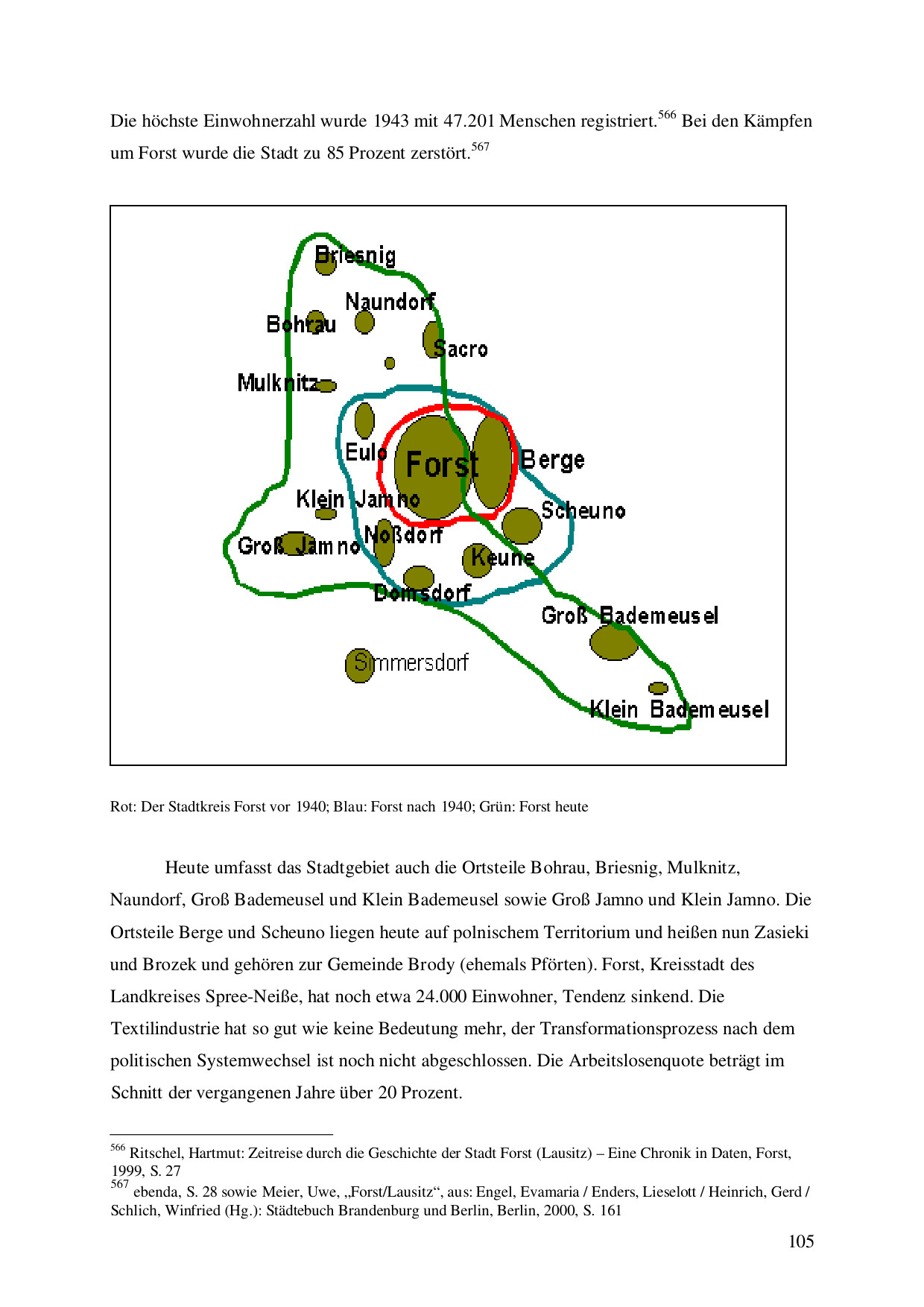
Source page 106 / 151
Compare with the original PDF →
Appendix A. Maps
Map text: Military Economic Office, Frankfurt/Oder district. Chamber of Industry and Commerce districts: Frankfurt/Oder and Cottbus. Labour office districts: Cottbus (Eberswalde), Finsterwalde, Forst, Frankfurt, Fürstenwalde, Guben, Küstrin, Landsberg/W., Meseritz, Senftenberg and Schwiebus.
Boundary symbols: district boundary, state boundary, county boundary. Scale 1:600,000. Side caption: “Copy from the Federal Archives”. Reproduced map sheet number: 18.
Historical place names and boundaries are retained in the map reproduction. It depicts administrative areas, not an individual camp layout.
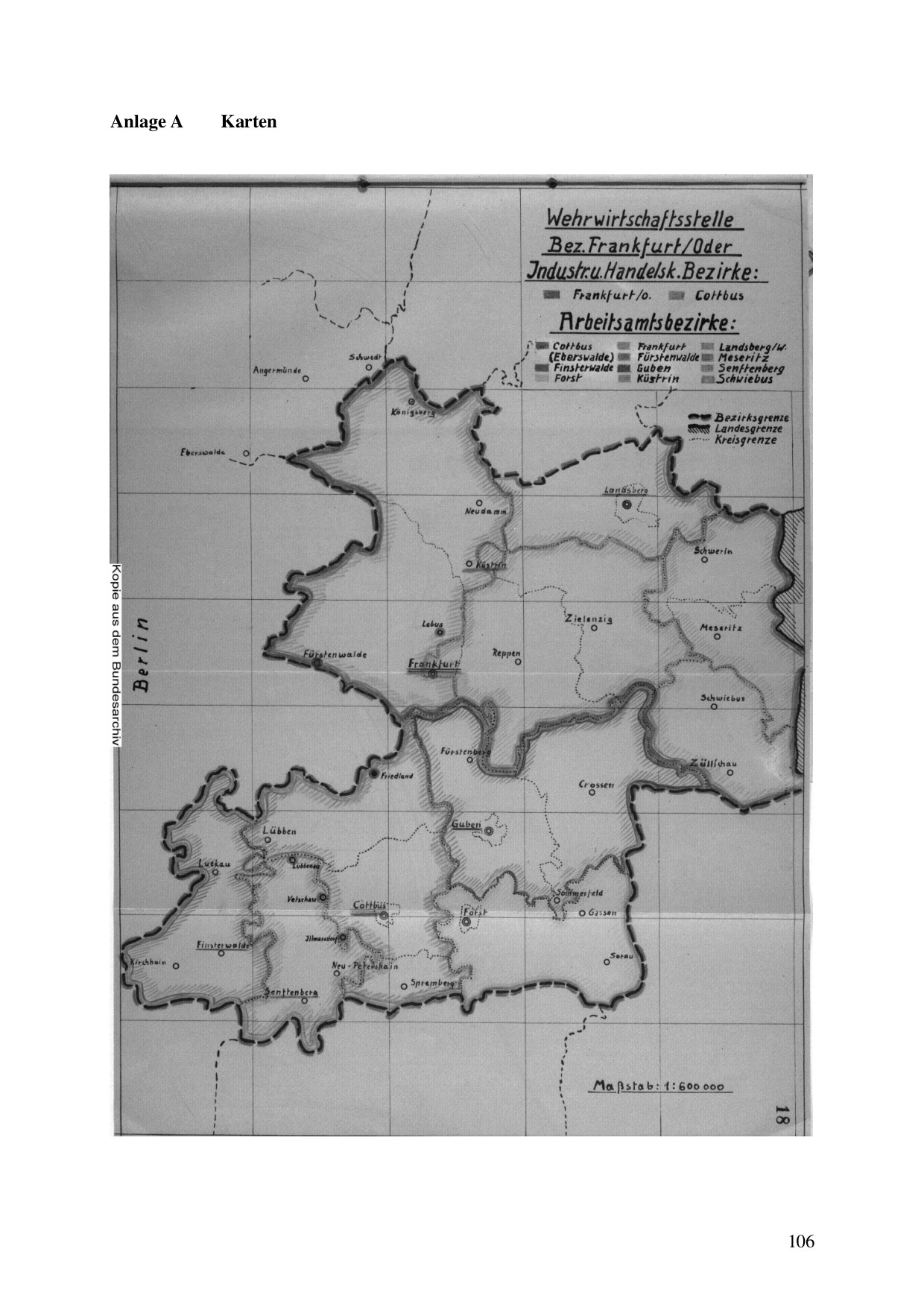
Source page 107 / 151
Compare with the original PDF →
Appendix A. Maps
Map text: Military Economic Office, Frankfurt/Oder district. War-economy establishments (OKW). Lead authority: Army, Navy, Air Force, administration. Number of establishments, respectively: 34; 1; 3; 51; total 89.
Boundary symbols: district boundary, state boundary, county boundary. Scale 1:600,000. Side caption: “Copy from the Federal Archives”. Reproduced map sheet number: 19.
Different symbols mark the locations of establishments. Place names retain their historical spelling in the reproduction; illegible pencil additions have not been reconstructed.
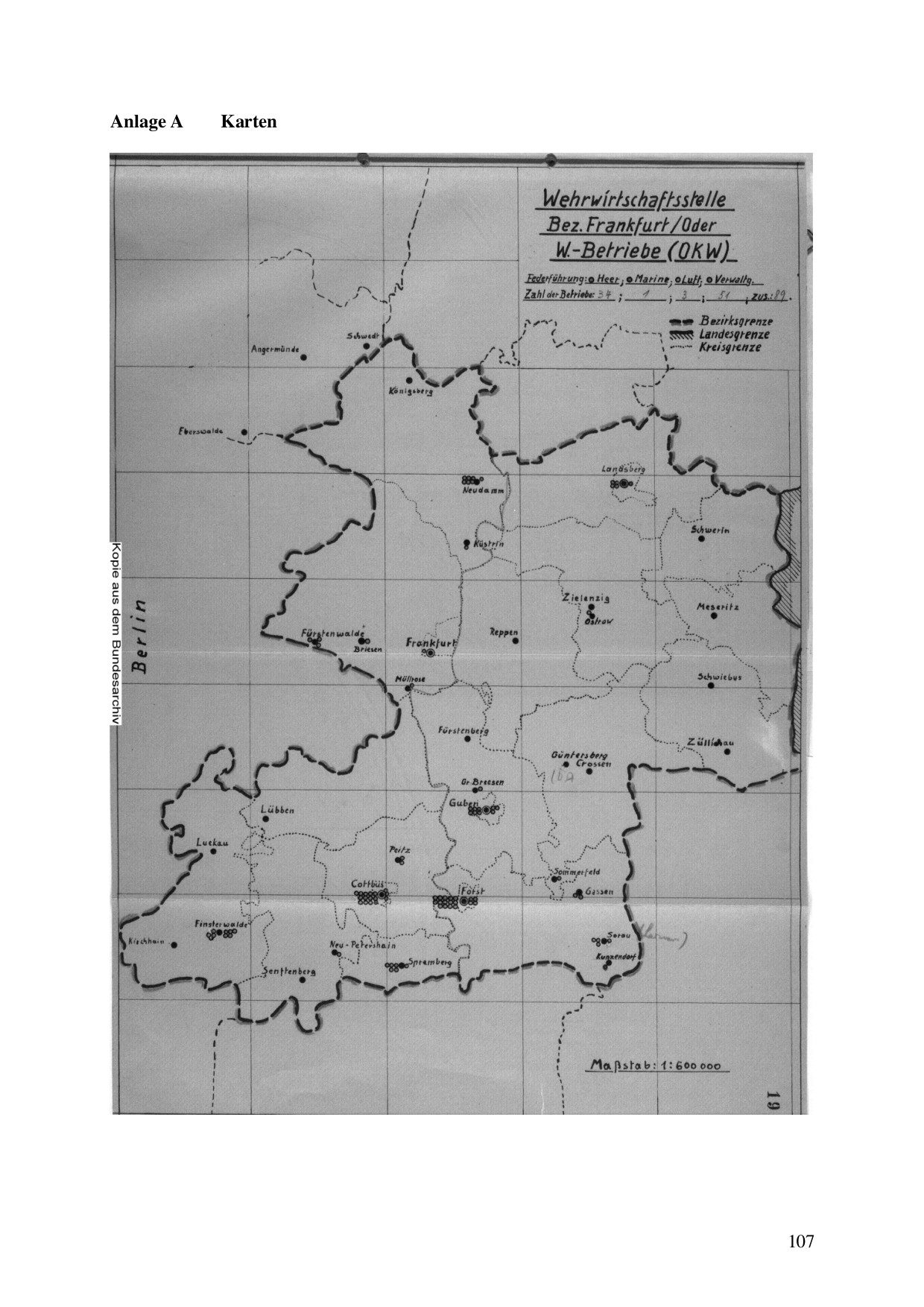
Source page 108 / 151
Compare with the original PDF →
Appendix A. Maps
Map text: Military Economic Office, Frankfurt/Oder district. War-economy establishments (O.P.W.), excluding the food sector. Symbol categories: power stations; gas, water and electricity supply establishments; industrial establishments.
Boundary symbols: district boundary, state boundary, county boundary. Scale 1:600,000. Side caption: “Copy from the Federal Archives”. Reproduced map sheet number: 20.
The historical place names and individual symbols are preserved in the reproduction. The abbreviation O.P.W. has been retained without an uncertain expansion.
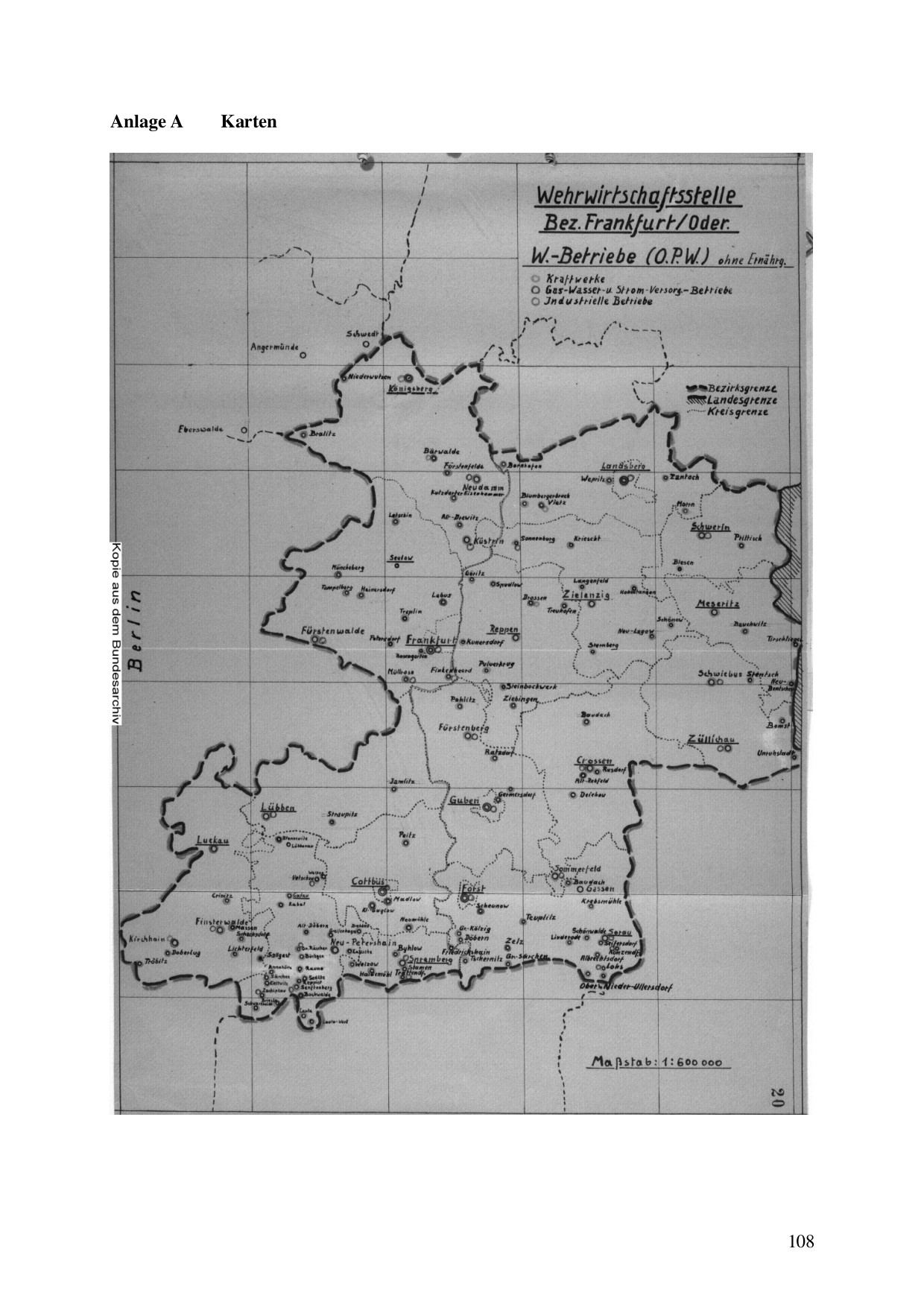
Source page 109 / 151
Compare with the original PDF →
Appendix A. Maps — camp locations
The old town plan of Forst marks the larger foreign-worker camps whose existence can be documented. Boxes at the edges do not show their precise locations, since some sites lie outside the area covered by the map.
Red boxes:
- Eulo Eastern-worker camp.
- Noßdorf camp.
- Muskauer Straße camp.
- Domsdorf camp.
- Simmersdorf camp.
- Scheuno-Ost camp.
- Pförtener Straße camp.
- Hänselhalle.
- Sacro camp.
Black: 1 — main cemetery, graves of Eastern workers.
Pink: 1 — former RAD camp at H.-Groeschke-Platz.
Plan title: “Plan of the Town of Forst (Lusatia)”; scale 1:10,000. The small printed list of buildings and streets is not sufficiently legible in this reproduction for reliable transcription.
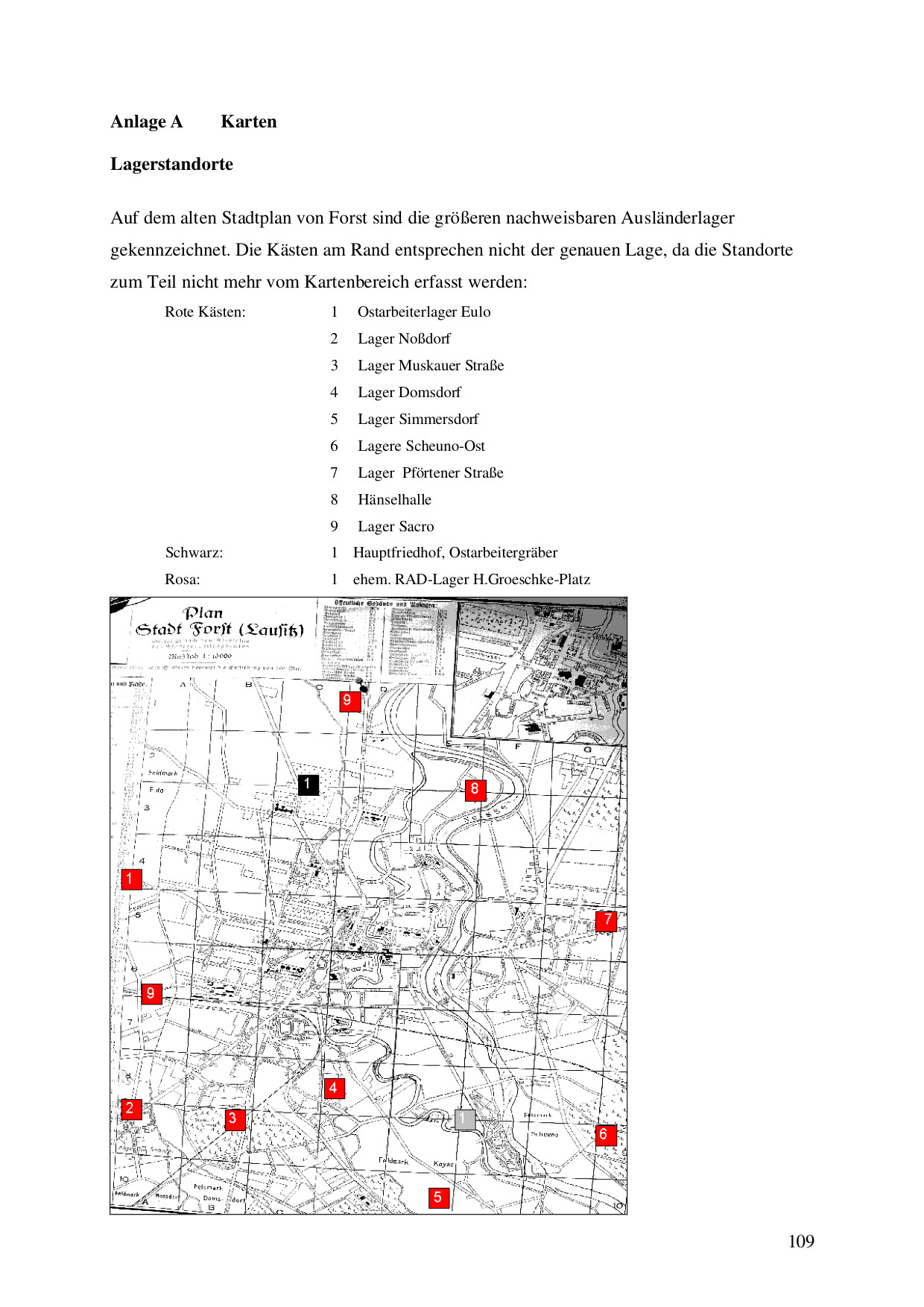
Source page 110 / 151
Compare with the original PDF →
Appendix A. Maps — Hänselhalle
A drawing in the Forst Town Archive shows the location and layout of the hall. It was prepared for a proposed extension for the SS that was never carried out. Prisoners of war and Italian military internees were later accommodated in the side sections.
Today there is an allotment-garden complex on the site. Remains of buildings can still be seen in an overgrown wooded area. The name of the restaurant there still recalls the former riding hall. (Source: Forst Town Archive.)
Legible plan labels: “Lageplan” — site plan; “Maßst. 1:1000” — scale 1:1,000; “Die Neiße” — the Neisse; “Wald” — woodland; “Saal” — hall. Other small, poorly legible annotations have not been reconstructed. “Today” refers to the situation described in the 2004 study.
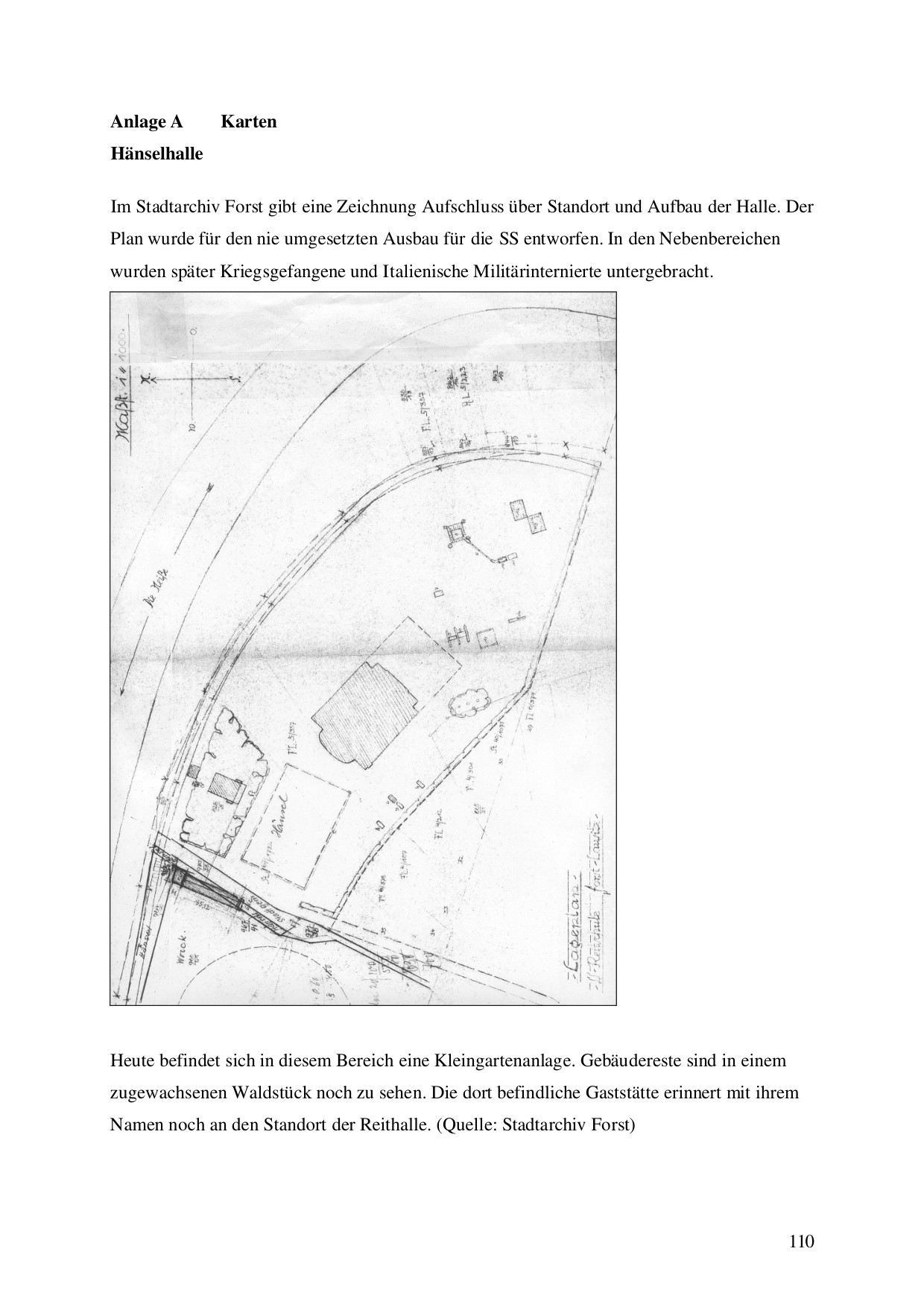
Source page 111 / 151
Compare with the original PDF →
Appendix A. Maps
Eulo RAD camp (today the Am Schafdamm allotment gardens)
The huts, camp fence, firing range, sports ground and grassed area are clearly visible. One of the buildings on the right still survives.
Source: topographic map 4253, Reichsamt für Landesaufnahme, 1940 (extract).
Labels in the map extract: “Schießst.” — firing range; “Sportpl.” — sports ground.
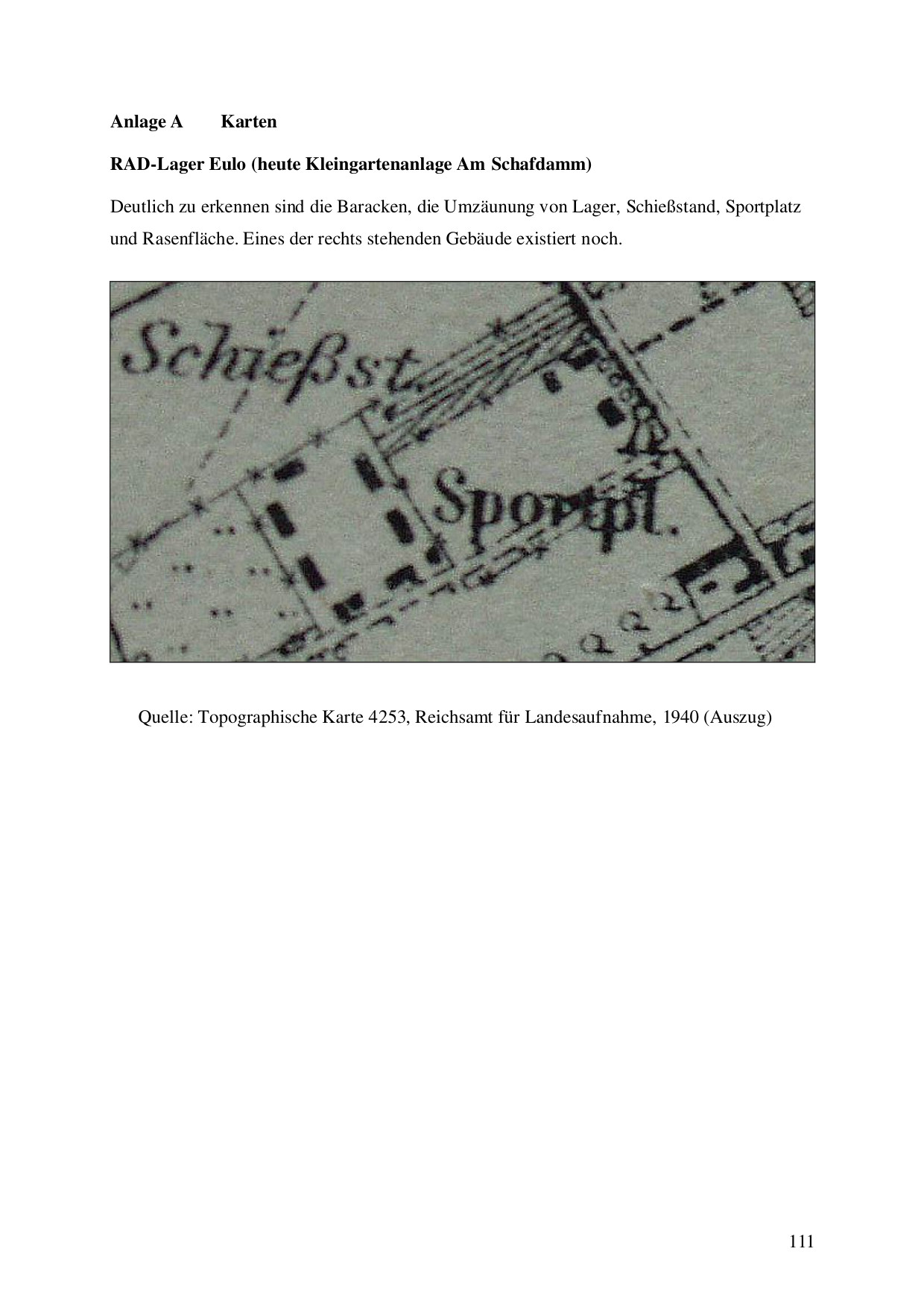
Source page 112 / 151
Compare with the original PDF →
Appendix B. Photographs
Original historical photographs were no longer available. Present-day photographs show that most of the camps no longer exist or have been forgotten.
Railway maintenance camp
This hut was probably the railway maintenance camp. It stands by the railway underpass on Euloer Straße.
The Scheuno-Ost camp
Only foundations and concrete-frame structures that could not be dismantled remain as reminders of what was probably Forst’s largest foreign-worker camp, at the Deutsche Sprengchemie plant. There are no plans showing the layout of the camp, which was evidently expanded during the war. As woodland has since overgrown much of the hut area, estimating the number of huts and the camp’s actual size is difficult.
Photograph caption: In places, only foundations still project from the forest floor.
“Present-day” and the descriptions of surviving remains refer to the period when the 2004 study was prepared.
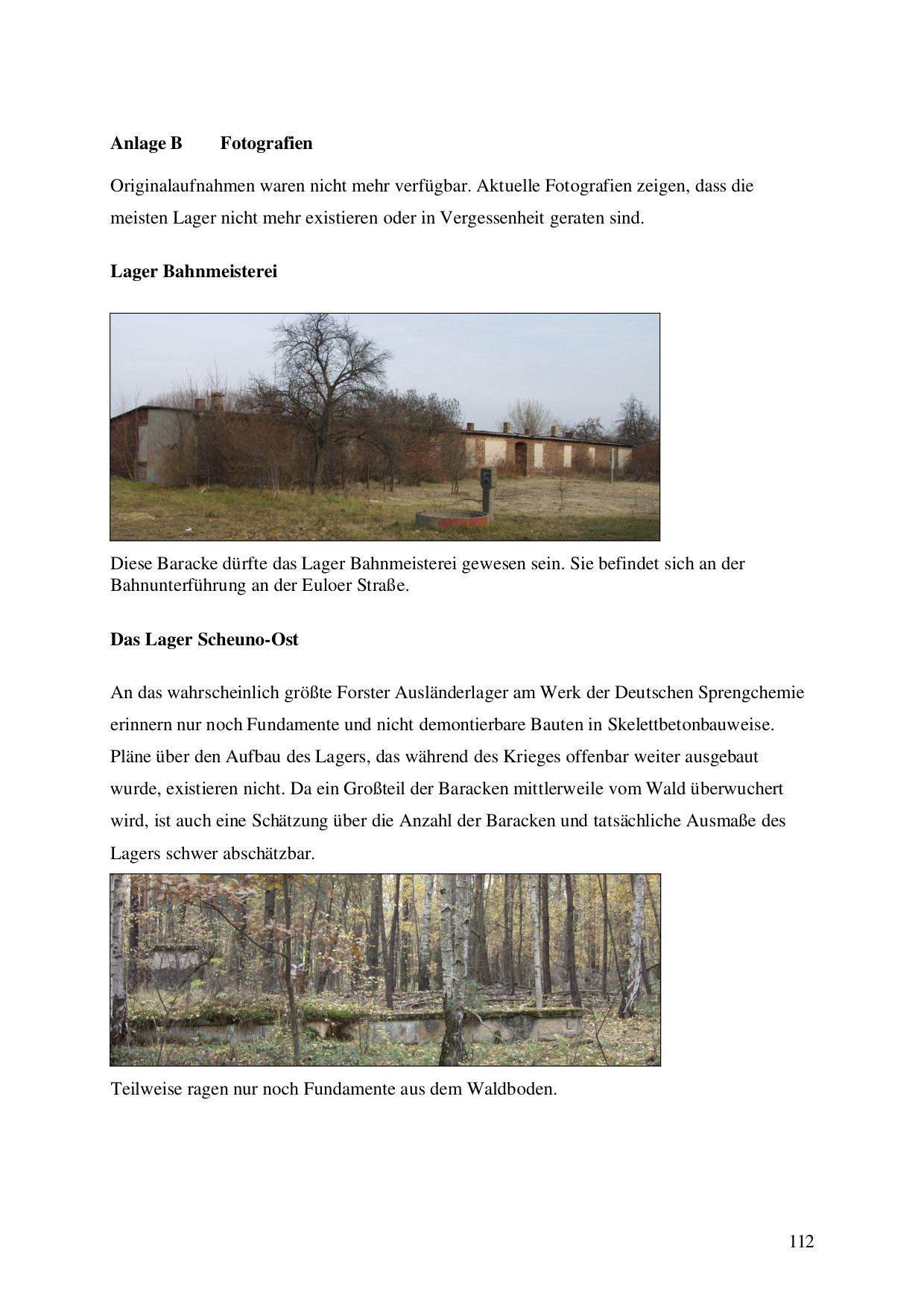
Source page 113 / 151
Compare with the original PDF →
Appendix B. Photographs — Scheuno-Ost
Upper photograph: The camp entrance with its guardhouse. An asphalt road approximately 300 metres long begins at the top of the rise.
Lower photograph: Hut foundations with cellars; in the background is a concrete-frame building.
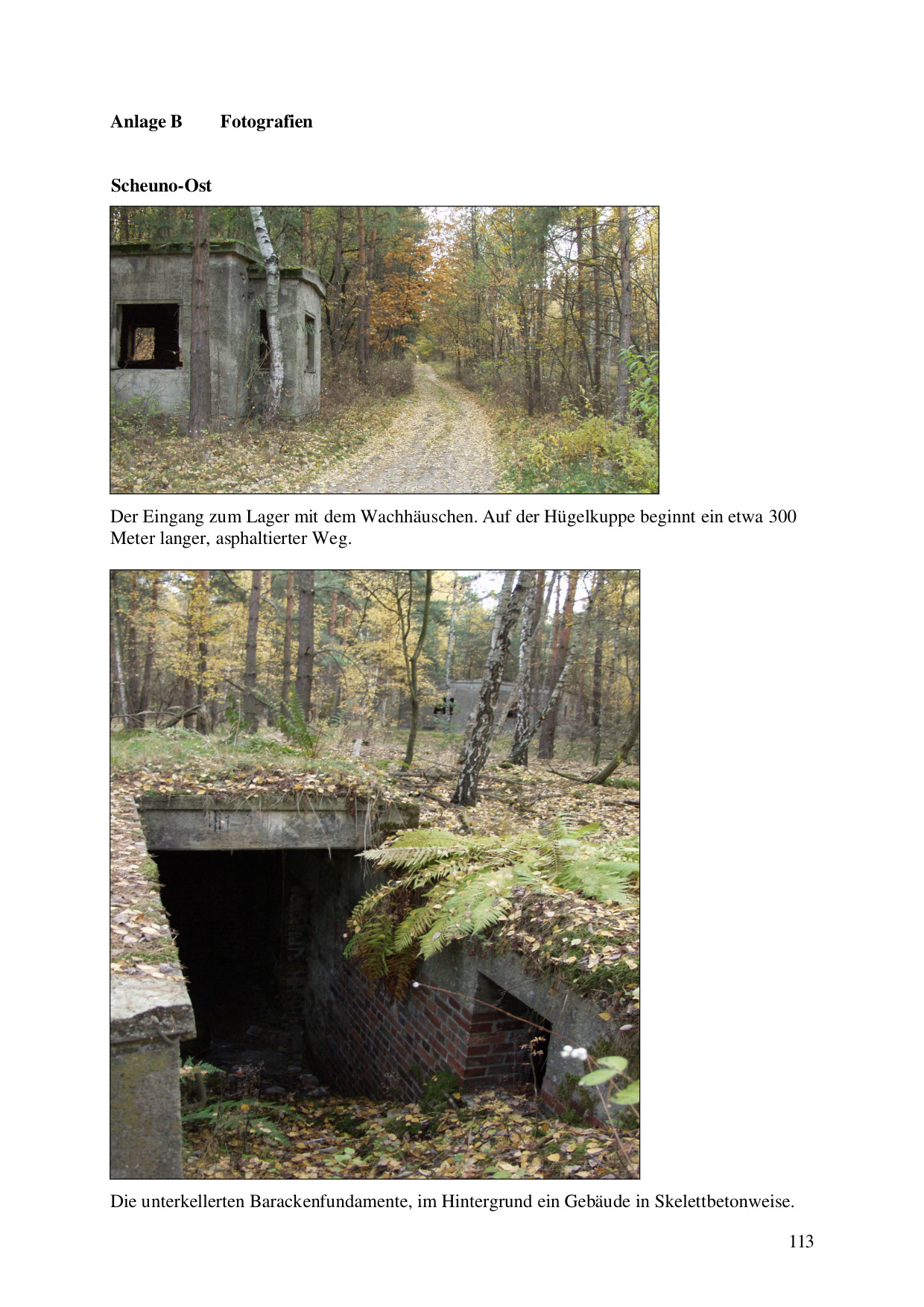
Source page 114 / 151
Compare with the original PDF →
Appendix B. Photographs — Noßdorf camp
The location of Noßdorf camp could be established from an address on an invoice. It was a gymnasium that no longer stands. The house number, “Spremberger Straße 109”, survives on an old gate pillar. Several fence posts also remain, having been reused for a property boundary.
Upper photograph: The house number is still present.
Lower photograph: Old posts from the camp fence still stand.
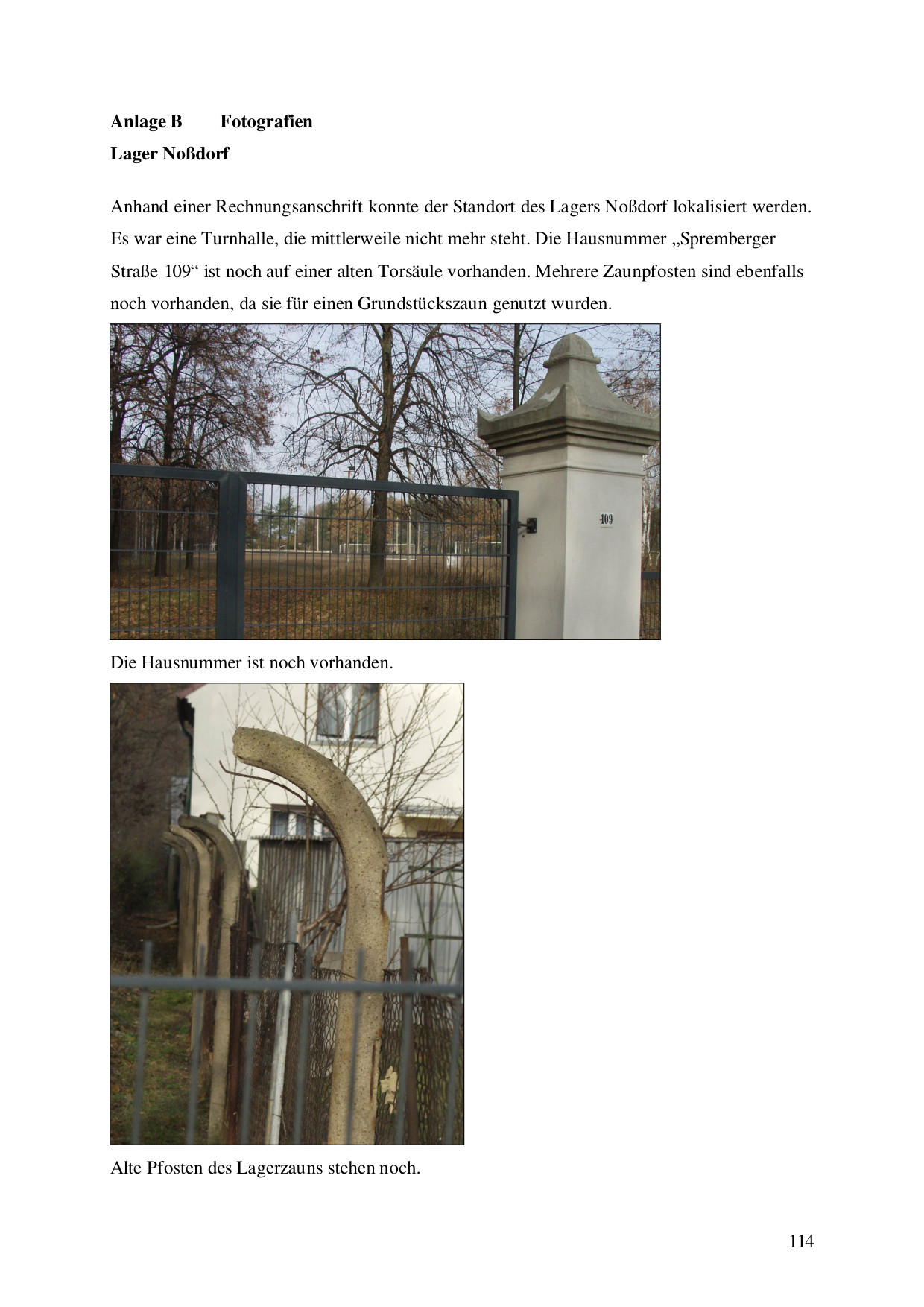
Source page 115 / 151
Compare with the original PDF →
Appendix B. Photographs — former RAD camp at Hammer-Groeschke-Platz
The RAD camp originated as early as 1931, when the Voluntary Labour Service was established; camps were also set up in Skurum and Bader’s factory at that time.568 Whether it was used to accommodate foreigners has not yet been established.
Research into Stalag III B Fürstenberg uncovered references to several labour detachments called “Rosengarten”, but without a place name. Although the former RAD camp on the TV sports ground lies directly beside Forst’s Rose Garden, and parts of its fence still survive in places, the International Committee of the Red Cross inspection reports appear instead to refer to the area of today’s Dahme-Spreewald and Oder-Spreewald districts.
Photograph caption: Remains of the camp fence between the TV sports ground, Wehrinselstraße and the Rose Garden behind it.
568. Address book of Forst, i.e. Forster Stadtbuch, Adressbuch der Industrie- und Handelsstadt Forst-Lausitz, 1935, p. XVI.
“Oder-Spreewald” follows the original wording. “Today” means the time at which the study was written.
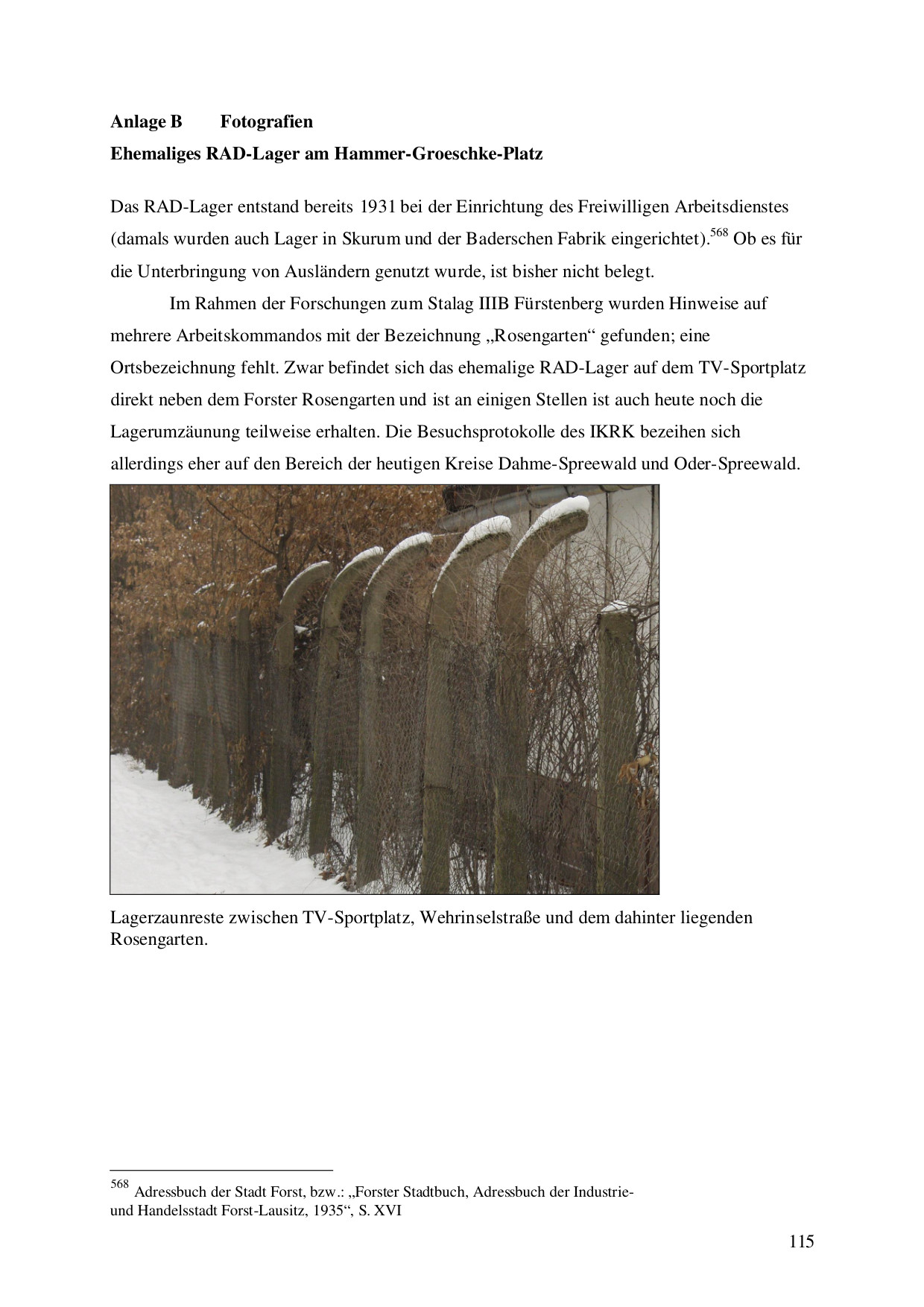
Source page 116 / 151
Compare with the original PDF →
Appendix B. Photographs
Two photographs of the former RAD camp in Keune (older spelling: Koyne) are known. They were published in the 21 November 2003 issue of the Forster Wochenblatt.
Inscription on the first photograph: “Arbeitsdienstlager Koyne” — Koyne Labour Service camp.
Caption below the first newspaper photograph: The RAD camp on Triebeler Straße. The flat-roofed building was a ruin in 1945. The gymnasium of Keune School was built on its foundations between 1962 and 1966.
Inscription on the second photograph: “Arbeitsdienstlager Koyne” — Koyne Labour Service camp.
Caption below the second newspaper photograph: The ruined RAD barracks were demolished after 1945.
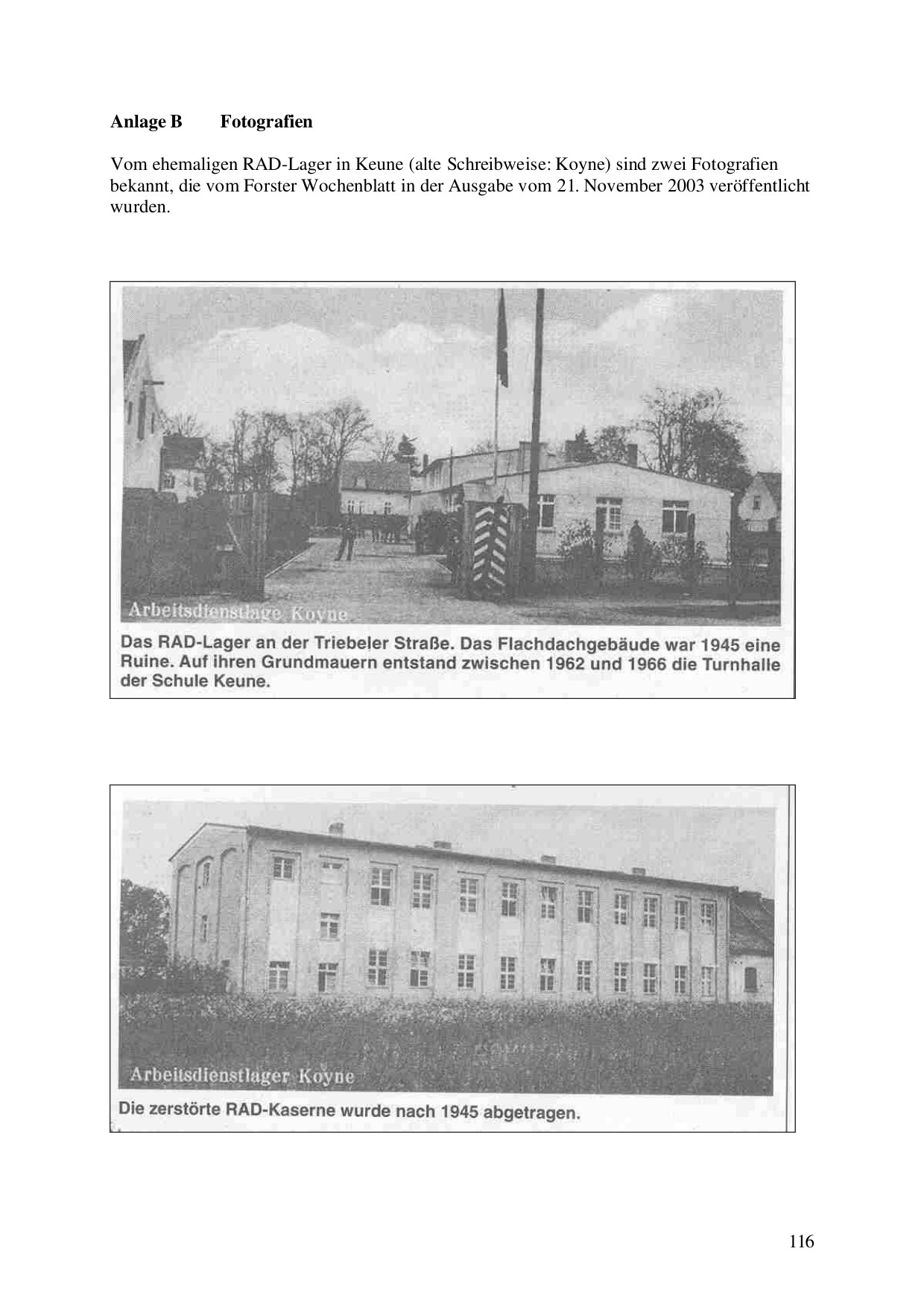
Source page 117 / 151
Compare with the original PDF →
Appendix B. Photographs
Gubener Straße 40
The dwelling and outbuilding at Gubener Straße 40 were already dilapidated at the beginning of the war and were to be demolished in 1942. However, Hänsel & Co’s application was rejected on the grounds that their possible use as accommodation for foreign workers should be examined. Two years later, this address was given for a Polish labourer employed by Hänsel & Co. The house no longer stands.
Muskauer Straße / Waldgürtel
The masonry buildings were erected in 1943–1944 and were probably used mainly to accommodate families of Eastern workers.
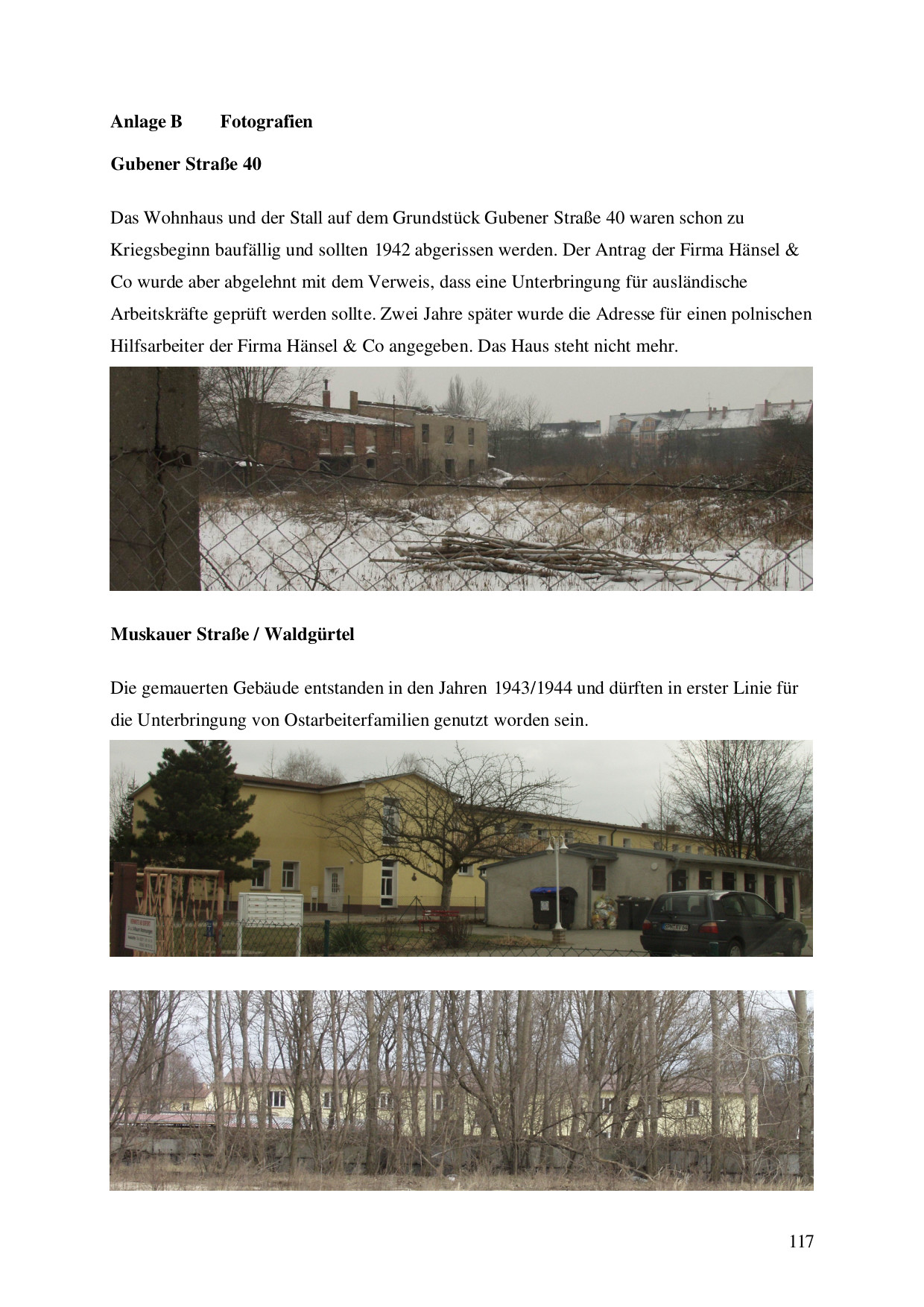
Source page 118 / 151
Compare with the original PDF →
Appendix B. Photographs
Frankfurter Straße 23
The former girls’ orphanage on Frankfurter Straße was used to accommodate Polish workers.
Simmersdorf
Parts for Focke-Wulf were manufactured in a formerly disused factory in Simmersdorf. A prisoner-of-war labour detachment had already been based there before that.
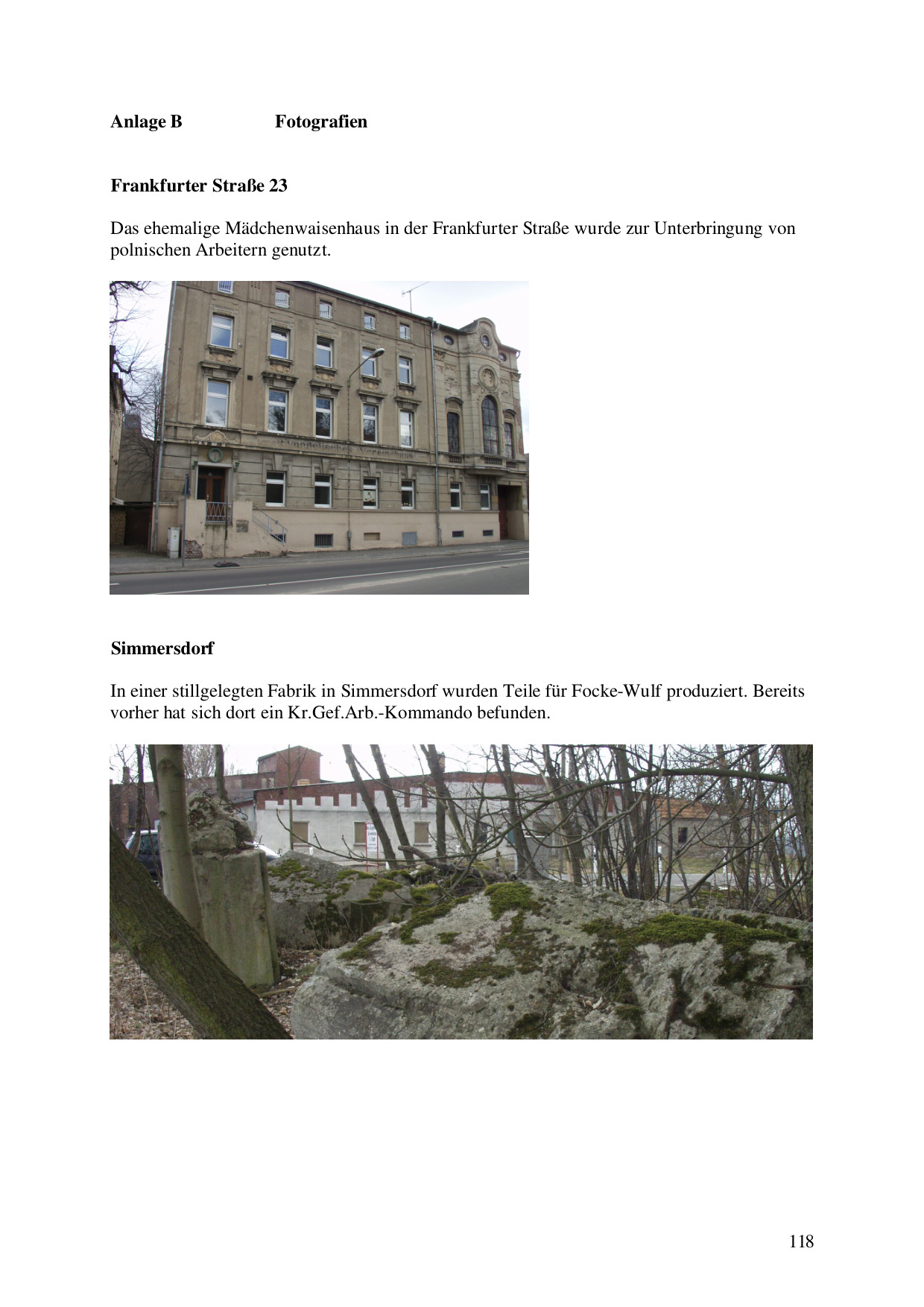
Source page 119 / 151
Compare with the original PDF →
Appendix B. Photographs
Eulo, site of the former RAD camp
The “Am Schafdamm” allotment gardens now occupy the site of the former Eulo RAD camp (see also the corresponding map in the appendix). It was later used to accommodate Eastern workers.
Sign on the gate: “Am Schafdamm” Garden Association, e.V. — a registered association.
Rumsch & Hammer
Prisoner-of-war labour detachment no. 930 was located on the premises of Rumsch & Hammer in Weststraße.
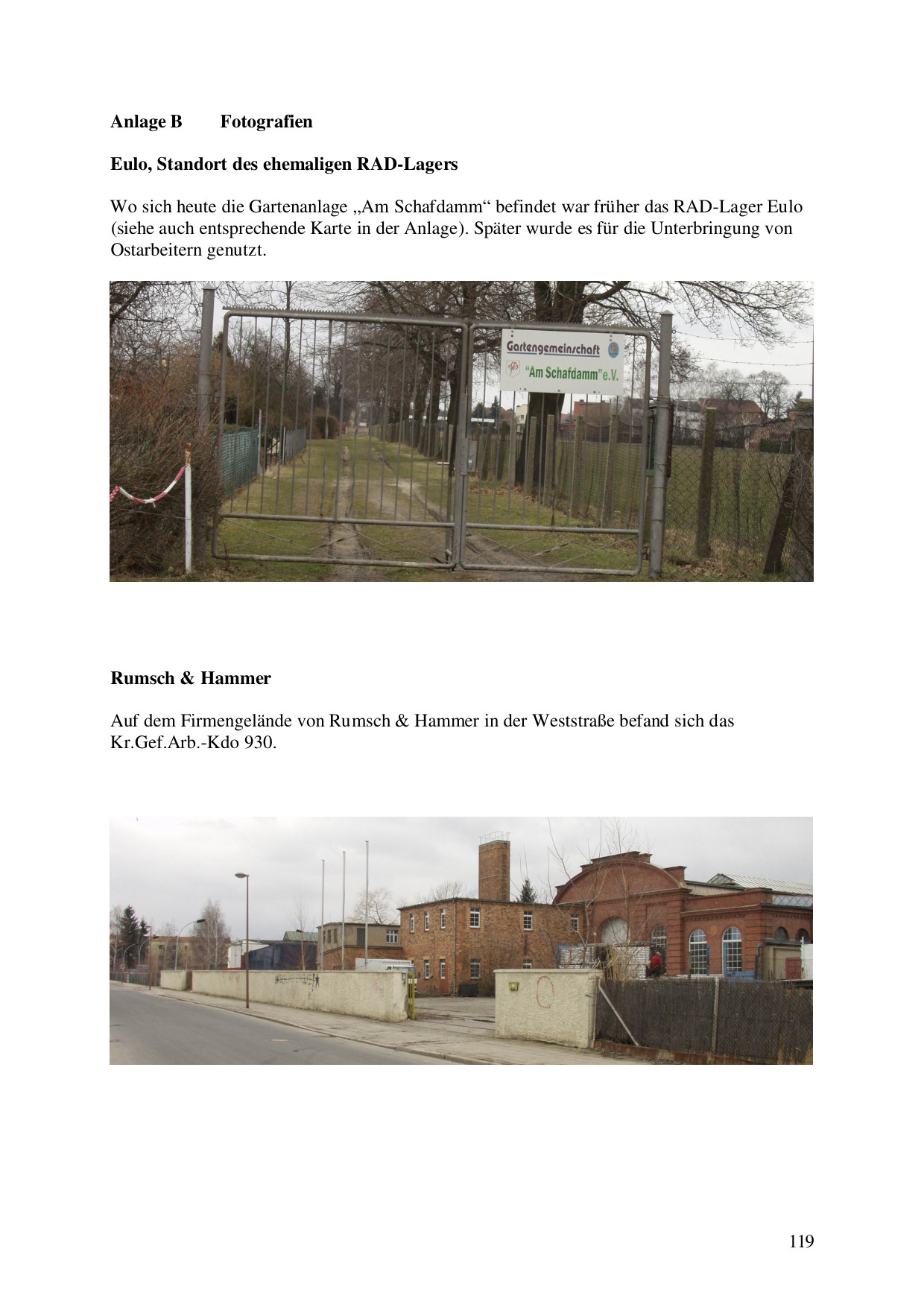
Source page 120 / 151
Compare with the original PDF →
Appendix C. Eyewitness accounts
All the following eyewitness interviews were conducted in autumn 2002 and recorded on tape. As not every interviewee agreed to publication of their name, the interviews are anonymised: access by third parties cannot be ruled out through copies deposited in various archives. The original recordings still exist and can, if requested, be heard by the examiners to verify the transcriptions; the witnesses’ identities can be disclosed to them in confidence. Only minor changes of expression were made in the transcriptions. Passages unrelated to the subject of the study were partly shortened. These included accounts of the end of the war in Forst, experiences elsewhere during the final phase of the war and the post-war period.
Eyewitness 1
During the war, about three or four huts were built [on] Am Waldgürtel […] for forced labourers. We then saw that many people had been quartered there, men and women. Some houses had an entrance from outside, up steps to a veranda. The rooms could be reached from this veranda, but somehow also from the main entrance. I cannot say where the forced labourers worked. They were employed in several local businesses. We had an armaments factory here, “Deutsche Vergaser”. It made spare parts for tanks, and some of them probably also worked in the ammunition factory in Scheuno.
The forced labourers could always be distinguished from the rest of the population; at any rate, you could always recognise them by their clothing: felt boots and very thick padded jackets. In winter the men wore those military caps lined with fur; the women wore such caps too, as well as headscarves.
The population was not allowed to speak to any of these forced labourers, address them, and certainly not give them anything, or they would be punished. We sometimes felt sorry for the people, but we could not make contact with them.
There was a grocery shop in the street where the huts stood. The forced labourers sometimes went shopping there. As became known in town, they bought green tomatoes pickled in vinegar […]. The shopkeeper was punished. His shop was closed. As a result, all the other shops also avoided helping these forced labourers.
People were very upset when they heard that a heavily pregnant forced labourer had been taken to Forst hospital. She was not admitted to the maternity ward; she gave birth in a bathtub. […] There was some resentment among the population that these people were treated so badly, as inferiors. Nothing could be said aloud, because anyone who did so would have had to expect to be picked up by the Gestapo.
There were also French prisoners in Forst who could walk about in their uniforms. They worked for the municipal cleansing service, drove the watering vehicles and refuse lorries, and always seemed very friendly and self-confident. But officially, residents were not allowed to contact them either.
We also had a factory producing cotton wool and dressings. Frenchmen worked there too, and there was a little contact between the employees, the Germans — all of them women, also conscripted for work — and the French workers. And there… [continued on the following page].
Source page 121 / 151
Compare with the original PDF →
…there was sometimes a little exchange: food for perfume and soap from France. These items arrived by post in parcels. The German women employed there exchanged goods for them or bought them themselves. This gave the prisoners a little more money, and they were not guarded as strictly as the people deported from Russia.
The cotton-wool factory was on Frankfurter Straße; I cannot say exactly where. My mother worked there, but I never asked precisely where she worked.
[…]
There were only Russian people in those huts “Am Waldgürtel” […], men and women from Russia. They went to work and returned directly there afterwards. Otherwise they had no freedom. They were guarded, and the whole site was fenced. They could not go out whenever they wanted, only to work and back. The French prisoners of war had somewhat more freedom; they were also seen walking through town after work. They probably had a much better time and were not so restricted.
The population was not allowed to contact them either.
If women made contact with foreigners and it became known — and it happened here too — their hair was cut off, their heads shaved, tar applied and chicken feathers stuck on. One such woman came from a nearby village. The NSDAP then paraded her through the town. Nobody objected. People tried first of all not to look, so as not to be suspected of perhaps feeling sympathy for the women. That too would have been suspicious.
I later heard that other women and young girls had contact, particularly with the French prisoners, and went back with them to their home country after the war, married there and stayed in France.
My sister worked in the payroll office at “Vergaser”. There was a supposedly Italian prisoner who had close contact with all the other prisoners employed there. They were housed in the former riding hall near the Neisse. After 1945 we met […] that prisoner again. We knew him as Forlani. I myself had often seen him […] at the health-insurance counter and knew he looked after sick prisoners. He came regularly with their medical certificates. My sister told me that he had been appointed the prisoners’ representative because he spoke good German. She herself had often given him lunch from the factory. Some senior employees noticed this. Her departmental manager warned her to stop, or things would become unpleasant for her. She then held back accordingly.
After the collapse we met the Italian prisoner Forlani again. At first we were very surprised by his appearance. We had known him only in the dirty uniform worn by the prisoners. Now he was very well dressed; I remember it precisely: a pale-blue shirt, shorts and, above all, we could now see his hair — it was blond. The prisoners’ heads had previously been closely cropped. He called my sister, and we turned round but did not recognise him at first. Then he came […] across the street and said, “Mrs […], don’t you recognise me?” “No,” she said. “I am Forlani.” We were very surprised. We went to Hofstraße, to what is now Primary School 6. It was the commercial school then. We talked for a long time in one of the classrooms. He told us that he had not been an Italian soldier at all, but a Yugoslav officer. Because he also spoke perfect… [continued].
Source page 122 / 151
Compare with the original PDF →
…Italian, he had passed himself off as an Italian for particular reasons. He told us how he regularly arranged medical certificates for the prisoners, thereby causing absences from work. This harmed the carburettor factory. It had been very well organised. He himself was then in the reception camp in Forst. All the deportees, prisoners and forced labourers from the surrounding area were initially gathered here. They were later taken by train to their home countries. This collection camp extended from the station up Bahnhofstraße, including today’s August-Bebel-Straße, Blumenstraße and Leipziger Straße, where houses still stood, as far as Nagelstraße — then Lothringer Straße. These streets were fenced off and inaccessible to returning Forst residents. The former deportees awaiting repatriation could leave the camp and walk freely through town. Only Forst residents were barred from the zone. There were well over a hundred people in the camp. I cannot estimate it exactly. Many houses were destroyed, but quite a number between them were still habitable. There were a great many people. […] Later, trains left Forst daily, via Cottbus and then either to Russia, Italy or France. […]
I know of no other camps. […]
I know of one case in my mother’s family. A man lived in a village near Forst and had a farm. He had been assigned a Russian helper. All farmers were instructed not to have personal contact with workers […] from the Soviet Union on their farms. My mother’s cousin had a relationship with the Russian woman. His own mother reported him, and he was immediately taken to Berlin-Moabit. He was a big, strong man, yet within eight days he was dead. His mother was told that he had died of pneumonia. From what we later learned about the treatment of such people, we assumed that the Gestapo had killed him in Moabit. […] The Russian woman was removed from the farm; I do not know where she was taken. […]
The colonial-goods shopkeeper, with the grocery, fruit and vegetable shop, was the Kuhlisch couple. They appeared in Forst only briefly after 1945. The parents and their son, when he returned from the war, then went west. They did not make a fresh start here in Forst.
The forced labourers and the prisoners must have been insured. They were in large businesses with collective employee accounts, but since the supposedly Italian prisoner brought in the medical certificates, the prisoners of war must also have had insurance.
No attempts at revenge by foreign prisoners after the war were known in Forst. Forst had been completely evacuated; we too were forcibly evacuated, everyone had to leave. Apart from the repatriation of the prisoners, who were kept here in what one might call a ghetto, although they could move freely through town, I know of no assaults.
Some Italians remained in Forst after the war, married here and started families. Unfortunately I have forgotten their names.
We heard of no deaths among the forced labourers. We never learned anything about the life that went on in those huts, except for the childbirth incident, which became known in town through the hospital staff.
The main organiser among the Italian workers at the carburettor plant was Forlani, who passed himself off as an Italian prisoner. They even dug a hole in the riding stable so that they could escape at night and obtain potatoes and other… [continued].
Source page 123 / 151
Compare with the original PDF →
…food. Otherwise they were not allowed to be seen in town. What they received was very limited and insufficient. They had to work and were effectively undernourished. Everything was tightly organised: obtaining food, medical certificates and the resulting absences from the factory. Forlani was chiefly responsible. It was decided exactly who was sick and who went to work. Then another group took its turn so that it would not attract attention. That was what he told us.
I cannot say when the riding hall was demolished. We all had other worries than checking whether it was still standing. The hall was fenced; it had already been an enclosed site when the factory owners used it for riding.
Other institutions were inaccessible to the prisoners. Forlani dealt with all their affairs because he spoke very good German. He always came alone and left alone. Nobody accompanied him as a guard. […]
I have no idea where the Frenchmen were accommodated. […]
I did not know any Polish forced labourers.
[…]
There were no air attacks on Forst, and Scheuno could not be distinguished from the air at all.
[… / air attack on Sorau / first-aid work / …]
I do not know of a foreign woman doctor working at the hospital in the later war years.
[…]
We learned about the ban on contact with prisoners through newspaper articles and word of mouth. It was passed around, and we heard that various people had been punished and imprisoned for it. So people complied. The newspaper announced in general terms that the population must not contact prisoners of war or deportees. But it did happen, as we found out later. Some Forst girls went to France with the French prisoners.
[…]
When we returned from Finsterwalde to Forst, on foot of course, Russian soldiers stopped us shortly before Groß Jamno. They were commissars, identified by armbands. We were told to move aside onto the meadow. A whole group of Polish men then passed, accompanied by Russian soldiers. They tried to take our belongings. The Russian soldiers prevented them. I cannot say where that group went. They were being taken towards Cottbus.
[…]
Supplement dated 24 June 2002
In addition […] I would like to tell you that after the war, in May 1945, my sister and I had contact with female forced labourers who were also in the Forst reception camp. We met in a Forst cloth factory. The doors and gates were open, and local people were taking yarn to make underwear and clothes (“Mausiwolle!”). We met some girls from Russia who were also collecting yarn. One girl, who spoke good German, told us that she had been a maid in Leipzig, in a household with children. She said it had been nice. Lady good, went with her to the hairdresser. Hair made nice and got nice things. Would have liked to stay. Russia very dirty. Another kind of story!
Source page 124 / 151
Compare with the original PDF →
I probably did not express myself correctly about the deported woman giving birth in Forst hospital. What I meant was that the birth took place in extremely primitive conditions. The cast-iron bathtub stood in a room used to store bedpans, urinals, rubbish bins and cleaning materials, as well as dirty bed linen awaiting collection for the laundry.
Forced labourers and prisoners of war were also used to build anti-tank barriers and trenches in February 1945. Italian forced labourers were also used to evacuate old people from the home for the infirm in Berge (now Poland). They had to carry the frail residents on stretchers across a pontoon bridge over the Neisse to Rüdigerstraße (now Dr.-Otto-Nuschke-Straße) and load them into freight wagons of the municipal railway. The Lange Brücke had already been blown up. The Italians worked for six hours.
The Italian who remained in Forst was called P. […]. He had married a pretty girl from Forst-Keune. He had six children. All of them had Italian citizenship. He could visit his home country even during the GDR period. After some years, he applied to leave for West Germany. He left with his wife, sons and one daughter. His wife and the girl returned because they were homesick. […]
Supplement dated 24 June 2002
In addition […] I would like to tell you that after the war, in May 1945, my sister and I had contact with female forced labourers who were also in the Forst reception camp. We met in a Forst cloth factory. The doors and gates were open, and local people were taking yarn to make underwear and clothes (“Mausiwolle!”). We met some girls from Russia who were also collecting yarn. One girl, who spoke good German, told us that she had been a maid in Leipzig, in a household with children. She said it had been nice. Lady good, went with her to the hairdresser. Hair made nice and got nice things. Would have liked to stay. Russia very dirty. Another kind of story!
I probably did not express myself correctly about the deported woman giving birth in Forst hospital. What I meant was that the birth took place in extremely primitive conditions. The cast-iron bathtub stood in a room used to store bedpans, urinals, rubbish bins and cleaning materials, as well as dirty bed linen awaiting collection for the laundry.
Forced labourers and prisoners of war were also used to build anti-tank barriers and trenches in February 1945. Italian forced labourers were also used to evacuate old people from the home for the infirm in Berge (now Poland). They had to carry the frail residents on stretchers across a pontoon bridge over the Neisse to Rüdigerstraße (now Dr.-Otto-Nuschke-Straße) and load them into freight wagons of the municipal railway. The Lange Brücke had already been blown up. The Italians worked for six hours.
The Italian who remained in Forst was called P. […]. He had married a pretty girl from Forst-Keune. He had six children. All of them had Italian citizenship. He could visit his home country even during the GDR period. After some years, he applied to leave for West Germany. He left with his wife, sons and one daughter. His wife and the girl returned because they were homesick. […]
The repeated supplement is retained because it also occurs in the original. Statements and judgements remain the witness’s account.
Source page 125 / 151
Compare with the original PDF →
Eyewitness 2
We lived on the outskirts of Berge. Pförtener Chaussee began there. […] My son was born in March 1944. A school friend had a baby at the same time […]. We used to meet in the afternoon and walk along the road with our prams. We had to pass the huts, although they stood some way back, about 50–100 metres, behind a fence. Families were there. We were pushing our prams when a young woman approached, carrying her baby — we could not communicate, of course, and nobody must notice. She came to the cycle path running beside the road towards Pförten and made us understand that she had nothing for her child: no bottle to drink from and nothing to eat. We thought: we must not do this, we must not have contact. We kept going, then came back. Then we thought of our own newborn babies, who were so small too. There was a Seifert bakery on Beethovenstraße in Forst. It baked rusks for children. We had ration coupons, cake coupons for example, so we could collect rusks for our children, and we did. One-pound packets, a bottle, a little powdered milk — somehow we made ourselves understood to the woman. So that nobody [noticed…], we dropped everything by the roadside. The young woman was watching. We went on, and when we came back it had gone. We did this twice. Then she stopped coming. We do not know whether her baby survived. […] Families lived in those huts. The men were taken to work and presumably brought back in the evening. […] The huts stood in the woods. […] I do not know how many there were, because we could not see inside at all. […] Nor do I remember when the wooden huts were built.
[…] Contact with foreigners was forbidden. […] Ukrainians, whole families, were accommodated in the camp. I do not know how many. […] The women were probably in the camp, because you could see people there. […] I cannot say whether it was guarded or whether the fence went all the way round, because we could not get close. […] I do not know how they were fed or whether they could shop. We felt sorry for them because we had babies too. […] The woman was about 25–30 years old. She was certainly older than us.
I no longer remember how long the camp existed. When the front approached, refugees arrived in their columns, and the road became impassable. I do not know whether the camp had been dissolved beforehand; I cannot say whether the prisoners died or got out.
[…] On Cottbuser Straße, from Bahnhofstraße, there was a fence. It was closed off, and foreigners were inside. They lived there, and we could not enter. Then people said the foreigners were leaving. They took all sorts of things they could still obtain here. We went to the station; they had handcarts, and I took one. We used it to collect fuel. […]
The foreigners lived in a separate area; we were from Berge. I lived near the station, and we never went there. The foreigners looted the flats. In 1945 the camp was cleared again, and they were allowed to return home.
We never found out what happened in the camp [on Pförtener Chaussee]. The huts had probably been built specifically for those foreigners. There was a Labour Service camp in Scheuno, at the Skurum bridge, by the sheep farm. There was supposedly a labour camp in Keune too.
I know of a Frenchman who worked in Scheuno, married a German woman […] and took her to France. […] I do not know whether their relationship began only after the war, but they met at the Scheuno plant.
[…]
Source page 126 / 151
Compare with the original PDF →
Eyewitness 3
I was […] fourteen when the war began. I remember exactly when the war against Poland started: it was a Sunday, and one of our journeymen had already received his call-up papers. The first years were not so bad. But when the Russian campaign began in 1941, again on a Sunday, my father was already in Russia, and my mother was left with an older journeyman and another one. The senior journeyman was then called up too, and we were assigned a French prisoner of war. It felt rather strange to all of us, and surely to him too, when he entered our family atmosphere. To us it was natural that he should share our meals. It helped that I had learned some French at school. He proved quite industrious, his colleagues got along with him, and there were really no problems. My impression was that he was particularly attached to his family. For a long time they had heard nothing from one another, but contact must later have improved. He often spoke about letters he received from home. He had a fiancée. Before long, French prisoners of war began to be converted into civilian workers. This meant that they received mail and parcels from home. Clothes were sent so that they had something to wear, and I suspect they did not even have fixed camp hours. If they were not there at ten in the evening, they were looked for, but the Hänselhalle was not run as strictly as a prisoner-of-war camp.
In 1943 I was assigned to work in Christianenstadt. My father had meanwhile returned from Russia, because the last journeyman had also been called up and my mother was left alone with the French prisoner and an apprentice. The Frenchman worked in my father’s butcher’s shop for three years, from 1942 to 1945, living first in the Hänselhalle and then, from about 1943, in Noßdorf. The Hänselhalle was the former riding hall. I never went there myself. Foreign workers, including Dutchmen and Belgians, were later in Noßdorf. They could not be distinguished. The Poles and Russians were forced labourers. My father was also assigned a Pole, around 1944, who later became a slaughterhouse director. He came here a few times. I do not know where the Pole was accommodated.
In Noßdorf the Frenchman lived in accommodation before the racecourse, directly on the main road. It was a large room, now burnt out. He came to the shop at about five in the morning, and breakfast was eaten in a room behind it. Lunch was at 12:30. The shop was always closed from 12:30 to 14:30. Mother prepared a parcel for the Frenchman to take away after work. During breaks he always sat at the table with us. Strictly speaking that was forbidden; they were supposed to eat separately. But nobody said anything. Our relationship with him was mainly work-related. Mother made a joke now and then. Communication was good, mostly in French. He also knew a few German words. He had to walk from the Hänselhalle to us. Later, when he was in Noßdorf, I think he had a bicycle.
Most journeymen in businesses were between twenty-five and thirty, so they had all been called up. That was why most businesses employed foreign workers. Smaller shops had them too. But many shops also closed because there was nobody to work.
Foreigners were not visible in the streets. They did not stand out. All the women [in the camp] at Am Waldgürtel had to go to Scheuno. They could not walk there; a train ran. They went to the station in the morning and travelled across. The first stop was just beyond the Neisse.
The dates and recollection of Sunday are retained as the witness stated them, not as a corrected chronology of the war.
Source page 127 / 151
Compare with the original PDF →
We did not celebrate family occasions together with foreigners. But at Christmas, for instance, the Frenchman came to us and we celebrated together. We sat by the tree, sang songs, and he joined the gift-giving too. He also received small presents. Mother had something for everyone.
[…]
In February 1945 the Frenchman lived entirely with us, in a room in the rear building. One day he was gone, leaving only a note. It said that he was hiding in Jocksdorf with a companion from his group. Foreigners were registered with the Gestapo, which now wanted to know where they had gone. They were certainly afraid of sabotage and of foreigners cooperating with the Russians. A Gestapo man once came to us. He asked how things were and so on. He also saw the Frenchman sitting with us. But everything was falling apart, so he said nothing about it. They only wanted to prevent foreigners from gathering together — the Russians were on the other side. The situation had become too dangerous for the Frenchman, so they hid. We never heard from him again. I always thought he would get in touch.
Our Polish employee had already left when I returned […]. They slipped away quietly, because it was dangerous here for him too. The Russians could have crossed the Neisse very quickly. He probably wanted to leave the battle area as quickly as possible and went “towards home”.
[…]
The Frenchman came to our business in summer 1941. My mother must have applied to the labour office, and they sent him. I do not know how payment was arranged; I had no insight into that. I think anyone lucky enough to be in a butcher’s shop then was not initially in need and had food: lunch and sausage, no delicacies, but everything was there. If they had a little meat and sausage, the baker was not so particular either. Barter was everywhere.
[…]
In Christianstadt, at the DAG plant, we had no contact with foreigners, except in the offices in the hut. Ukrainian women worked in one office. They were quite pleasant, cheerful and normally dressed. They distributed meal coupons. That was very fortunate for them: they were in the warmth and had contact with Germans. Most could speak German too. When women workers came with a request, everything proceeded normally. The higher the level of education, the less badly they were treated. There were also the “little Nazis” who presumably wanted to make more of a show, whereas Dr Rahts [phonetic spelling] spoke differently to the Frenchmen and could explain things better. It was the same with the chemists; things were different there. There was no violence.
[…]
Apart from the butcher’s shop, I really knew nothing about foreigners. […] I also saw Italians in Christianstadt in 1944. They were in a very wretched state. They rummaged everywhere for food. The different climate, too — I still often picture them suffering. They were not treated particularly well. They were enemies, after all. They seemed undernourished to me; there was scarcely any food left even for many Germans. It was probably all too much for them. […]
Perhaps I can still find some entries showing what my mother paid to the main camp. They came from the main camp and were paid through it.
[…]
Source page 128 / 151
Compare with the original PDF →
Eyewitness 4
Some summers were very hot, looking back at 1942, 1943 and 1944. My father had become ill […]. There were four of us children. […] Nobody was allowed to contact these Eastern workers. But a child had no sense that something might happen because of it […], and Mother did not talk to us about it. I remember summer, when we received coal. […] It was tipped out. Whenever I came home from school there was a huge pile beside our house on Triebeler Straße. Then it was shovelled into the cellar. In the afternoons I was always puzzled; I wanted to help shovel. Mother said, “Oh, leave it.” I did not have to. Then women came, sometimes one, sometimes two — Eastern workers, Ukrainians I think. They must have seen Mother shovelling and said they wanted to do it. After they virtually insisted, Mother let them. As a child you do not think about it, but now I know it was a great danger for them and for us, because contact really was forbidden. Over the years it became customary for these women — probably always the same ones — to shovel in the coal. Meanwhile Mother, who was a kind person, hurried indoors and peeled potatoes. A large potful; I had to help. Whenever the women came, there were always mashed potatoes, scrambled eggs on top and buttermilk. Meanwhile the boiler was heated in the washhouse for the zinc bath. The water was made warm enough for them to bathe. A bath was a luxury for those women. When they finished, they could bathe. That was the best thing for them. Then they were given food. After eating a little, they wanted to pack up the rest. Mother always told them to keep eating; she had enough left. They ate hungrily. It was wartime, so we did not have much either. When they had finished, Mother filled a large earthenware jug with mashed potatoes and gave them eggs for the other Eastern workers living farther out on Triebeler Straße, where the gymnasium is […]. That was where the camp stood. […]
The next day the women put the washed jugs back in the corner of the house. You could rely on that completely. It was like a silent agreement.
[…] The workers were still there in summer 1944. We did not notice when the camps were actually dissolved. That was our last summer in Forst. As a child I was always distressed by their strange shoes. We did not have much either. They were like better wooden clogs, but closed right up to the top with canvas and leather straps. Underneath was a thick wooden sole that did not bend at all when they walked. Suffering unimaginable to us. They had no proper underwear.
Only now do I realise what could have happened if someone had denounced us. As children we never understood. They had no underpants or shirts. In wartime everything was on points coupons. Whatever you bought was counted and the corresponding sections cut out. I remember it very clearly, because my sister died and Mother gave me her coupon card. I wanted to buy a nightdress […] with it. My aunt gave the women whatever she could spare. After bathing they received clean underwear. They cried with joy at having something clean. They had worked all day.
In the mornings they walked into town in their strange shoes. I would think they worked on Kirchstraße at Mix und Genest; there was a gunpowder factory there. They worked on shells or something. My grandfather, although already an old man, also had to… [continued].
Source page 129 / 151
Compare with the original PDF →
…give up his own job and work there in armaments. Women like these worked there too. Then in the afternoons they went to shovel coal. They worked all day on very little food.
But it was a blessing for them that someone took them in, gave them food, let them eat their fill and occasionally bathe. That was something tremendous. And that they received some underwear. I remember exactly how one Ukrainian woman once hugged me; it felt strange and rather unsettling. She cried as she told us she had five children. With her hand she showed their heights, from taller to smaller. She had been separated from them and never knew where they were. What must such a mother have endured? I think I could not have gone on living. That was suffering.
I would say that people with a heart did not forget the Eastern workers. But I was too young to know how the majority regarded them. If I had been fourteen or fifteen, I would have thought differently, but I was only ten. I shall never forget it.
In Keune the women were alone, without families; otherwise that woman would not have spoken of her children and of being separated from them during transport. She would not let me out of her arms. It almost frightened me […]. Mother sometimes hugged us too, but she could not do it every few minutes, whereas the Ukrainian woman would not let go. Perhaps I resembled her own child; I do not know. I still think of it often, especially of what became of them. I imagine they are dead now. Perhaps she was already in her late thirties then; you do not think about such things as a child. These experiences left their mark.
(…) Opposite […] was a farmer who had also been assigned two Eastern women workers. I would say they came from Ukraine too. I remember one had black plaits. I can even remember their names; I was especially fond of one. One was called Nastya, the other Marusya. […] They were probably no more than sixteen, seventeen at most. In summer evenings they sat by the kerb and cracked seeds, sunflower seeds or something similar. We children always found it surprising and shelled them too. Nobody said anything when we stood around them outside.
[…]
When we crouched with the girls by the kerb, nobody said anything. Perhaps none of those local Party leaders happened to pass […]. I liked the two Ukrainian girls, but ultimately they had to work. I can only speak about the women who used to come. It became customary and nothing happened. Somebody could have reported us if the wrong people had been there. They certainly did take people away. You could not even squeak at that time.
But I cannot say from either personal experience or what I was told that anybody was taken away. Mother did not discuss it with us. Perhaps she knew and did not want to tell us in case we let something slip.
I also remember foreigners where the “Waldgürtel” was. They were there too; I know that for certain. But I am quite sure about the Keune camp because I had relatives in Keune. I saw the camp from outside; we never went in. I also remember the gymnasium, where I think they had their beds. We could not speak to the Ukrainian women because they did not know German. One only gestured about her children. They did not dare approach us. I think they were so… [continued].
Source page 130 / 151
Compare with the original PDF →
…intimidated that they did not dare. Yet there was a sense of solidarity from the Germans. They had worked for it all day. […]
Eyewitnesses 5
I worked in Forst in 1939. Then I went to Scheuno. They were looking for people to peel potatoes. […] I worked my way up from potato peeling into the kitchen. Everything happened in stages. I knew the work, and they also had many cooks. I cooked all sorts of things for them, vegetables and so on. Later the shop was expanded, and I moved into sales […]. At first our own people came to eat and shop. Then came all the foreigners: Italians, Frenchmen, every kind was there. We got along well with them. They all had their jam jars. Then Mother and I lived there in the camp. […] I started in the peeling kitchen, then moved to the kitchen, the shop and the till, where they all came. Inside, we did not notice fights between them; they helped one another. The worst things always happened outside.
The […] Italians, Belgians and Dutchmen also bought from us, just like our German workers […]. Everything was peaceful and quiet. Apparently things happened when they walked to the plant. But we had no influence over that. The Russians and Poles were separated again within the compound, behind a large gate. But that too was always open; it was not as though they were always completely locked away. You cannot say that.
At the front were the personnel and the large gate with the guard post. Everything was fenced around. […] The huts stood in the yard. Across it stood the hut where people ate. It contained the canteen where they shopped. There were huts everywhere. Among them was a large one with the kitchen, sales counter and canteen. Then there was a big gate, and behind it were the Poles and Russians. They had a kitchen too, where German cooks worked. Once a month they were allowed to cook for themselves. They bought much of their food in Pförten. […] I cannot say exactly how many huts there were altogether; quite a few. In their large hut, the Poles and Russians also had a kind of common room where they celebrated occasions such as Christmas. Later they had “Father Frost”. We often went to watch. Nobody, no guard, sent us away. It is astonishing how they organised something out of virtually nothing. They also often worked in nurseries and for families whose men were absent, earning a little extra by mowing lawns and digging. The junior camp manager was sometimes so nasty that he took away a cabbage or something else they had earned. He was responsible for the whole camp. […] We had a chief camp manager, Bernhardt, and a junior manager, Frischke. Bernhardt was very humane. […] He said to Mother, “You also have a little granddaughter. We have a Russian girl here, about twelve or thirteen. Imagine her having to work in the plant; she is the same age as my daughter.” Her name was Nellie. We often sent bread and rolls through her, or put them outside. The road was a little lower and the huts stood higher. Several steps led up to the common room […].
When everything collapsed, the senior people were there, but the bosses had all gone. We were ordered to prepare marching rations. When we could no longer agree, Mother said we should open everything and let people help themselves. Nobody was looking after the foreigners any more, and they had to… [continued].
Source page 131 / 151
Compare with the original PDF →
…eat something. Jahn the baker was still delivering bread, sometimes extra. The foreigners bought sunflower oil and large quantities of sunflower seeds at the estate in Pförten. They liked chewing them.
Mother always asked for that Russian, Ukrainian girl. They had to mop the store, and in return sometimes received a sack of sunflower seeds, which was then stored. That was the quiet cooperation between people. Many Germans working with foreigners at the back, in the plant, also took bread along. Craftsmen sleeping in the camp told us about it.
The marching rations distributed when the camp was dissolved went to Germans and foreigners alike. Everyone who came received something. Nobody pushed anybody away. The camp was abandoned in great haste; it was not an organised departure. Tanks had advanced as far as the plant. By the time we learned about it, many people were already gone. I often wondered what became of all those foreigners. Suddenly they had no protection. They walked everywhere through town and could have taken anything: money, cloth, sewing machines. But they were only afraid for their lives. When we got home, they arrived with a large handcart, saw us and came over. We were frightened, but one said only, “No be afraid. We will not hurt you. We want to move on.” I do not know where they all went. At first they stopped in town, stayed briefly and ate. We really had no need to be afraid. Some spoke good German. They left everything alone. Many still worked in Forst. Did they all make it across at all? Perhaps they crossed the bridges. We were the last. We had barely arrived home when the last wooden bridge at Scheuno was blown up […]. Many probably remained on the other side. Perhaps not everyone got out of the camp. They were probably transported back afterwards. My sister-in-law too.
But there was no need to be afraid, and we were not, because they were human too. Nor can one say that anything ever happened. The Italians were perhaps somewhat isolated at first, but later they were allowed to shop with us like everyone else. So were the Belgians and Dutchmen. No distinction was made. Their fights among themselves were their own affair. Sometimes they quarrelled, but only with one another; they never attacked any of us.
[…] Because our parents had previously belonged to the Communist Party, we knew about the quiet cooperation between foreigners and Germans in the camp. Someone would leave a paper bag of rolls or put down a few rolls. It worked without words. Some people took food to the factory and passed it to the foreigners. They were not all alike. There were good people and others.
[…] We were not compelled to work at the plant. We worked there voluntarily and were paid by Sprengchemie. Sprengchemie had also built the camp. I [sister 2] also came to the plant by chance. Chief camp manager Bernhardt did not want Mother to let me be called up for Labour Service: the front was getting closer, and they needed me here. That was how I came to the plant’s sales outlet. I was of the age when they started calling us up. Many were also assigned to anti-aircraft units.
[…] My daughter attended a nursery. There was none in the camp; she went to one on Biebersteinstraße in Forst. Later a nursery was built in the camp for foreigners, because many women were pregnant. Since those women were then… [continued].
Source page 132 / 151
Compare with the original PDF →
…needed for work again, a nursery section was built directly in the Polish and Ukrainian area. A woman doctor came once a week. Mother said she often spoke to the women because some wanted a second abortion. The doctor said that was unhealthy and asked whether they would rather carry the child to term. The foreign women only kept saying, “Not by a German man!” The women were always escorted together from camp to factory and back. We do not know exactly how many children lived in the camp. They had several little beds so that the children could be looked after. A Russian woman doctor often came too. The children really were properly cared for; there is nothing to criticise there. Chief camp manager Bernhardt organised it all. If they needed the workers, they had to provide for them. Many Poles and Russians also met there and stayed together. That was inevitable. Forming couples was not forbidden; otherwise they would not have expanded the babies’ section. They worked well and were friendly. We already knew one another. We learned things through Nellie; news spread. They helped one another and stuck closely together.
Sometimes, when we washed clothes in the large rooms, the laundry was gone the next day and the line cut. We could buy new things and still had more at home. Sometimes we brought small items of underwear and left them on the steps or to one side; somebody quickly took them. Where else could they get clothes? They needed them too. I still regret that we never heard from Nellie again. Her sister was a teacher, her brother an engineer, and she was thirteen. Her whole family was in the camp; they came from Ukraine. Attractive, intelligent people.
The shop sold jam, bread, sausage, curd cheese, sugar and so on. Payment involved vouchers, a kind of ration coupon. The vouchers were handed over, and our money was used to pay. The Belgians and Italians really did have our currency. They received wages there and paid just like our workers. You took the full cashbox home, without even being afraid that someone might attack you and take it.
Poles and Russians were not allowed to buy in the shop. Nor did they receive extra rations, at Christmas for example. They had the worst conditions. Then, for a short time, Jews were driven through the camp. They did not stay long. There were Jewish children too. I remember the partly walled rubbish corners. Peel and other scraps lay there, and the Jews crawled about and took things out. They were probably driven farther inland afterwards. There was no border here yet. They were probably taken to other places. Perhaps they were taken somewhere and gassed.
[…]
One person worked alone in the camp shop. Someone else served the authorities, who received better things. I really was lucky there. The Labour Service manager received everything and sometimes drove me to Forst. She got her spirits and cigars. She came specially from Sonneberg to Forst. Everyone always supported one another. Sometimes the Italians fought or stabbed one another; that was briefly their own affair. Otherwise nobody was attacked. We did what we could. There was food. Many people were also summoned to headquarters and feared arrest when they saw the thick register. But we had nothing to do with the camp; we did not go there. Many people visited them.
Source page 133 / 151
Compare with the original PDF →
There was always a guard at the camp entrance. The main gate, through which everyone passed, was staffed around the clock. Nobody entered the residential camp without a pass. The guards belonged directly to plant security. I think Sprengchemie employed them. They wore dark-grey uniforms. Plant security also took the people into the factory; the foreigners walked. I have no idea how far Sprengchemie was from the camp. […] I think the guards carried pistols. They were only at the gate and did not patrol the fence. Everything was quiet. Nobody was afraid of the Russians, Poles or Belgians. They talked a lot about home, since they could speak German. We do not know what conditions were like inside the plant or what happened there. Sometimes we saw a glow of fire from home: something had exploded at the plant again. There must have been deaths and injuries in these explosions, but little was heard. They covered everything up. We assume so, but it was not discussed […]. Injured people were not noticeable in the camp. Scheuno had a cemetery, but the camp did not. If someone died in the camp, which did happen, they were buried in Forst’s main cemetery. Nobody knows exactly whether anyone from the camp actually lies there. There was a burial area before the Russian cemetery. Perhaps someone in private accommodation died and was buried there.
We lived in wooden huts with heating and separate rooms, some large and some small. Christel and Nellie were always in the children’s room, which was a little smaller. Nellie came in the morning and left in the afternoon. The rooms had wardrobes and beds and measured about twelve to fifteen square metres. The foreigners also had beds and wardrobes.
I often took things to the camp, food and so on. They were all humane; there were only one or two “scoundrels” […]. Some foreigners’ rooms probably slept as many as ten people. Every room had central heating; I do not think there were stoves. There was also a really large kitchen with big boilers. A German cook worked there. When he was off, the foreigners could cook as they pleased. They bought cabbage and white cabbage and cooked it. Bernhardt always said they were people just like us. If they were expected to produce and work, they must be given food and allowed to eat their fill.
Chief camp manager Bernhardt was employed by Sprengchemie and wore no uniform. He lived in a small house inside the camp. We do not know where he came from; it was somewhere farther away. We know now that he is dead. […] Shortly after 1945 we learned that Bernhardt was dead. Mother heard about it. Perhaps he had been too humane; then they took him away and he was gone.
The camp inmates testified, and apparently the junior and chief camp managers were confused. The junior manager was not so kindly. When present, he usually had the guards confiscate food the foreigners had bought. Our mother often worked with the chief manager and heard him say, “Look the other way! Why does a cabbage bother you? They earned it.” […] The junior manager, Fritschke (?), was not local either. Apparently he too was taken away later. When Mother was once taken in, nobody believed she knew no one. Eventually somebody said the factory and camp had been separate. A thick book at headquarters apparently contained all the names of those who had worked in the camp. Mother was asked whether she knew anyone. She said only that she had worked in the store and knew nobody. She did know some, but did not say so. She was exhausted. You did not know everyone, but you knew a few.
[…]
However, there was an organisational separation between camp and plant.
Source page 134 / 151
Compare with the original PDF →
The camp administration had a separate fitted-out house. We do not know where the office and accounts department were. […] We never went into the laundry. Both of us worked in the shop. Only Germans worked in the kitchen. Mother worked in the store and always requested cleaners. She did that deliberately so that they could receive sunflower seeds, for example, again.
Many Germans from elsewhere also lived in the camp. At first the foreigners were treated as though confined, but later they could move freely. Russians, Ukrainians and Poles did not have these privileges, including extra food at Christmas. We do not remember Estonians or Lithuanians; they did not stand out.
Several hundred people lived in the camp altogether. Many foreigners and people from elsewhere stayed here afterwards, including an Italian who worked in a tailor’s shop on Albertstraße […]. He had already been in Scheuno and later built a small house here. […] Dutchmen, Belgians and Italians could also move freely through town. Ukrainians often worked for local people too. Shift work at the plant enabled them to do additional work in town. They never felt confined in the camp either. There was simply a sentry who checked them as they entered and left. The sentries already knew us.
[…]
Nobody knows whether Bernhardt was convicted. People only said he was gone. He stayed in the camp until the end. He did not run away like all the others. The tailors and butchers in the camp, for example, all fled. They left money, sewing machines, everything behind. They were all German employees.
Sometimes Poles escaped from stone works and similar places; they were then caught again in Scheuno and beaten. That was in 1945.
[…]
It may well have been called Scheuno-Ost. There were no other names.
Source page 135 / 151
Compare with the original PDF →
Appendix D. Original documents
A list of Polish prisoner-of-war labour detachments in the Sorau district was compiled by Stalag III B Fürstenberg in connection with their transfer to civilian employment. The document is held at the BLHA.
Translation of the reproduced document
Stalag III B. Counterintelligence officer. Kr./Gs.
SORAU DISTRICT. Approximate order of labour detachments for the discharge of Polish prisoners of war.
| Labour detachment no. | Location | Number of prisoners |
|---|---|---|
| 241 | Sackrow | 61 |
| 168 | Simmersdorf | 70 |
| 169 | Kl. Kölzig | 88 |
| 42 | Kromlau | 61 |
| 296 | Kemnitz | 18 |
| 230 | Triebel | 26 |
| 229 | Hänsel | 18 |
| 228 | Eskartswalde [sic] | 16 |
| 105 | Albrechtsdorf | 40 |
| 353 | Wilhelmshütte | 12 |
| 166 | Kunzendorf | 47 |
| 104 | Goldbach | 57 |
| 373 | Wellersdorf | 16 |
| 62 | Reinswalde | 44 |
| 43 | Benau | 52 |
| 103 | Laubnitz | 45 |
| 102 | Droskau | 35 |
| 227 | Gersdorf | 19 |
| 63 | Brestau | 55 |
| 358 | Eichenrode | 17 |
| 44 | Teuplitz | 61 |
| 165 | Niewerle (Drehne) | 30 |
| 61 | Gassen | 69 |
| 101 | Buckrow | 41 |
| 226 | Culm | 17 |
| 65 | Waltersdorf | 64 |
Signed: Trüstedt, captain and counterintelligence officer.
Distribution: commandant's office — 1; administration — 1; labour deployment — 1; camp doctor — 1; deployment office of the Guben Labour Office — 1; deployment office of the Frankfurt Labour Office — 1; responsible Labour Office — 1; responsible district administrator — 1; discharge commission — 1; counterintelligence — 2. Total: 11.
Transcription note: the left-hand edge of the copy is partly obscured. Historical place-name spellings visible in the table have been retained, including “Eskartswalde”. The handwritten archival reference at the top has not been expanded because its complete wording is not sufficiently legible. The reproduction permits comparison with the original.
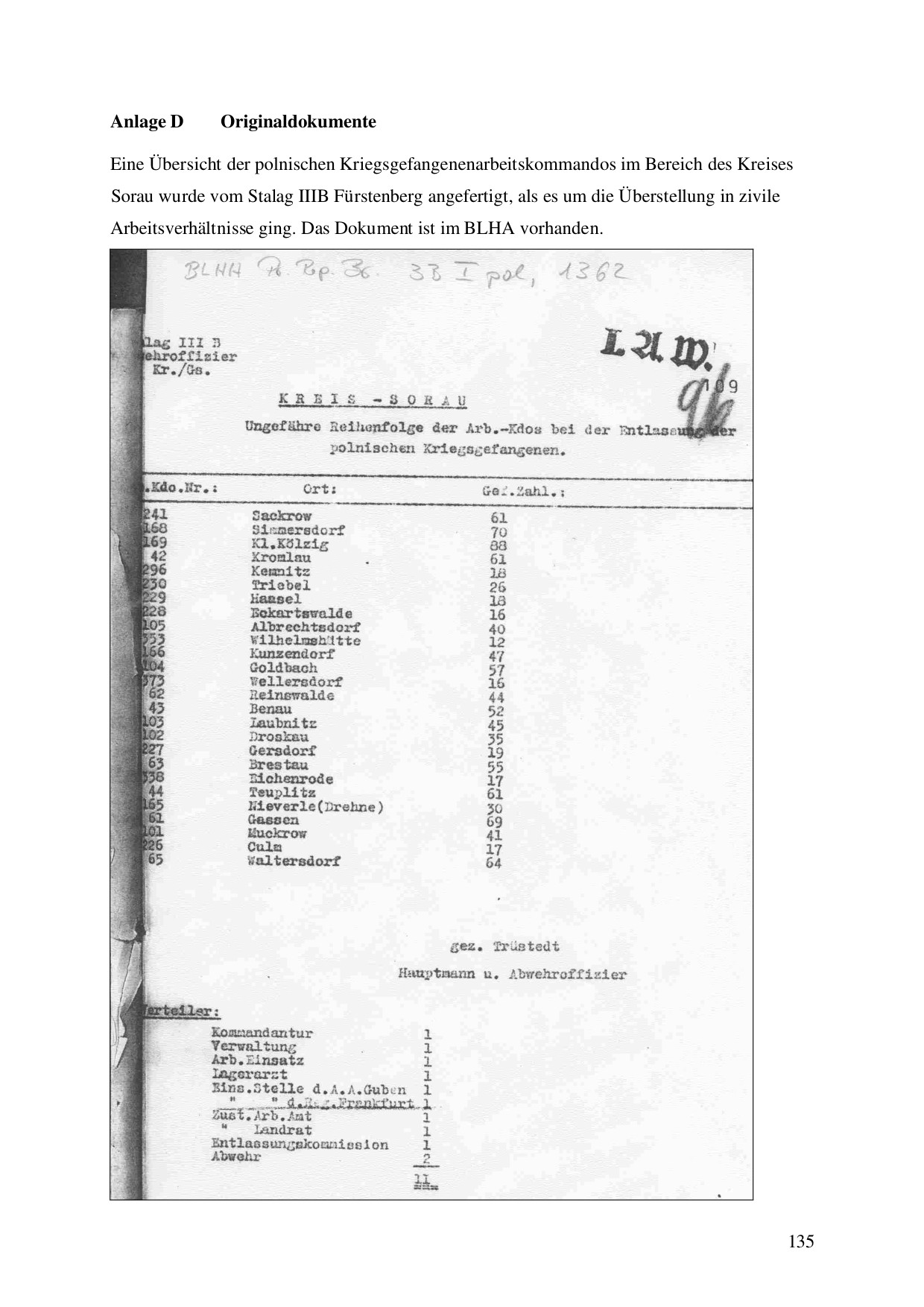
Source page 136 / 151
Compare with the original PDF →
Appendix D. Original documents
Planning for the deployment of “prisoners from the West” in the Sorau district began while preparations were being made to transfer Polish prisoners of war to civilian-worker status. The camps at Sacro and Simmersdorf, among others, were to remain in use; their work sites lay within the present-day municipal area of Forst. (Forst Municipal Archives)
Translation of the letter dated 15 June 1940
Copy.
The district administrator — District Building Office.
Register no. IV.
Sorau, 15 June 1940.
To the Labour Office in Forst (Lausitz).
With reference to the discussions held on Thursday the 13th of this month concerning the transfer of Polish prisoners of war to the employment status of civilian workers of Polish ethnicity, I intend to continue the following work using prisoners from the West:
- Rural road construction at Guschau — 30 prisoners from the West.
- Naundorf–Sacro association — 50 prisoners from the West.
- Land drainage at Kl. Jamno — 50 prisoners from the West.
- Gebersdorf–Kemnitz road construction — 25 prisoners from the West.
Arrangements for accommodating the prisoners in the camps have already been clarified. They will be accommodated in the camps previously used for Polish prisoners. The mayors, or the Viktor mine in Kemnitz, are willing to continue maintaining the camps and to take over their management.
Accommodation would be arranged as follows:
- Guschau road construction — 30 men — camp of the town of Gassen.
- Naundorf–Sacro association — 50 men — camp of the municipality of Sacro.
- Land drainage at Kl. Jamno — 50 men — camp of the municipality of Simmersdorf.
- Gebersdorf road construction — 25 men — camp at the Viktor mine in Kemnitz.
Please apply for prisoners from the West to be assigned to the above projects and camps, and make all necessary arrangements.
It would be advantageous if the prisoners from the West could be available as soon as possible after the Poles are released.
Signed: Scheringer.
The German expression “polnische Lager” refers to camps holding Polish prisoners, not to camps administered by Poland.
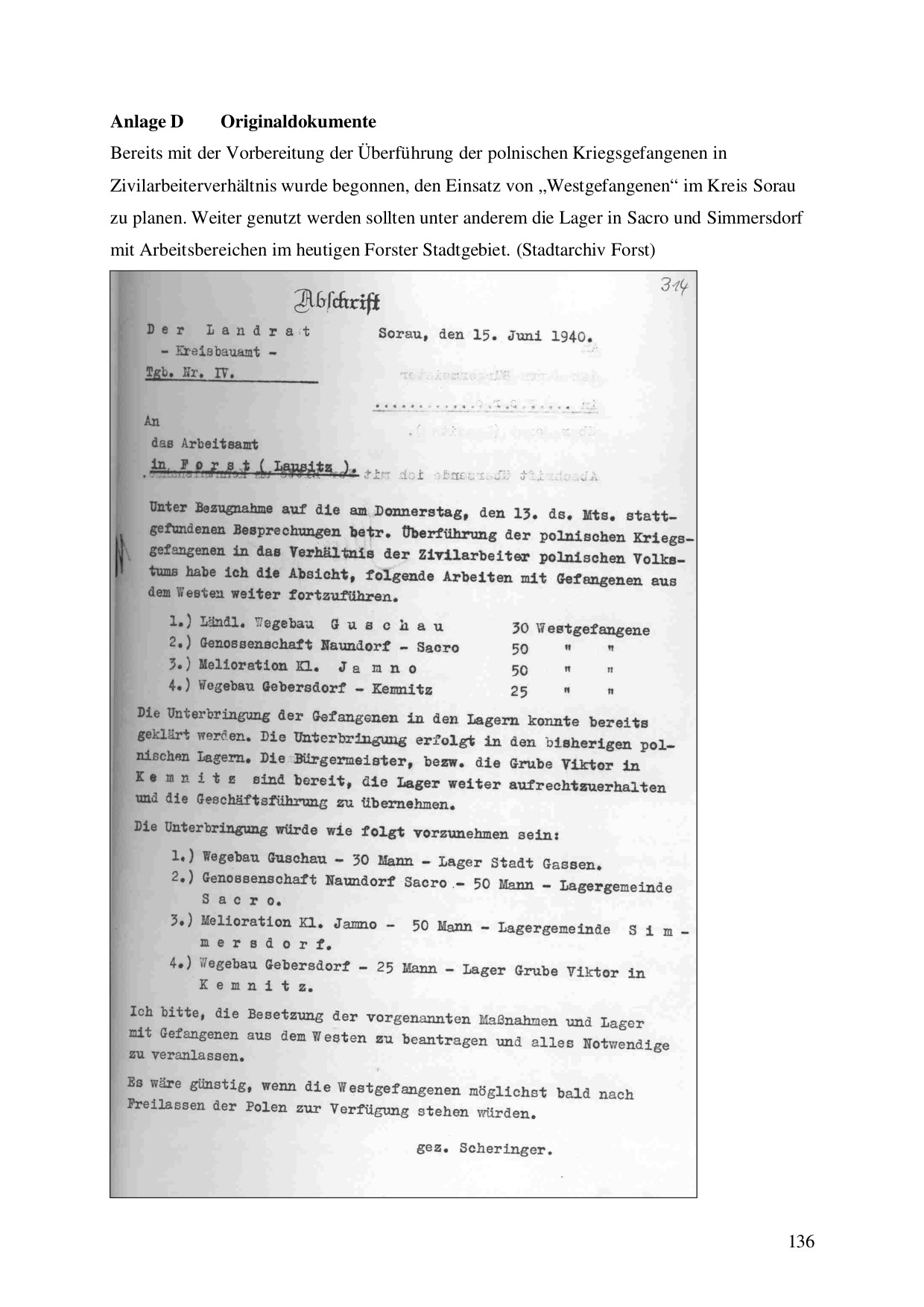
Source page 137 / 151
Compare with the original PDF →
Appendix D. Original documents
A list of camps for foreigners in the town of Forst — one, if not the only recoverable example — survived because of a special allocation of 20 grams of yeast for Soviet prisoners of war, Italian military internees and Eastern workers. It is striking, however, that the Scheuno camp does not appear. The list must therefore be considered incomplete. Sacro is also absent; at that time it did not yet form part of the town of Forst. (Forst Archives; note: the handwritten annotation “Weststr.” on the second copy was added by the author).
Translation of the letter
1. To Department IV for action [further annotation illegible].
2. Report.
To the Chief President of the Province of Mark Brandenburg — Provincial Food Office, Department B — in (2) Berlin NW 7, Karlstrasse 29.
Food Office, Department B. 18 July 1944.
Supplementary food for Italian military internees, Soviet prisoners of war and Eastern workers in camps for the 64th and 65th rationing periods.
The number of persons entitled to supplies who qualify for an allocation of dried yeast amounts here to 425.
Distribution to the individual camps will be undertaken by the colonial-goods wholesaler August Hamann in Forst (Lausitz), Hochstr. 1.
3. Resubmit on 25 July 1944.
Forst (Lausitz), 18 July 1944.
The Lord Mayor [abbreviated in the original].
Office annotations: item 1 — dealt with; item 2 — dealt with on 18 July 1944; dispatched on 18 July 1944. Other initials and some handwritten marks are illegible.
Italian military internees, Soviet prisoners of war and Eastern workers in camps
| Category | Location | Number |
|---|---|---|
| Italian military internees | Hänselhalle | 140 |
| Italian military internees | Hammer & Haebler | 22 |
| Soviet prisoners of war | Hammer & Haebler | 16 |
| Soviet prisoners of war | Gut Nossdorf | 19 |
| Eastern workers | Keune | 121 |
| Eastern workers | Rumsch & Hammer [handwritten: Weststr.] | 37 |
| Eastern workers | Bahnmeisterei | 38 |
| Eastern workers | Speer | 54 |
| Eastern workers | Windhoff | 8 |
Typewritten total: 455. Handwritten additions: +20 and 475.
Note: the letter states 425 persons, the table totals 455, and the handwritten correction gives 475. These different figures appear in the reproduced documents and have not been harmonised. “Bahnmeisterei” means a railway track-maintenance unit. Other establishment names have been retained.
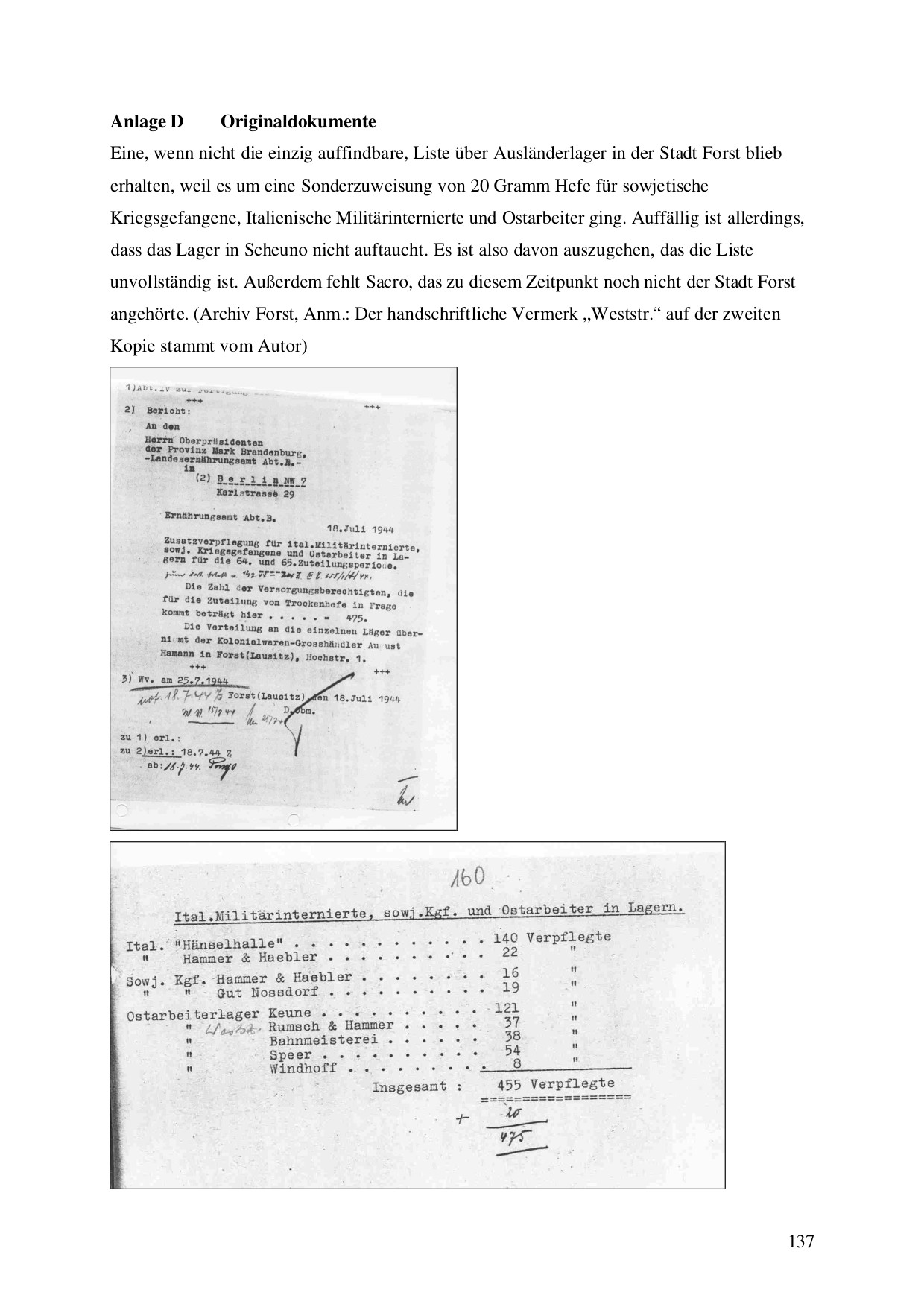
Source page 138 / 151
Compare with the original PDF →
Appendix D. Original documents
In a letter to the Lord Mayor of Forst, the Ministry for the East complained about inadequate food for children in its camp. Deaths among small children and infants had reportedly already occurred there. (Forst Municipal Archives)
Translation of the letter dated 22 December 1943
Reich Minister for the Occupied Eastern Territories.
No. 1696/43 CB/Boy/Pl..
Please quote this reference and the subject in further correspondence.
The Special Commissioner for Labour from the Occupied Eastern Territories, State Councillor Henningsen.
Berlin C 2, 22 December 1943.
Neue Königstr. 27/37.
Telephone 520018.
To the Lord Mayor in Forst/Niederlausitz.
Dear Lord Mayor,
As I learned today from desk officer Hofer, the food situation in the camp under my direction has become tolerable thanks to your kind support. However, food allocations have so far continued to be made on the “Eastern worker” basis, although, as we have already discussed, the people from Ostland housed there do not fall under the regulations for Eastern workers. Instead, they are regarded as refugees taken under German protection on account of their proven conduct during the occupation period, who were directed into employment in Germany. They must receive German camp rations, as is customary for the other workers of foreign ethnicity.
The food situation is made more difficult by the fact that workers' families, including small children and infants, had to be placed at the disposal of the firm carrying out the building work. The general rations are entirely insufficient for these children, and several deaths have already occurred, presumably not least as a result. This is unacceptable for political reasons.
Although the question of food falls within the responsibility of the firm carrying out the construction work, I considered it necessary to send some nourishing foodstuffs available to me to Forst as a temporary measure. These supplies are now nearing exhaustion.
I therefore ask you kindly to support desk officer Hofer, who will call upon you, in obtaining food for the children on the basis of the considerations I have set out.
On behalf of the Minister: [signature illegible].
Note: this translation preserves the Nazi authority's language and reasoning; these are not the editors' terms or judgements. Parts of the stamps and handwritten annotations on the copy remain illegible. The letter itself is dated 22 December 1943; the upper margin of the copy also bears the date 31 March 1944. This later annotation does not indicate the letter's date of composition.
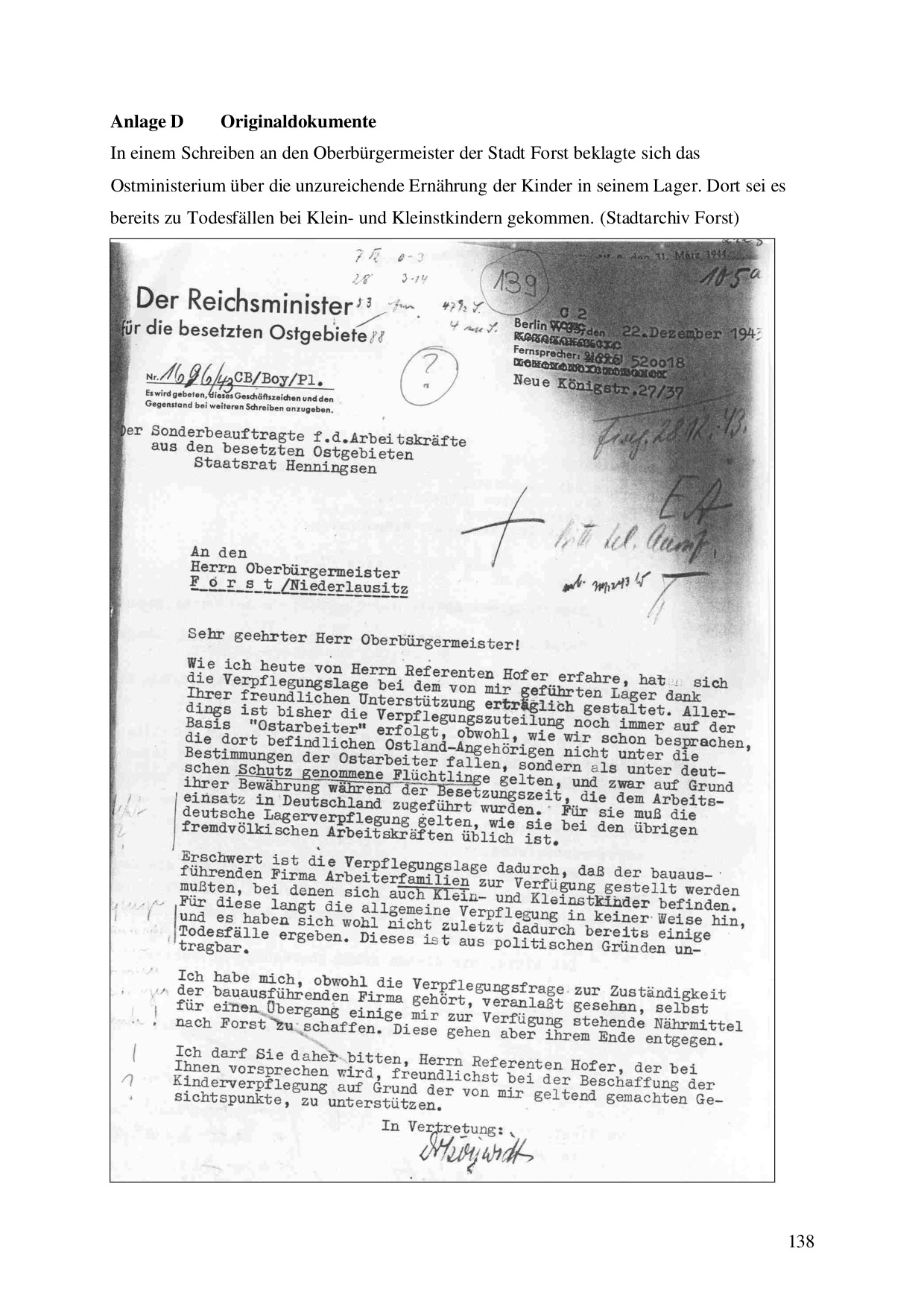
Source page 139 / 151
Compare with the original PDF →
Appendix D. Original documents
By email from Axel Drieschner / Barbara Schulz, Berlin, 6 March 2004.
Transcript. French labour detachments at Rosengarten
Political Archive of the Foreign Office, R 40991, unpaginated.
“Report on the inspection of Stalag III B Fürstenberg”. Visits to labour detachments on 15 and 16 January 1942.
Page 9:
“Detachment 748 — Rosengarten.
Prisoners' representative: Corporal FAVELIER.
Strength: 21 men.The prisoners work in a sawmill, on a farm and for a building firm. Pay ranges between 13.50 and 18 marks per month. The centrally heated accommodation is good. Food is sufficient. The clothing, recently replaced, is in good condition. The shoes are poor. The washrooms are well equipped, and the prisoners have unlimited supplies of hot and cold water. Mail arrives irregularly.”
Page 15:
“List of detachments inspected on 15 and 16 January 1942, or whose representatives were able to speak with the delegate”.
[…]
Detachment no. Location Strength Type of work Special remarks 609 Rosengarten 26 Concreting Cold accommodation 728 Rosengarten 85 Laying ballast Food somewhat scant 924 Rosengarten 20 Tree felling 94 Rosengarten 10 Agriculture 748 Rosengarten 21 Sawmill […]
[* The “prisoners' representative” column has been omitted; exclusively French names].
Supplement by email dated 26 March 2004 (summarised):
The labour detachments visited by the International Committee of the Red Cross on 15 and 16 January 1942 were located in Fürstenwalde, Jänickendorf, Guelsdorf, Ketschendorf, Frankfurt/Oder, Rosengarten, Lieberose, Holbrunn, Sta[a ]kow, Leeskow [Beeskow?], Gamlitz [Jamlitz?], Ullersdorf and Lübben. Some place names are obviously misspelled.
The author's conclusion: since almost all these places lie within the present-day districts of “Daghme Spreewald” (LDS) and “Oder-Spreewald” (LOS), a location of the Rosengarten detachments in the Forst area should be considered unlikely.
Note: uncertain place names and district-name spellings in the study have been preserved. The correct names corresponding to LDS and LOS are Dahme-Spreewald and Oder-Spree. “Present-day” belongs to the study's 2004 context.
Source page 140 / 151
Compare with the original PDF →
Appendix D. Original documents
Translation of the handwritten account for prisoner-of-war labour
Naundorf–Sacro Water and Soil Association, Sorau district, Lower Lusatia.
Naundorf, 23 January 1941.
Subject: work carried out by prisoners of war.
To the church at Sacro, for the attention of the treasurer, Mr R. Penack [?], Jähnsdorf.
According to the guard, the prisoners of war carted peat and carried out levelling work for you from 25 to 28 August and from 25 September to 9 October 1940 (list on the reverse!).
Our costs amount to 2.50 RM per man per day. You must therefore reimburse us 120 RM for 3 men over 16 days (3 × 16 × 2.50 = 120).
We expect payment by the 15th of [month ambiguous] 1941 into our account E 1 at the Savings and Loan Bank in Sacro, expressly marked “Work carried out by prisoners of war”.
Heil Hitler!
By authority: [signature uncertain], association chairman.
List of carting work
| Date | Days | Name / wording in the document | Number of POWs | Work units |
|---|---|---|---|---|
| 26.8.–28.8.1940 | 3 | Krahl | 3 | 9 |
| 25.9.–26.9.1940 | 2 | Klein Kügel [?] (Fuhrner [?]) | 3 | 6 |
| 27.9.–28.9.1940 | 2 | Wreschik [?], Otto | 3 | 6 |
| 30.9.–1.10.1940 | 2 | Lubatsch | 3 | 6 |
| 2.10.–4.10.1940 | 3 | Pastel | 3 | 9 |
| 5.10. + 7.10.1940 | 2 | Lubatsch | 3 | 6 |
| 8.10.–9.10.1940 | 2 | Schulz, Max | 3 | 6 |
Total: 16 days × 3 prisoners = 48 work units.
“Errors excepted!” [signature].
Transcription note: both letter and table are handwritten. Uncertain names are marked [?], and the illegible signature has not been reconstructed. In the letter, the August period appears to begin on 25 August, whereas the table gives 26 August; this discrepancy has been retained. The calculation 3 × 16 × 2.50 = 120 RM is legible. The Nazi greeting is reproduced solely as part of a historical document.
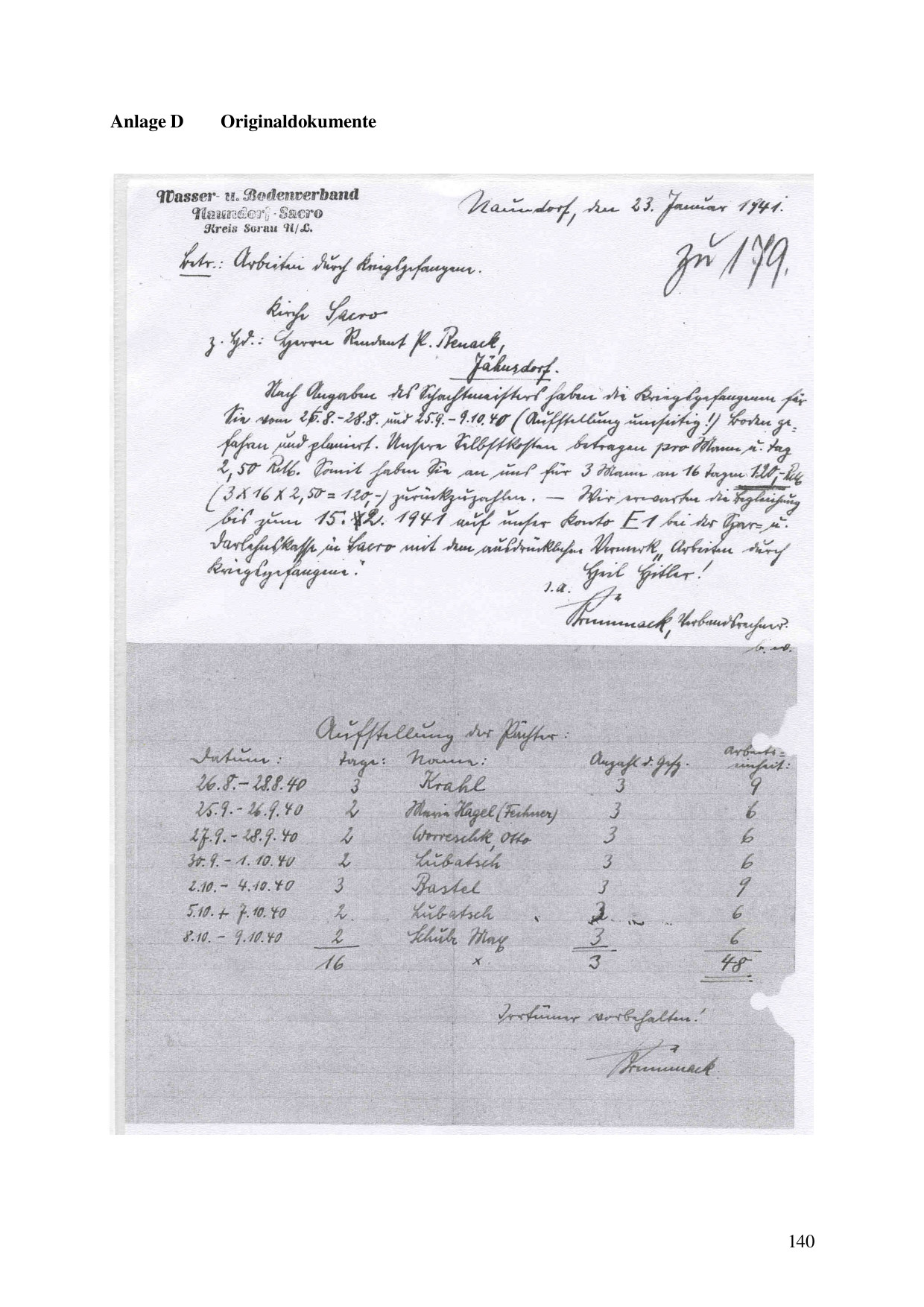
Source page 141 / 151
Compare with the original PDF →
Appendix D. Original documents
Meal card and coupons
Camp provisioning administration of Deutsche Sprengchemie. Meal card no. 530. Week 38. Name [blank]. Form code C/1749.
Two sections of card no. 530: “Lunch — Saturday — 38 — collected” and “Lunch — Sunday — 38 — collected”.
Food coupons: B — sausage 1; margarine 1; cheese 1; C — sausage 1; sugar 1; A — bread roll 1; jam 1; B — bread roll 1.
Entry pass no. 2473
Pol. II.
Armand Henen, born on 1 July 1924, from the readiness camp at Forst-Scheuno, is permitted to enter the factory premises for the purpose of taking up work.
Forst (Lausitz), 8 February 1945.
Valid until 28 February 1945.
Extended until [two blank fields].
Deutsche Sprengchemie GmbH, Forst plant.
[Signature illegible].
Employment card
Belgium. Employment card. Valid only for the workplace specified below.
Official reference: Bez. Brandenburg I/[…] / 54 [partly illegible beneath the stamp].
- Surname: Henen. Given name: Armand.
- Form field: “for women, maiden name as well”.
- Marital status: unmarried; other options on the form crossed out.
- Date of birth: 1 July 1924.
- Does the holder speak German: no.
- Sex: male; female crossed out.
- Home town: Stembert. District: [blank].
- Nationality: Belgian.
- Employed as: unskilled labourer.
- Occupational group: [blank]. Work book / replacement card number and occupational group: [blank fields].
- Business owner (employer): Deutsche Sprengchemie G.m.b.H., plant [further wording partly obscured].
- Workplace (town): Forst/L. District: Forst/L.
- Issued on 22 March 1943 [day faint in the reproduction]. Valid until 22 March 1945.
- No. 4055. Lg. Wh. West.
Form notes: (*) Delete as appropriate. (**) This employment card must be handed to the foreign national. “Turn over!”
Certificate granting town leave
Forst (Lausitz), 1 February 1945.
This is to certify that the Belgian HENEN Armand, no. 2473, from the Scheuno-Ost readiness camp has town leave on 1 February 1945 until midnight.
He is visiting comrades in Berlinerstrasse.
Scheuno-Ost readiness camp, via Forst (Lausitz). Form code C-1724.
Note: the certificate form retains the preprinted year “1944”, but the inserted date and the body of the document clearly indicate 1 February 1945. The number 2473 and the name Armand Henen occur on both the entry pass and the leave certificate. Blank fields have been preserved as blank, and indistinct stamps have not been expanded.
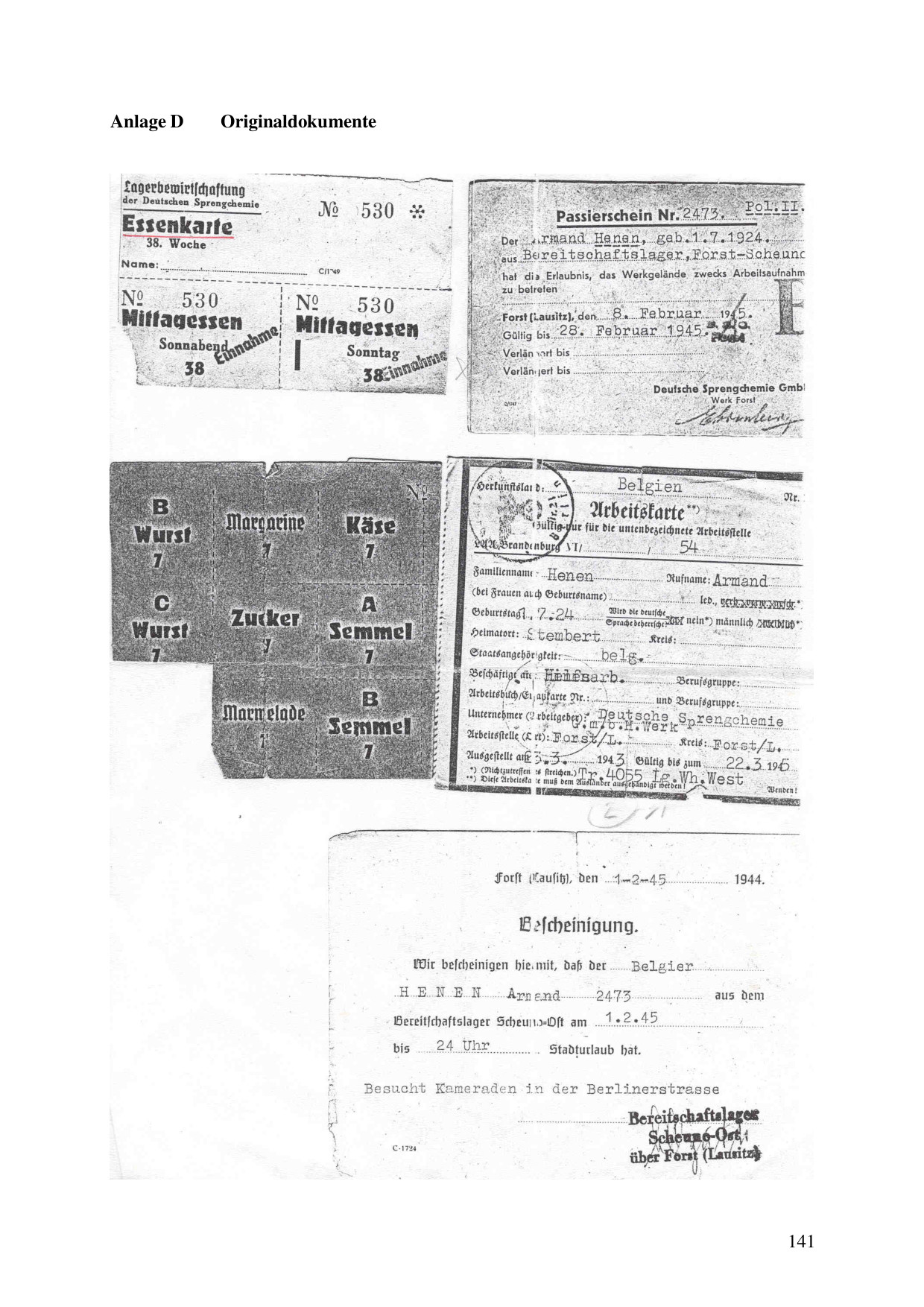
Source page 142 / 151
Compare with the original PDF →
Overview of known labour detachments in Forst
Prisoner-of-war labour detachments in Forst and the surrounding area
| No. | Designation | Location |
|---|---|---|
| 168 | Simmersdorf | Simmersdorf |
| 438 | Sacro | Sacro |
| 619 | Scheuno DSC | Forst-Scheuno |
| 634 | unknown | unknown |
| 863 | Forst-Domsdorf | Forst-Domsdorf |
| 930 | Mix & Genest | Forst |
Overview of Italian military internee labour detachments in Forst
| No. | Designation | Location |
|---|---|---|
| 105 | Hänselhalle | Forst |
| 135 | Hammer & Haebler | Forst |
Note: names and detachment numbers reproduce the author's table. No. 930 is assigned here to Mix & Genest; this entry has not been harmonised with other references in the study.
Source page 143 / 151
Compare with the original PDF →
Forced labourers buried in Forst's main cemetery
Town of Forst, Cemetery/Crematorium section, “List of adults”, excluding other cemeteries in the districts and the crematorium. As of August 2001.
| No. | Surname | Given name | Date of birth | Date of death | Nationality | Status |
|---|---|---|---|---|---|---|
| 1 | Ogorek | Stanislawa | 20.04.1924 | 01.02.1943 | PL | civilian worker |
| 2 | Balatzyk | Peter | 23.01.1924 | 01.03.1944 | — | Eastern worker |
| 3 | Klimenko | Boris | 04.02.1926 | 01.05.1944 | — | Eastern worker |
| 4 | Tschuwaschow | Gregor | 03.12.1911 | 01.06.1943 | — | Eastern worker |
| 5 | Tschikrita | Nadja | 28.10.1929 | 03.06.1944 | — | Eastern worker |
| 6 | ??? | Erik | 23.10.1923 | 04.05.1943 | — | Eastern worker |
| 7 | Rzoska | Stanislaus | 20.10.1898 | 07.10.1940 | — | agricultural worker |
| 8 | Skamaldinow | Falklistan | 28.06.1923 | 08.02.1944 | — | Eastern worker |
| 9 | Maschurenko | Wassili | 10.08.1919 | 09.08.1944 | — | Eastern worker |
| 10 | Wertybezky | Andrej | 19.11.1886 | 10.04.1944 | PL | worker |
| 11 | Sabrowsky | Antnia (née Rybnikswa) | 12.02.1918 | 13.03.1944 | — | Eastern worker |
| 12 | Kobierski | Mieczyslaw | 05.01.1928 | 13.04.1944 | — | agricultural worker |
| 13 | Gosutowicz | Olga | 20.10.1923 | 13.06.1943 | — | Eastern worker |
| 14 | Pjatschenko | Anna | 13.02.1901 | 13.11.1943 | — | Eastern worker |
| 15 | Wlodarczak | Michael | 30.08.1886 | 14.10.1944 | PL | worker |
| 16 | Starachonek | Zenja | 10.12.1922 | 15.09.1944 | — | female grinder |
| 17 | Swerinowa | Wera | 20.09.1922 | 16.01.1944 | — | Eastern worker |
| 18 | Wroblwski | Sygmund | 14.08.1921 | 16.08.1943 | PL | agricultural worker |
| 19 | Woinow | Romian | 01.01.1924 | 17.02.1943 | — | Eastern worker |
| 20 | Bernatzki | Illia | 23.08.1895 | 18.08.1944 | — | Eastern worker |
| 21 | Starschaglo | Nybola | 06.06.1906 | 19.11.1944 | — | — |
| 22 | Dudnik | Wera | 22.12.1924 | 20.12.1944 | — | Eastern worker |
| 23 | Rosogrejewa | Katharina | 05.07.1892 | 21.01.1945 | — | Eastern worker |
| 24 | Jusenka | Uljana | 03.09.1924 | 21.04.1944 | PL | worker |
| 25 | Antoniadi | Wladimir | 20.11.1918 | 22.06.1944 | — | Eastern worker |
| 26 | Babescha | Wassily | *1887 | 22.07.1944 | RUS | agricultural worker |
| 27 | Pawlaw | Wassily | 22.04.1917 | 22.12.1944 | — | Eastern worker |
| 28 | Droumka | Anna | 17.10.1925 | 24.04.1944 | — | Eastern worker |
| 29 | Bokowski | Iwan | **081898 | 24.10.1942 | — | Eastern worker |
| 30 | Pluska | Helene | 15.05.1896 | 25.07.1944 | RUS | female teacher |
| 31 | Leonow | Alexander | 15.08.1904 | 26.05.1943 | RUS | civilian worker |
| 32 | Solecka | Iwana | 18.10.1922 | 27.01.1943 | PL | civilian worker |
| 33 | Wawrowski | Tadeusz | 10.10.1920 | 27.04.1944 | PL | worker |
| 34 | Piotrowski | Franz | 14.09.1906 | 27.10.1943 | PL | worker |
| 35 | Sereda | Katharina | 23.04.1921 | 27.10.1944 | — | Eastern worker |
| 36 | Husyen | Gegic | 26.04.1915 | 28.04.1944 | KRO | worker |
| 37 | Gryzenko | Halina | 22.12.1925 | 28.05.1944 | — | Eastern worker |
| 38 | Satyga | Josef | 24.06.1918 | 28.06.1944 | PL | worker |
| 39 | Jewdcki | Samorodima | 18.06.1923 | 29.09.1943 | — | Eastern worker |
| 40 | Getter | Heinrich | 16.07.1896 | 29.12.1944 | PL | worker |
| 41 | Malinowski | Josef | 16.03.1899 | 30.06.1943 | PL | civilian worker |
| 42 | Sinitzki | Johann | 02.05.1902 | 30.06.1944 | — | Eastern worker |
| 43 | Murczan | Franz | 21.08.1913 | 31.12.1942 | PL | agricultural worker |
Table translation note: surnames and given names retain the study's spellings, including apparently corrupted forms. No nationalities or statuses have been supplied for blank fields (shown here as “—”). Legible dates printed without separators in the source have been separated with full stops in day–month–year order; the incomplete entries “*1887” and “**081898” are retained literally. PL — Poland; RUS — Russia; KRO — Croatia. “Eastern worker” translates the historical German administrative category “Ostarbeiter”. The table contains 43 people and is not a complete list of all victims of forced labour in Forst.
Source page 144 / 151
Compare with the original PDF →
List of foreigners
The following 228 foreigners are documented as having worked in Forst during the Second World War or are buried there. Cases in which the spelling of a name was unclear, varied or was illegible in the records (repository, reference number, folio; here StadtA means the Forst Town Archive) have been taken into account. Asterisks (*) indicate where a name was abbreviated or the handwriting became illegible; a question mark denotes an unknown name.
Translator’s note: names, variants, abbreviations, nationality codes and uncertainties have been retained from the author’s list. Blank fields have not been filled in, and entries with similar names have not been merged. A blank cell means that this table supplies no information. The terms in the “Status” column translate the categories recorded in the source, with the German wording retained in parentheses. This is neither exclusively a list of deceased people nor a list of confirmed fatalities.
| Surname | Given name | Nationality | Status | Source |
|---|---|---|---|---|
| Andrezak | Eugen | PL | StadtA 3037, 91 | |
| Antoniadi | Wladimir | eastern worker (Ostarbeiter) | cemetery list | |
| Asselin | Albert | F | civilian worker (Zivilarbeiter) | StadtA 2707, 29 |
| Audibert | Henri | StadtA 3230 | ||
| Babescha | Wassily | RUS | agricultural worker (Landarbeiter) | cemetery list |
| Baday | Louis | StadtA 3230 | ||
| Bakkal | Annatll. | StadtA 3230 | ||
| Balatzyk | Peter | eastern worker (Ostarbeiter) | cemetery list | |
| Baran | Stefan | eastern worker (Ostarbeiter) | StadtA 1980 | |
| Barrier | Jean | StadtA 1984, 37 | ||
| Bednarek | Wawz* | PL | StadtA A2020, 66 | |
| Bekarodow | Fedor | foreigner (Ausländer) | StadtA 3037, 100 | |
| Berko | Iwan | SU | eastern worker (Ostarbeiter) | StadtA 5307, 4 |
| Bernatzki | Illia | eastern worker (Ostarbeiter) | cemetery list | |
| Betrand | Constand | F | civilian worker (Zivilarbeiter) | StadtA 2707, 29 StadtA 3230 |
| Bloesch | Antoine | F | civilian worker (Zivilarbeiter) | StadtA 2707, 29 StadtA 3230 |
| Bodarenko | Iwa. | StadtA 3230 | ||
| Boiko | Wasilij [also: Wasily] | SU | eastern worker (Ostarbeiter) | StadtA 5307, 4 |
| Boismartel | Raphael | F | prisoner of war (Kgf) | StadtA 314 |
| Bokowski | Iwan | eastern worker (Ostarbeiter) | cemetery list | |
| Bondar | Nikolai | eastern worker (Ostarbeiter) | StadtA 1980, 7,10 | |
| Bondarenko | Iwan | eastern worker (Ostarbeiter) | StadtA 1980, 7 | |
| Bos | Januar | NL | StadtA 3037, 100 | |
| Bouillon | Georges | foreigner (Ausländer) | StadtA 3037, 100 | |
| Boulva | André (Andree) | F | civilian worker (Zivilarbeiter) | StadtA 2707, 29 StadtA 3230 |
Source page 145 / 151
Compare with the original PDF →
| Surname | Given name | Nationality | Status | Source |
|---|---|---|---|---|
| Bouton | Arthemy | StadtA 3230 | ||
| Brachet | Lucien | StadtA 3230 | ||
| Browka | Denja | eastern worker (Ostarbeiter) | StadtA 1980, 7,10 | |
| Buillon | Georges | StadtA 1984, 37 | ||
| Bulatoff | Demjan | eastern worker (Ostarbeiter) | StadtA 1980, 7 | |
| But | Fedir | eastern worker (Ostarbeiter) | StadtA 1980, 7, 9 | |
| Cattégne | Maurice | F | civilian worker (Zivilarbeiter) | StadtA 2707, 29 |
| Ceng | Alfred | foreigner (Ausländer) | StadtA 3037, 100 | |
| Champ | Arthur | F | prisoner of war (Kgf) | StadtA, 314 |
| Chatalain | Eduard (Eduorard) | foreigner (Ausländer) | StadtA 3037, 100 1984, 37 | |
| Chuchro | Peter | StadtA 3230 | ||
| Cisterne | Andre | StadtA 3230 | ||
| Colas | Albert | F | prisoner of war (Kgf) | StadtA, 314 |
| Colgajewski | Ma. | StadtA 3230 | ||
| Comble | Arthur | StadtA 3230 | ||
| De Bastiani | Raymond | I | StadtA 3037, 66 | |
| de Nooyer | Louwrenz | StadtA 1984, 37 | ||
| Deboffle | Andr. | StadtA 3230 | ||
| Degtjareff | Iwan | eastern worker (Ostarbeiter) | StadtA 1980, 7, 10 | |
| Depecher | Marc | StadtA 3230 | ||
| Djatschenko | Iwan | Rus | civilian worker (Zivilarbeiter) | StadtA 2702, 4 |
| Donis | P* | F | Pusch postcard | |
| Donziech | Erne | StadtA 3230 | ||
| Drosdow | Wasil (Wasel.) | eastern worker (Ostarbeiter) | StadtA 1980, 7 StadtA 3230) | |
| Droumka | Anna | eastern worker (Ostarbeiter) | cemetery list | |
| Dudnik | Wera | eastern worker (Ostarbeiter) | cemetery list | |
| Dupont | Jules | F | prisoner of war (Kgf) | StadtA, 314 |
| Fedlitzki | Bohslaw | eastern worker (Ostarbeiter) | StadtA 2707, 47 | |
| Fkorik | Elia | eastern worker (Ostarbeiter) | StadtA 2707, 47 | |
| G[ra]dus | Waclaw | PL | StadtA 1984, 69 | |
| Gang | Alfred | StadtA 1984, 37 |
Source page 146 / 151
Compare with the original PDF →
| Surname | Given name | Nationality | Status | Source |
|---|---|---|---|---|
| Gaudard | Reme | StadtA 3230 | ||
| Gendre | Reymon | StadtA 3230 | ||
| Getter | Heinrich | PL | worker (Arbeiter) | cemetery list |
| Girontschuk | Alexander | eastern worker (Ostarbeiter) | StadtA 1980, 7,10 | |
| Giroud | Raymon. | StadtA 3230 | ||
| Golberski | Wladislaus | PL | StadtA 2020, 66 | |
| Gorski | Kasimir | StadtA 3037, 97 | ||
| Gorski | Bonifacy | PL | StadtA 3037, 72 | |
| Gorski | Anton | PL | StadtA A2020, 66 | |
| Gosutowicz | Olga | eastern worker (Ostarbeiter) | cemetery list | |
| Goujon | Marcel | F | civilian worker (Zivilarbeiter) | StadtA 2707, 29 StadtA 3230 |
| Grabenjuk [also: Grebenjuk] | Iwan | StadtA 3037, 96 StadtA 1984, 84,96 | ||
| Gradus | Waclaw | PL | eastern worker (Ostarbeiter) | StadtA 3037, 69 |
| Graezyk | Stefan | PL | StadtA A2020, 66 | |
| Graschdanow | Paul | eastern worker (Ostarbeiter) | StadtA 2707, 47 | |
| Gruschinsky | Josef ? | StadtA 3037, 96 | ||
| Gryzenko | Halina | eastern worker (Ostarbeiter) | cemetery list | |
| Gumulka | Josef | PL | StadtA A2020, 66 | |
| Gygan | Bolislaw | PL | StadtA 1984, 66 | |
| Haiwliga | Niokola | eastern worker (Ostarbeiter) | StadtA 1980, 7 | |
| Hameury | Andre | foreigner (Ausländer) | StadtA 3037, 100 | |
| Henen | Armand | B (Wal) | foreigner (Ausländer) | document |
| Herbert | Marcel | F | civilian worker (Zivilarbeiter) | StadtA 2707, 29 |
| Holuk | eastern worker (Ostarbeiter) | StadtA A2702, 86 | ||
| Hop | Willem | NL | Dutchman (Holländer) | StadtA 3037, 44 |
| Houdoire | Rene | StadtA 3230 | ||
| Hubert | Pierre | F | civilian worker (Zivilarbeiter) | StadtA 2707, 29 |
| Husyen | Gegic | KRO | worker (Arbeiter) | cemetery list |
| Isajew | Efim | Rus | civilian worker (Zivilarbeiter) | StadtA 2707, 4 |
| Jablonski | Johann | eastern worker (Ostarbeiter) | StadtA 1980, 7 StadtA 3230 |
Source page 147 / 151
Compare with the original PDF →
| Surname | Given name | Nationality | Status | Source |
|---|---|---|---|---|
| Jantschewskaja | Elena | RUS | female doctor from the East (Ost-Ärztin) | StadtA 5727 |
| Jardin | Jean | StadtA 3230 | ||
| Jasinski | Franz | PL | StadtA 1984, 67 | |
| Jaworski | Johann | returnee (Rückkehrer) | StadtA 2462, 52 | |
| Jaworski | Geslawa | returnee (Rückkehrer) | StadtA 2462, 52 | |
| Jaworski | Johanna | returnee (Rückkehrer) | StadtA 2462, 52 | |
| Jaworski | Weslawa | returnee (Rückkehrer) | StadtA 2462, 52 | |
| Jewdcki | Samorodima | eastern worker (Ostarbeiter) | cemetery list | |
| Jossé | Alphonse | F | prisoner of war (Kgf) | StadtA 314 |
| Jurin | Viktor | eastern worker (Ostarbeiter) | StadtA 1980, 7 | |
| Jusenka | Uljana | PL | worker (Arbeiter) | cemetery list |
| Kanaschore(c)k | Wa. | eastern worker (Ostarbeiter) | StadtA 3230 StadtA 1980, 10 | |
| Kasperski | Wojcik | PL | StadtA 3037, 69 | |
| Klimenko | Boris | eastern worker (Ostarbeiter) | cemetery list | |
| Kobierski | Mieczyslaw | agricultural worker (Landarbeiter) | cemetery list | |
| Kononenko | Wera | StadtA 3230 | ||
| Kornijen | Paul | eastern worker (Ostarbeiter) | StadtA 2707, 47 | |
| Kosatschenko | Grogori | eastern worker (Ostarbeiter) | StadtA 1980, 7,9 StadtA 3230 | |
| Kowalenko | Mychajl | SU | eastern worker (Ostarbeiter) | StadtA 5307, 4 |
| Kozlowski | Anton | StadtA 3037, 96 | ||
| Krawezyk | Ignatz | PL | StadtA A2020, 66 | |
| Kroizinsky | Jurij | Rus | civilian worker (Zivilarbeiter) | StadtA 2707, 4 |
| Kryschtopa | Wladimir | Rus | civilian worker (Zivilarbeiter) | StadtA 2707, 4 |
| Kubiak | Wladislaw | StadtA 1984, 37 | ||
| Kubik | Wojciech | StadtA 3037, 96 | ||
| Kultschinski | Nikolai | eastern worker (Ostarbeiter) | StadtA 1980, 7,10 | |
| Kwizinsky | Jury | Rus | civilian worker (Zivilarbeiter) | StadtA 2707, 8 |
| Laine | Léon | F | prisoner of war (Kgf) | StadtA, 314 |
| Lalanne | Jack | StadtA 1984, 37 | ||
| Laschpagier | Wasil | eastern worker (Ostarbeiter) | StadtA 2707, 47 | |
| Laschpagier | Iwan | eastern worker (Ostarbeiter) | StadtA 2707, 47 |
Source page 148 / 151
Compare with the original PDF →
| Surname | Given name | Nationality | Status | Source |
|---|---|---|---|---|
| Lasor | (?) | eastern worker (Ostarbeiter) | StadtA 1980, 10 | |
| Lasurenko | Oleksander | Rus | civilian worker (Zivilarbeiter) | StadtA 2707, 4 |
| Lawrenow | Afar(a)ssfew | eastern worker (Ostarbeiter) | StadtA 1980, 7 StadtA A2100 | |
| Lecomte | Henri | F | prisoner of war (Kgf) | StadtA, 314 |
| Ledoux | Roland | F | civilian worker (Zivilarbeiter) | StadtA 2707, 29 StadtA 3230 |
| Leonow | Alexander | RUS | civilian worker (Zivilarbeiter) | cemetery list |
| Leprince | Jean | StadtA 1984, 37 | ||
| Listopadowa | Nadja | Rus | StadtA Ch/106 | |
| Losukow | Nikolaus | StadtA 3037, 70 | ||
| Lutziuk | Anton | eastern worker (Ostarbeiter) | StadtA 1980, 7,10 | |
| Lys(s)enko | Petai(t) | eastern worker (Ostarbeiter) | StadtA 3230 StadtA 1980, 8, 10 | |
| Lysak | Alesuj | Rus | civilian worker (Zivilarbeiter) | StadtA 2707, 4 |
| M[a]wtschan | Myk[o]la | Rus | civilian worker (Zivilarbeiter) | StadtA 2707, 4 |
| Maleze | Rene | StadtA 1984, 37 | ||
| Malinki | Fedor | eastern worker (Ostarbeiter) | StadtA 2707, 47 | |
| Malinowski | Josef | PL | civilian worker (Zivilarbeiter) | cemetery list |
| Marchese | Cosimo | I | civilian worker (Zivilarbeiter) | StadtA 1984, 50 |
| Markowski | Michael | eastern worker (Ostarbeiter) | StadtA 1980, 8,9 StadtA 3230 | |
| Maschurenko | Wassili | eastern worker (Ostarbeiter) | cemetery list | |
| Michel | René | F | civilian worker (Zivilarbeiter) | StadtA 2707, 29 |
| Milleville | Herm. | StadtA 3230 | ||
| Morel | Gabriel | F | civilian worker (Zivilarbeiter) | StadtA 2707, 29 |
| Mowtschan | Mykola | SU | eastern worker (Ostarbeiter) | StadtA 5307, 4 |
| Mrozowsky | Michael | PL | StadtA 2020, 66 | |
| Murczan | Franz | PL | agricultural worker (Landarbeiter) | cemetery list |
| Naiwliga | Nikoly | StadtA 3230 | ||
| Nalo(s)chikowski [also: Malochowski] | Peter | eastern worker (Ostarbeiter) | StadtA 1980, 8,10 StadtA 3230 | |
| Nooyer | Louwrens de | foreigner (Ausländer) | StadtA 3037, 100 |
Source page 149 / 151
Compare with the original PDF →
| Surname | Given name | Nationality | Status | Source |
|---|---|---|---|---|
| Nowicki | Ignatz | PL | StadtA A2020, 66 | |
| Ochwat | Andre | SU | eastern worker (Ostarbeiter) | StadtA 5307, 4 |
| Ogorek | Stanislawa | PL | civilian worker (Zivilarbeiter) | cemetery list |
| Onyschtschuk | Peter | eastern worker (Ostarbeiter) | StadtA 1980, 8,10 | |
| Pawlaw | Wassily | eastern worker (Ostarbeiter) | cemetery list | |
| Pawluk | Nikola | eastern worker (Ostarbeiter) | StadtA 1980, 8 StadtA 3230 | |
| Peron | Renk | F | civilian worker (Zivilarbeiter) | StadtA 2707, 29 |
| Petriepschenko | Wladislaus | eastern worker (Ostarbeiter) | StadtA 2707, 47 | |
| Piechota | Josef | PL | StadtA A2020, 66 | |
| Piko | Andre | eastern worker (Ostarbeiter) | StadtA 2707, 47 | |
| Pilipenko | Wlachimir | SU | eastern worker (Ostarbeiter) | StadtA 5307, 4 |
| Piotrowski | Franz | PL | worker (Arbeiter) | cemetery list |
| Piskunow | Michael | eastern worker (Ostarbeiter) | StadtA 2707,47+RS | |
| Pjatschenko | Anna | eastern worker (Ostarbeiter) | cemetery list | |
| Pluska | Helene | RUS | cemetery list | |
| Popow [also: Poposo] | Grigori | Rus | civilian worker (Zivilarbeiter) | StadtA 2707, 4+l 8 |
| Powerk | Dimitri | eastern worker (Ostarbeiter) | StadtA 2707, 47 | |
| Praussu | Jean | F | prisoner of war (Kgf) | StadtA, 314 |
| Propp-Russin | Al. | StadtA 3230 | ||
| Przygodske | Wachaus | PL | StadtA A2020, 66 | |
| Quvré [also: Quvre] | René | F | civilian worker (Zivilarbeiter) | StadtA 2707, 29 StadtA 3230 |
| Rachuba/Rackuba | Artem/Arten) | eastern worker (Ostarbeiter) | StadtA 3230 StadtA 1980 8+10 | |
| Rams | Januar | StadtA 3230 | ||
| Rebours | Henry | StadtA 1984, 37 | ||
| Relich | Josef | PL | StadtA A2020, 66 | |
| Remerand | Marcel | StadtA 3230 | ||
| Remesowski | Alexej | eastern worker (Ostarbeiter) | StadtA 1980, 8+10 | |
| Roslofski | Alexander | eastern worker (Ostarbeiter) | StadtA 2707, 47 | |
| Rosogrejewa | Katharina | eastern worker (Ostarbeiter) | cemetery list |
Source page 150 / 151
Compare with the original PDF →
| Surname | Given name | Nationality | Status | Source |
|---|---|---|---|---|
| Rozé | Emilie | F | civilian worker (Zivilarbeiter) | StadtA 2707, 29 |
| Runst | Romain van | B | StadtA 3037, 98 | |
| Rzoska | Stanislaus | agricultural worker (Landarbeiter) | cemetery list | |
| Sabrowsky | Antnia | eastern worker (Ostarbeiter) | cemetery list | |
| Samoilowitsch | Iwan | eastern worker (Ostarbeiter) | StadtA 1980 8/9 StadtA 3230 | |
| Satyga | Josef | PL | worker (Arbeiter) | cemetery list |
| Schewtschenko | Michajl | SU | eastern worker (Ostarbeiter) | StadtA 5307, 4 |
| Schischko | Nikolai | eastern worker (Ostarbeiter) | StadtA 1980, 8+10 | |
| Scholatin [also: Scholotin] | Wladimir | eastern worker (Ostarbeiter) | StadtA 2707, 47 | |
| Schuljack | Andrej | eastern worker (Ostarbeiter) | StadtA 1980, 8+9 | |
| Sereda | Katharina | eastern worker (Ostarbeiter) | cemetery list | |
| Sermet | Jules | StadtA 3230 | ||
| Sienkio(-e)witsch | Wladimir | eastern worker (Ostarbeiter) | StadtA 1980, 8+10 | |
| Sigonnieere | Roger | StadtA 3230 | ||
| Sinitzki | Johann | eastern worker (Ostarbeiter) | cemetery list | |
| Sinkiwitsch | Wladimi. | StadtA 3230 | ||
| Skamaldinow | Falklistan | eastern worker (Ostarbeiter) | cemetery list | |
| Solecka | Iwana | PL | civilian worker (Zivilarbeiter) | cemetery list |
| Solomka | Hrihnor | SU | eastern worker (Ostarbeiter) | StadtA 5307, 4 |
| Starachonek | Zenja | cemetery list | ||
| Starschaglo | Nybola | cemetery list | ||
| Stasiak | Johann | PL | StadtA A2020, 66 | |
| Strokon | Grigori | SU | eastern worker (Ostarbeiter) | StadtA 5307, 4 |
| Strokonin | Nikolai | SU | eastern worker (Ostarbeiter) | StadtA 5307, 4 |
| Susset | Georges | F | civilian worker (Zivilarbeiter) | StadtA 2707, 29 StadtA 3230 |
| Suszwedyk | Anton | PL | StadtA 3037, 62 | |
| Swada | Iwan | SU | eastern worker (Ostarbeiter) | StadtA 5307, 4 StadtA 1980, 8 StadtA 3230 |
Source page 151 / 151
Compare with the original PDF →
| Surname | Given name | Nationality | Status | Source |
|---|---|---|---|---|
| Swerinowa | Wera | eastern worker (Ostarbeiter) | cemetery list | |
| Szewezyk | Wladislaus | PL | StadtA A2020, 66 | |
| Tarjamjk | Wasiyl | SU | eastern worker (Ostarbeiter) | StadtA 5307, 4 |
| Thibault | Maurice | F | civilian worker (Zivilarbeiter) | StadtA 2707, 29 |
| Thiollier | Germain | F | prisoner of war (Kgf) | StadtA, 314 |
| Tkazschenko | Fedir | eastern worker (Ostarbeiter) | StadtA 1980, 8+9 | |
| Trozinsky | Stanislaus | StadtA 3037, 97 | ||
| Tschikrita | Nadja | eastern worker (Ostarbeiter) | cemetery list | |
| Tschuwaschow | Gregor | eastern worker (Ostarbeiter) | cemetery list | |
| Verlier | Claude | F | prisoner of war (Kgf) | StadtA, 314 |
| Vion | Louis | F | civilian worker (Zivilarbeiter) | StadtA 2707, 29 |
| Wawrowski | Tadeusz | PL | worker (Arbeiter) | cemetery list |
| Wertybezky | Andrej | PL | worker (Arbeiter) | cemetery list |
| Wester | Piet | NL | Stadt 3037, 100 | |
| Wi[c]krucki | Zygmund | PL | StadtA 1984, 66 | |
| Wielgos | Stefan | SU | child of eastern workers (Ostarbeiterkind) | StadtA 2702, 84 |
| Witwa | Alexander | eastern worker (Ostarbeiter) | StadtA 1980, 8+10 | |
| Wlodarczak | Michael | PL | worker (Arbeiter) | cemetery list |
| Woinow | Romian | eastern worker (Ostarbeiter) | cemetery list | |
| Woloschtschek | Pascha | eastern worker (Ostarbeiter) | StadtA 1980, 8 | |
| Wroblwski | Sygmund | PL | agricultural worker (Landarbeiter) | cemetery list |
| Wrzosek | Josef | PL | StadtA A2020, 66 | |
| Wynnyk | Oleksiy | SU | eastern worker (Ostarbeiter) | StadtA 5307, 4 |
| Zehelnyk | Wasil | SU | eastern worker (Ostarbeiter) | StadtA 5307, 4 |
| Zjn[e]h/Zjuch | Mychajl | SU | eastern worker (Ostarbeiter) | StadtA 5307, 4 |
| ? | Erik | eastern worker (Ostarbeiter) | cemetery list | |
| ? | Josef | PL | Natusch, p. 46 |