
About the source
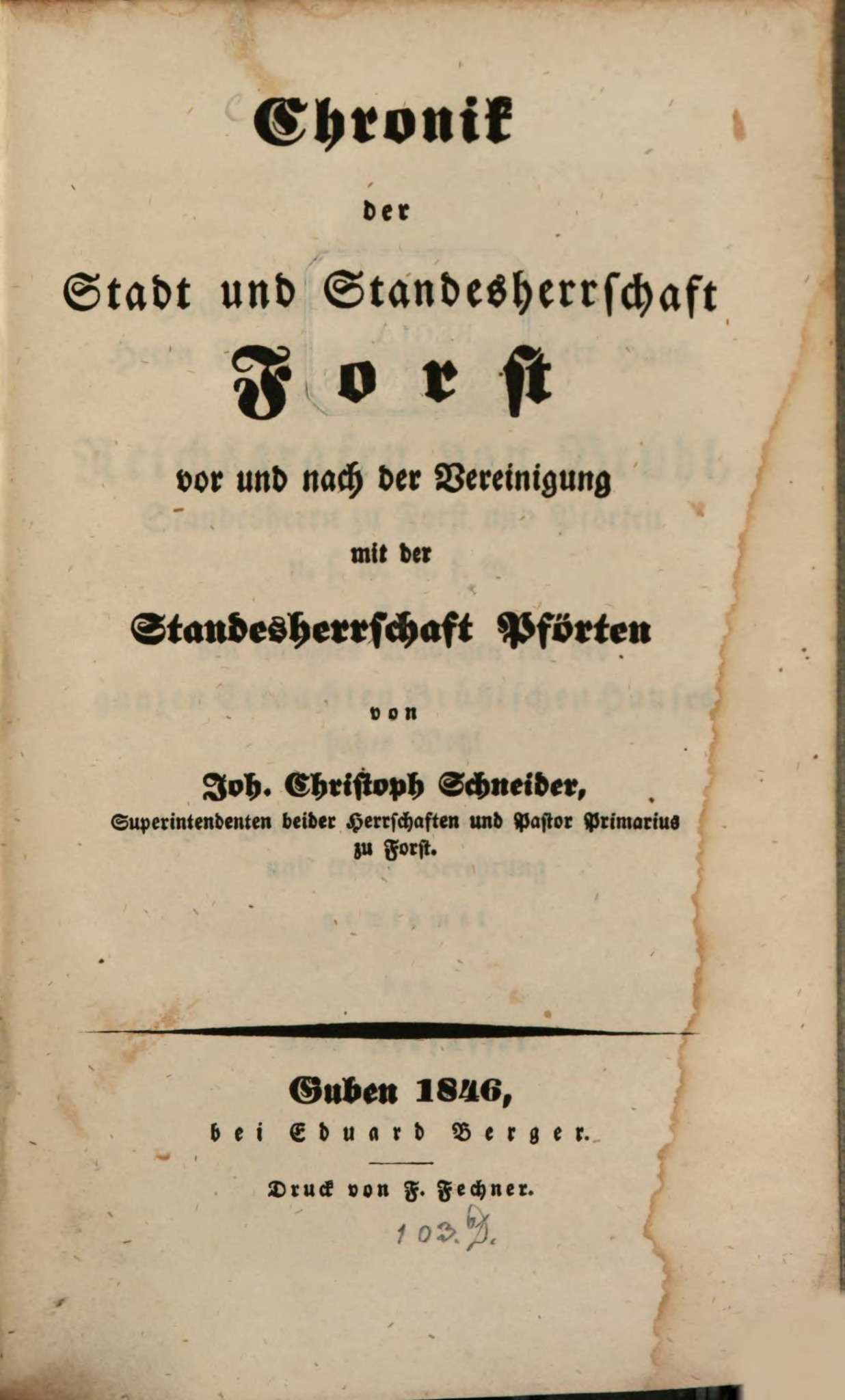
This account is based on Johann Christoph Schneider’s Chronik der Stadt und Standesherrschaft Forst vor und nach der Vereinigung mit der Standesherrschaft Pförten, published in Guben in 1846 by Eduard Berger and printed by F. Fechner. It is the English version of a Polish-language discussion of selected passages, not a complete or literal translation of the whole book. Historical names have been retained where they help identify places.
The river that shaped settlement
Today’s international border cuts through a landscape that functioned for centuries as a single economic and social area. Roads, bridges, mills, fields, churches and patterns of ownership connected Forst, Berge, Scheuno and their neighbouring settlements. The Lusatian Neisse lay at the heart of this story. Its waters powered industrial equipment but threatened buildings and crops during floods.
Schneider cites an older account according to which a large weir was built and a new channel dug around 1380 near Scheuno, at the site of the later New Mill and large iron hammer works. Water directed towards the castles and the town was intended to supply the mills while also strengthening Forst’s defences. Embankments and ditches were enlarged as well. The chronicler describes their course through the vicinity of Altforst, the fields of Koine and the town’s former vineyards.
These structures did not remove the danger. During the great flood of 18 August 1595, the water broke through the embankment at the so-called deep ditch and spread widely towards Eulo. In subsequent centuries, ice jams and rising waters destroyed bridges, cut off settlements and interrupted milling. In 1655, floating ice swept away bridges on the road to Scheuno and near the hammer works and brickworks, among others, while also flooding Berge. A similar disaster in July 1703 again destroyed the bridge to Scheuno, the bridge beside the brickworks and other crossings. Water even entered the cemetery and disturbed graves.
The great iron hammer on the Neisse
One of the most interesting features of the former industrial landscape was Neißhammer, a water-powered iron-smelting and forging works. The chronicle places it near the New Mill upstream of Forst, not far from Scheuno. This was more than a small village blacksmith’s workshop. According to Schneider, the works had two smelting installations and a forge. Its listed workforce comprised an ironworks clerk or official, a hammer master, a blacksmith, two smelters, three workers handling the furnace charge, four workers extracting raw material and two charcoal burners.
Apparently minor references also reveal the works’ economic importance. In 1617, the chronicle records the punishment of a thief who had taken several iron bars from Neißhammer. Following a later division of the estates, income from the works, like that from the mills, remained subject to shared rights held by the owners of the separated portions of the former lordship. In 1740, the hammer works on the Neisse and the vineyard at Scheuno were listed among the assets transferred to the Pförten estate acquired by Heinrich von Brühl.
In the nineteenth century, the former Neißhammer site found a new purpose. The chronicler describes how Jeschke’s spinning mill, established in 1821, was moved from the castle and an adjoining factory building to the former hammer works beside the New Mill. This demonstrates the continuous use of an industrial location: from water-powered iron production to an increasingly mechanised textile industry.
The vineyard on Scheuno’s hill
Before modern industrialisation, the area around Forst was also a wine-growing landscape. Schneider recalls that local vineyards survived the Thirty Years’ War but subsequently declined. One notable exception was the manorial vineyard near Scheuno, which still existed in the chronicler’s lifetime, although it had become much smaller.
Accounts from the Bieberstein period describe annual yields sometimes exceeding one hundred quarters of wine, a considerable proportion of which was sold in Forst. The chronicle also preserves an anecdote about the 1592 and 1602 vintages from Scheuno’s hill. At a feast in 1613, the guests drank this wine for many hours. After leaving the house, one nobleman struck his head against a wall and died. This is an account of social life reported by the author, not evidence establishing an exact volume of wine production.
Four winegrowers worked in the vineyard. They received cash wages and substantial payments in kind, including butter, grain, beer, cheese, salt, an animal for slaughter and vegetable plots. The detail of this list shows that the vineyard was an organised operation requiring regular work, not merely a small garden plantation. The names Weinberg and Scheuno’scher Weinberg are therefore important clues when studying old maps, estate boundaries and surviving traces in the landscape.
Wars passing through Berge and Scheuno
During the Thirty Years’ War, the area repeatedly experienced troop movements and billeting. In August 1626, large imperial forces under Wallenstein reached Forst. The chronicle associates their passage with heavy burdens on neighbouring villages and describes an epidemic and a catastrophic town fire after the army’s departure. When Wallenstein returned on 20 August 1627, there was not enough accommodation in the buildings. Some soldiers camped between Berge and Scheuno, and the townspeople were required to supply them with food and drink.
The year 1642 was equally dramatic. The chronicler mentions raiders approaching from Guben and crossing the Neisse between Jahnsdorf and Berge. During the war, inhabitants fled with their belongings and lost animals, food and documents. In 1645, a fire that began in Forst spread to Berge and destroyed most of the village. Among the buildings that survived were two manorial farms, the parsonage, some other houses, the mill and the village church. Schneider also records a tragic incident from the same period: a girl from Scheuno was reportedly killed by a wolf.
Sorbian communities and everyday life
Berge and Scheuno were more than points on an estate map. The chronicle repeatedly describes them as communities taking part in religious life, maintaining churches and supporting the local economy. The chapel of St Gotthard stood in the old cemetery outside the Mill Gate and was associated with the inhabitants of Berge, Scheuno and the mill suburb. Schneider gives a tradition that dates its foundation to around 1300. This should be treated as a chronicle’s account rather than a securely established foundation date.
In 1653, residents of the surrounding villages were required to contribute towards new bells. Payments depended on their economic status: full farmers, gardeners and smallholders paid different amounts. An episode from early 1660 is particularly revealing. Sorbian worshippers from Koine, Scheuno, Berge, Altforst and neighbouring farms asked for afternoon services to be restored in their church. Their petition was rejected, and the services did not resume until many years later. The account reveals a distinct linguistic and religious community attempting to protect its religious practices.
Village economic life was regulated by estate owners and urban guilds. A brewing agreement of 1657 granted Forst’s burghers the right to supply beer to Berge and Scheuno, including their manorial farms, mills and sheep farms, among other places. An attempt to sell beer from Pförten there in 1729 met with opposition. Such disputes reveal the connections of a local market that extended beyond today’s town boundaries.
Fires, storms and lost buildings
The chronicle records a distressing succession of nineteenth-century disasters. On 18 May 1810, a fire in Berge engulfed the properties of six farmers, five gardeners, eight smallholders and five lodgers or occupants of small houses. A woman and two children died in the flames. During a violent storm on 25 May 1830, the wind overturned two barns in the village and destroyed a cattle shed on the local manorial farm, killing eight oxen; a ninth animal later had to be put down.
The fire at Scheuno on 4 June 1833 was just as destructive. It destroyed the properties of seven farmers, one half-farmer, two gardeners and one smallholder. Two people died. Taken together with earlier floods and wars, these accounts show how repeatedly the villages’ built landscapes were reconstructed. The absence of old buildings today does not necessarily mean that a substantial settlement never existed there.
Traces of names and memory
At the end of his work, Schneider considers older Slavic names. He explains that the German names Berge, Buchholz and Erlenholz were translations of earlier Sorbian names, although he does not give their full equivalents in this passage. He also records the form “Broscheinze” for Scheuno and acknowledges that his informants could not explain its origin. This spelling should be regarded as historical evidence of how a name sounded, not as a final determination of its etymology.
Schneider’s chronicle thus portrays the former eastern bank of the Neisse not as a peripheral part of Forst but as a landscape of work, cultivation, industry and events. The iron hammer works, vineyard, bridges, mills, manorial farms and churches linked Berge and Scheuno to the town. These collected details provide a starting point for identifying places in old maps, archival documents and the present-day landscape. The account mainly concerns the period up to 1846; its findings should not be transferred directly to the history of twentieth-century factories and camps.
Historical source
Johann Christoph Schneider, Chronik der Stadt und Standesherrschaft Forst vor und nach der Vereinigung mit der Standesherrschaft Pförten, Guben 1846, published by Eduard Berger, printed by F. Fechner. Digital copy: Bayerische Staatsbibliothek / Münchener DigitalisierungsZentrum. Open the digitised chronicle.
An account prepared by the Rokita Foundation from a reading of the digital scan, allowing for possible errors in automatic recognition of the historical typeface. Anecdotes and traditions concerning place names are presented as reports made by the chronicler.