

The division on the Neisse
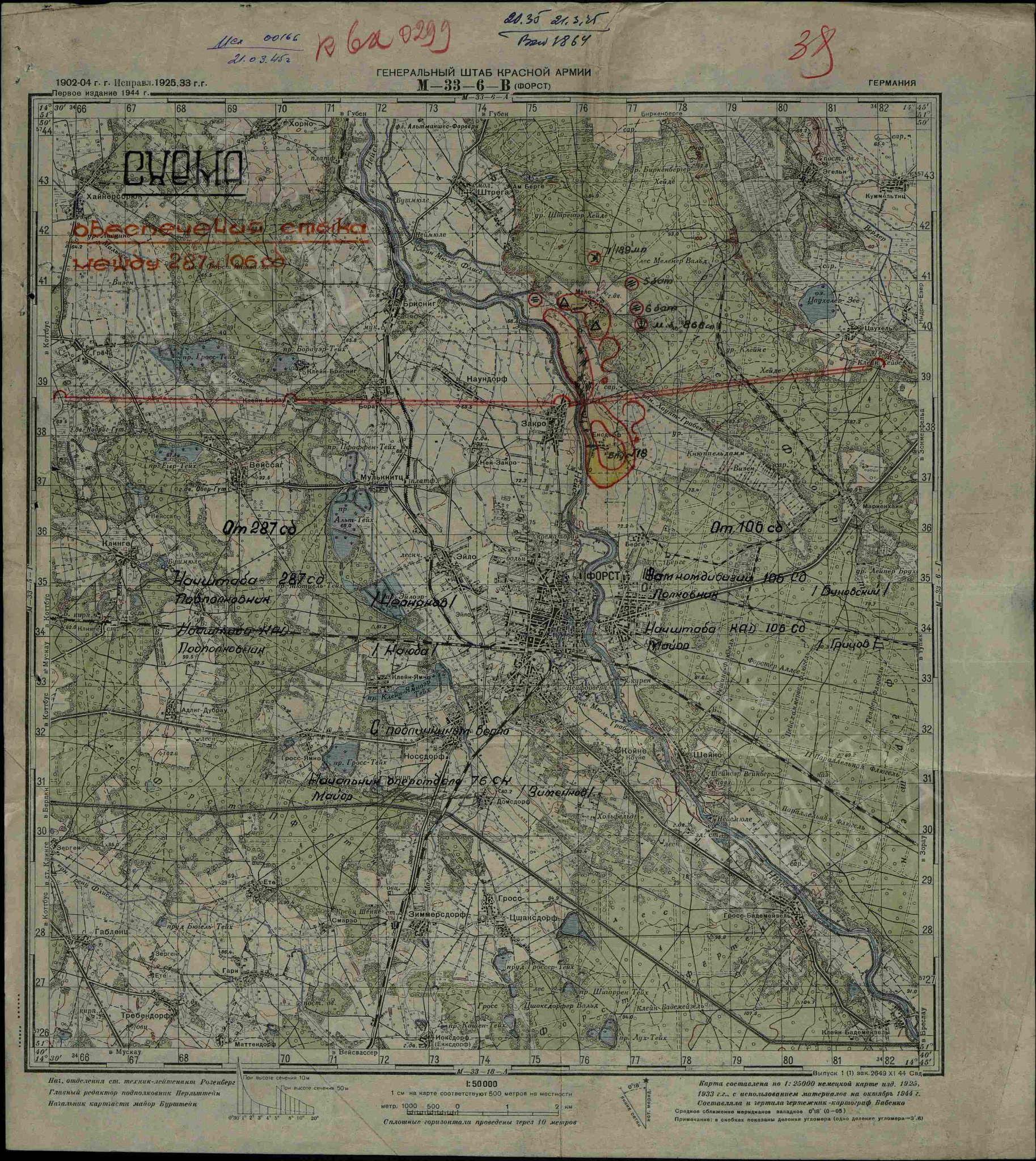
In March 1945 the 106th Rifle Division held positions on the eastern bank of the Lusatian Neisse opposite Forst. Reports describe an urban and riverside front based on bridges, embankments, eastern Forst, Berge and Scheuno. For weeks the fighting consisted mainly of observation, field engineering, sniper and artillery activity, and limited reconnaissance raids.
Units and tasks
Chronology
German counterattack
An attack on the 188th Regiment, supported by artillery and armoured vehicles, was repelled after roughly an hour. Reported casualties are treated as the unit’s own operational claim.
Order No. 069
The command demanded continuous observation, fully developed positions and systematic reconnaissance of German defences.
Bridges, Forst and Scheuno
Regiments received defined sectors; artillery was tasked with blocking reserve movements and conducting counter-battery fire.
Reconnaissance in force
A battalion of the 188th Regiment crossed the Neisse to locate fire positions and obstacles before the main offensive.
Berlin offensive begins
After artillery preparation, troops began crossing the Neisse. The records combine tactical orders, engineering activity and observation reports into a detailed account.
Source criticism
Place names are often phonetic or inconsistent in the records. Losses and claimed successes are reports by the formation itself, not independently verified statistics. Uncertain readings are marked rather than silently completed.
Pamyat Naroda – Soviet operational recordsOrders, reports and maps of the 106th Rifle Division.