

Scope and sources
The reconstruction is based on the 121st Guards Rifle Division war diary, Orders No. 023 and 024, the handwritten diary of the 313th Guards Artillery Regiment, the histories of the 340th and 342nd Guards Rifle Regiments, and staff maps. Claims about losses and destroyed enemy equipment are presented as the formation’s own reports, not independently verified totals.
Order of battle
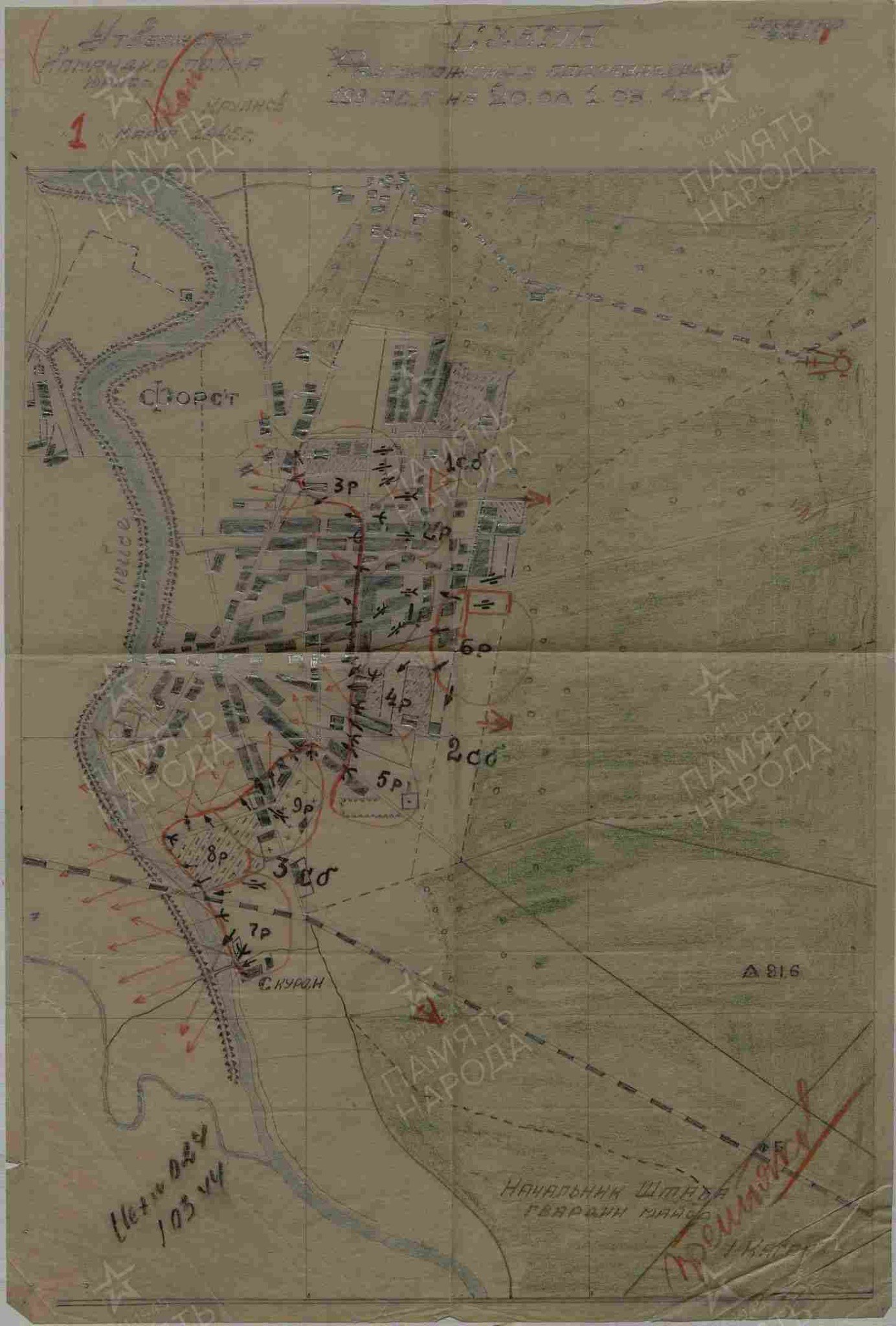
From Benau to Forst
In February 1945 the division served in the 102nd Rifle Corps of the 13th Army, 1st Ukrainian Front. After fighting around Benau and Gassen, elements reached Scheuno, the large powder-storage area and eastern Forst. The Soviet records refer to an underground powder complex but do not use the name Deutsche Sprengchemie; identification with the DSC site follows from location, maps and description.
Benau, Scheuno and the Neisse
The regiments fought out of a threatened position, reached the river and temporarily established small bridgeheads on the western bank.
Forst and the works
The 342nd Regiment’s account describes fighting for houses, floors and street blocks. Artillery was used over open sights while German counterattacks slowed the advance.
Nieder-Billau
After leaving the immediate urban sector, the division defended a new line, improved positions and prepared for further operations.
Berlin offensive
The division moved to the 24th Rifle Corps and operated in the 13th Army’s second echelon. Its records are valuable for the wider operation, although the division did not assault Forst in the first echelon on these dates.
Historical assessment
The records connect industrial and operational history: railways, works roads, woodland, bridges and the Neisse shaped movement and fire. Uncertain place names and hypotheses—such as the identity of a captured German colonel—are explicitly marked as unresolved.
Pamyat Naroda – 121st Guards Rifle Division recordsWar diaries, orders, regimental histories and maps.