
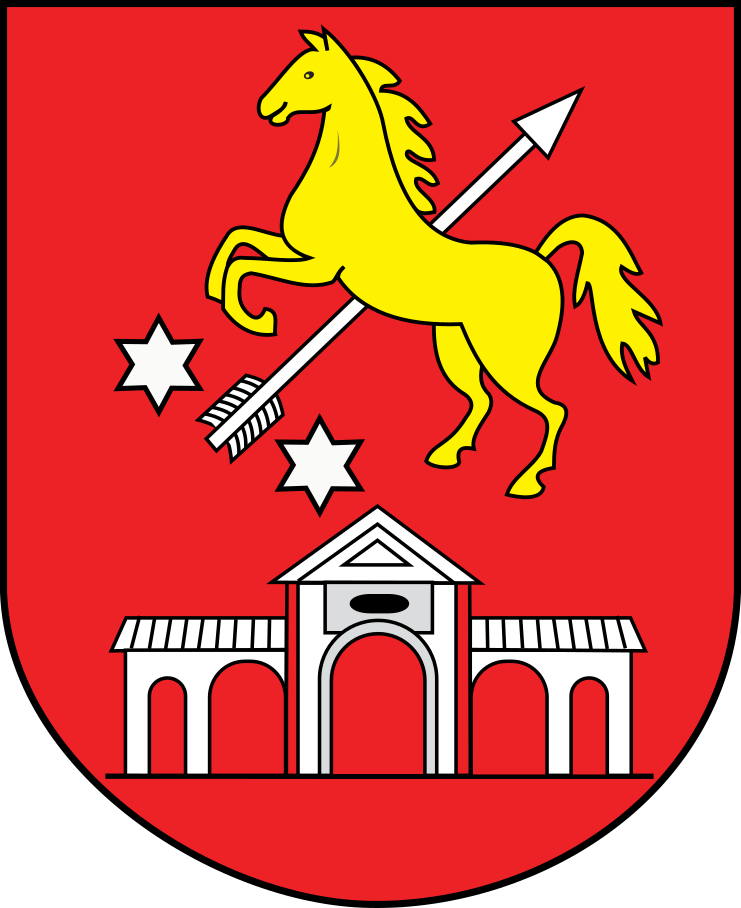
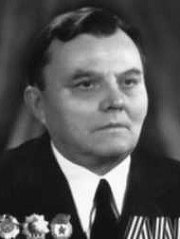
Research status: a plausible reconstruction. The matching day, area and military rank form an important circumstantial link. However, none of the Russian accounts published here names the captured officer. We therefore do not present his identification as Glase as a conclusively established fact.
Two trails leading to 22 February 1945
The German material used in the Rokita Foundation’s research refers to Willy Glase, also recorded as Willi Georg Glase. According to the Foundation’s findings to date, German records note his disappearance on 22 February 1945. The account of the fighting at Forst also cites a report that he took command of Grenadier-Regiment 698 on 21 February and was replaced by Stegmann the following day.
That brief period in command and his sudden disappearance raise the possibility that he was captured. However, the original German page recording him missing, together with its full archival reference, is not included in the present source collection. The German information is therefore attributed to the Foundation’s earlier research, pending a supporting scan, rather than presented as a newly verified transcription of a war diary.
The second trail comes from the biography of Alexei Ivanovich Dvoinoi in the Russian portal “Герои страны”. It states that on 22 February 1945, while marching on the approaches to Forst, Dvoinoi was serving in a flank guard. He encountered a group of German soldiers, opened fire, killed four and captured a German colonel. The prisoner’s name is not given. [1]
Who was Alexei Dvoinoi?
Alexei Ivanovich Dvoinoi (Алексей Иванович Двойной; 29 January 1921 – 22 December 1985) was a senior scout in the headquarters platoon of the 3rd battalion of the 313th Guards Artillery Regiment. The regiment belonged to the 121st Guards Rifle Division, serving with the 13th Army on the 1st Ukrainian Front. His Russian rank, “гвардии ефрейтор”, is rendered here as Guards corporal.
After the incident near Forst, his regimental commander recommended him for the Order of the Patriotic War, 1st Class. He was ultimately awarded the Order of Glory, 2nd Class, by an order of the commander of the 13th Army dated 17 April 1945. 22 February is the date of the reported action; 17 April is the date of the award. They must not be confused.
A possible reconstruction
If the two accounts concern the same event, Glase may have been moving with a small group of soldiers on the eastern approaches to Forst on 22 February. An artillery scout providing flank protection for a marching Soviet unit encountered that group. Following an exchange of fire, the officer was taken prisoner. This sequence could explain both the German missing-person report and the Russian account of a high-ranking officer’s capture.
This is a conditional reconstruction, not a surviving interrogation record. Glase’s precise route, the location of the encounter, the other participants and the prisoner’s subsequent fate are unknown. We cannot identify a particular building or stretch of railway as the capture site.
What does the page “Город Форст” add?
The Russian scan reproduced below, numbered page 10, describes a march through woodland, the arrival at a railway line and the seizure of a station. According to the account, the 3rd Rifle Battalion under Guards Captain Ivanov occupied the station, while the 1st Battalion captured a German army colonel nearby. The same page mentions a gunpowder plant and the fighting in Forst. [2]
This is an important parallel report of a colonel’s capture, but it names neither Glase nor Dvoinoi. The reference to the 1st Battalion and the artillery scout’s biography could describe the same contact, or separate incidents. They must not be merged without qualification.
Below the narrative is operational report no. 010, dated 25 February 1945 at 16:00. That date belongs to the report and does not automatically date all the preceding paragraphs. It therefore provides no basis for moving the capture from 22 to 25 February.
Reading the order of 17 April
The second document is the first page of order no. 139/н to the troops of the 13th Army, 1st Ukrainian Front, dated 17 April 1945. The visible page lists six other servicemen receiving the Order of the Red Banner. Dvoinoi’s name is not on this page. Its date matching the biography does not by itself establish that this is his individual award entry. The relevant following sheet or award recommendation is needed for that confirmation. [3]
Limits of the evidence and the next research steps
- The strongest circumstantial link is the matching date of 22 February 1945 and the Forst area in the German disappearance report and the Russian biography.
- The Russian word “полковник” means colonel; German accounts also call Glase an Oberstleutnant, or lieutenant colonel. We record the discrepancy, but it does not by itself settle the prisoner’s identity.
- The key missing evidence consists of the original German missing-person entry, a Soviet prisoner registration naming the officer, an interrogation record and Dvoinoi’s complete award documentation.
- The claim that the plant was underground, its purported “one tenth” share of gunpowder production and the identification of tanks as “Tigers” belong to the Soviet document. They are not automatically verified technical or industrial facts.
The battle for Forst did not end in February 1945. The February accounts describe operations at that stage, including fighting in the eastern part of town. The battle continued until the evening of 17 April 1945. This distinction remains important where the Soviet narrative uses broad expressions such as “clearing the town”.
The two Russian scans, their transcriptions and translations follow below. Historical language has been retained: judgements, casualty figures and claims of success belong to the original authors, not to the Foundation’s present-day assessment.
Document 1. “The town of Forst” — full reading of page 10
Translation of the entire visible page, including the end of the preceding passage and the narrative below the report. Words split across lines have been joined. The regimental number in the first paragraph was altered by hand; the reading 240 is uncertain. The chief of staff’s surname also needs comparison with a clearer original. Judgements, the description of an “underground” factory and unverified industrial and combat figures are retained as statements made by the source.
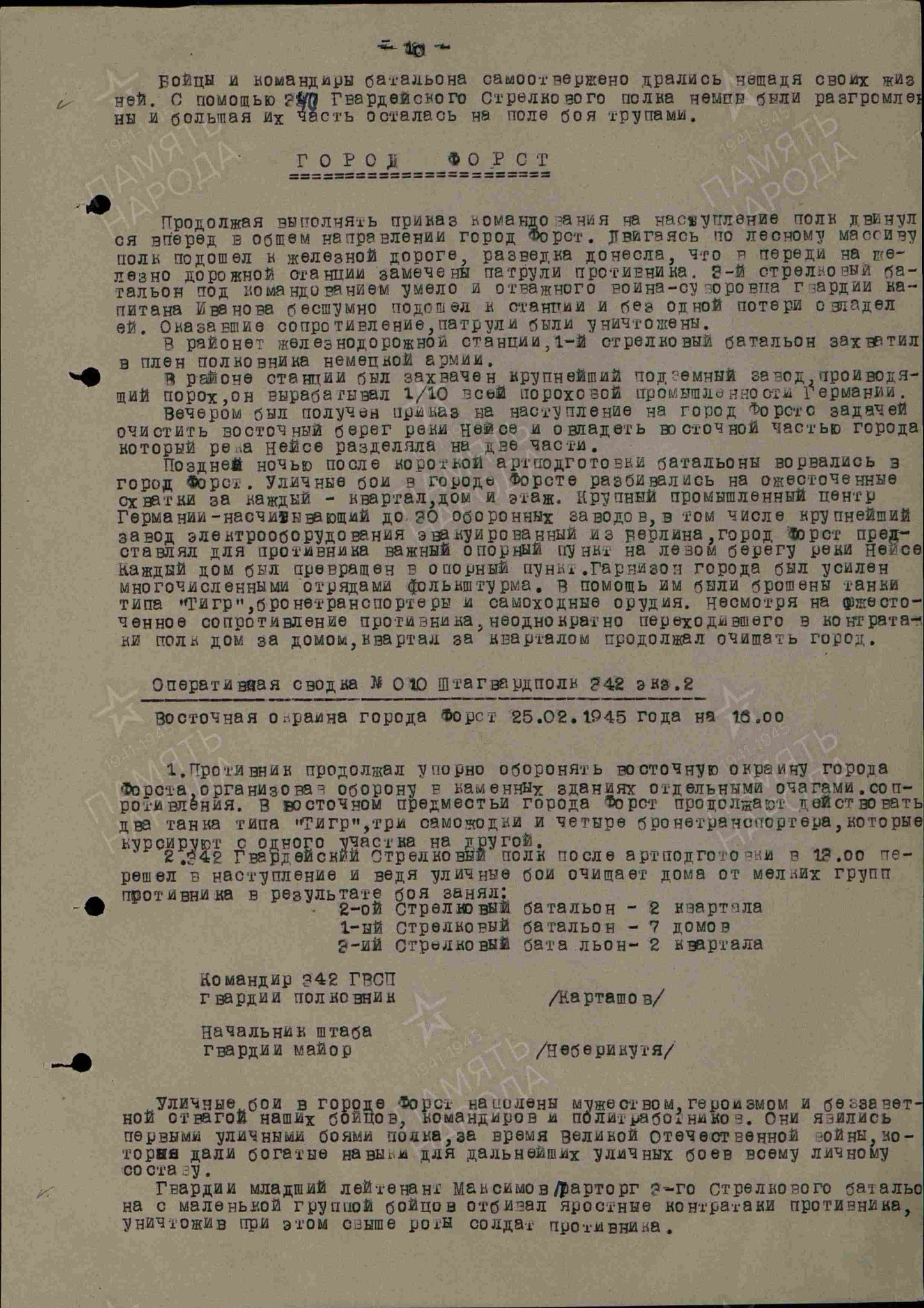
Russian original – transcription
— 10 —
Бойцы и командиры батальона самоотверженно дрались нещадя своих жизней. С помощью 240 [номер исправлен; чтение неуверенное] Гвардейского Стрелкового полка немцы были разгромлены и большая их часть осталась на поле боя трупами.
ГОРОД ФОРСТ
Продолжая выполнять приказ командования на наступление полк двинулся вперед в общем направлении город Форст. Двигаясь по лесному массиву полк подошел к железной дороге, разведка донесла, что впереди на железнодорожной станции замечены патрули противника. 3-й стрелковый батальон под командованием умелого и отважного воина-суворовца гвардии капитана Иванова бесшумно подошел к станции и без одной потери овладел ей. Оказавшие сопротивление, патрули были уничтожены.
В районе железнодорожной станции 1-й стрелковый батальон захватил в плен полковника немецкой армии.
В районе станции был захвачен крупнейший подземный завод, производящий порох, он вырабатывал 1/10 всей пороховой промышленности Германии.
Вечером был получен приказ на наступление на город Форст с задачей очистить восточный берег реки Нейсе и овладеть восточной частью города который река Нейсе разделяла на две части.
Поздней ночью после короткой артподготовки батальоны ворвались в город Форст. Уличные бои в городе Форсте разбивались на ожесточенные схватки за каждый — квартал, дом и этаж. Крупный промышленный центр Германии — насчитывающий до 30 оборонных заводов, в том числе крупнейший завод электрооборудования эвакуированный из Берлина, город Форст представлял для противника важный опорный пункт на левом берегу реки Нейсе. Каждый дом был превращен в опорный пункт. Гарнизон города был усилен многочисленными отрядами фолькштурма. В помощь им были брошены танки типа «Тигр», бронетранспортеры и самоходные орудия. Несмотря на ожесточенное сопротивление противника, неоднократно переходившего в контратаки полк дом за домом, квартал за кварталом продолжал очищать город.
Оперативная сводка № 010 Штагвардполк 342 экз. 2
Восточная окраина города Форст 25.02.1945 года на 16.00
1. Противник продолжал упорно оборонять восточную окраину города Форста, организовав оборону в каменных зданиях отдельными очагами сопротивления. В восточном предместьи города Форст продолжают действовать два танка типа «Тигр», три самоходки и четыре бронетранспортера, которые курсируют с одного участка на другой.
2. 342 Гвардейский Стрелковый полк после артподготовки в 12.00 перешел в наступление и ведя уличные бои очищает дома от мелких групп противника в результате боя занял:
2-ой Стрелковый батальон — 2 квартала
1-ый Стрелковый батальон — 7 домов
3-ий Стрелковый батальон — 2 квартала
Командир 342 ГВСП
Гвардии полковник /Карташов/
Начальник штаба
Гвардии майор /Неберивутя/ [чтение фамилии неуверенное]
Уличные бои в городе Форст насыщены мужеством, героизмом и беззаветной отвагой наших бойцов, командиров и политработников. Они явились первыми уличными боями полка, за время Великой Отечественной войны, которые дали богатые навыки для дальнейших уличных боев всему личному составу.
Гвардии младший лейтенант Максимов — парторг 3-го Стрелкового батальона — с маленькой группой бойцов отбивал яростные контратаки противника, уничтожив при этом свыше роты солдат противника.
English translation
— 10 —
The battalion’s soldiers and commanders fought selflessly, sparing no thought for their lives. With the assistance of the 240th [number corrected; reading uncertain] Guards Rifle Regiment, the Germans were routed, and most of them were left dead on the battlefield.
THE TOWN OF FORST
Continuing to carry out the command’s offensive orders, the regiment advanced in the general direction of Forst. Moving through a forested area, it reached a railway line. Reconnaissance reported enemy patrols at the station ahead. The 3rd Rifle Battalion, under the skilful and courageous soldier in the Suvorov tradition, Guards Captain Ivanov, approached the station silently and seized it without a single loss. The patrols that offered resistance were destroyed.
Near the railway station, the 1st Rifle Battalion captured a colonel of the German army.
Near the station, the largest underground gunpowder plant was captured. It produced one tenth of the entire output of Germany’s gunpowder industry.
In the evening, an order was received to attack Forst, clear the eastern bank of the Neisse and capture the eastern part of the town, which the Neisse divided into two parts.
Late at night, after a short artillery preparation, the battalions broke into Forst. Street fighting in Forst became a series of fierce struggles for every block, house and floor. A major German industrial centre with as many as 30 armaments plants, including the largest electrical-equipment factory evacuated from Berlin, Forst was an important enemy strongpoint on the left bank of the Neisse. Every house had been turned into a strongpoint. The garrison had been reinforced with numerous Volkssturm units. Tiger-type tanks, armoured personnel carriers and self-propelled guns were sent to assist them. Despite the enemy’s fierce resistance and repeated counterattacks, the regiment continued clearing the town, house by house and block by block.
Operational report no. 010. Headquarters, 342nd Guards Rifle Regiment. Copy 2
Eastern outskirts of Forst, 25 February 1945, situation as at 16:00
1. The enemy continued stubbornly to defend the eastern outskirts of Forst, organising separate centres of resistance in masonry buildings. Two Tiger-type tanks, three self-propelled guns and four armoured personnel carriers continue to operate in the eastern suburb of Forst, moving between sectors.
2. Following artillery preparation, the 342nd Guards Rifle Regiment went on the offensive at 12:00. Fighting in the streets, it is clearing small enemy groups from houses. In the course of the fighting it captured:
2nd Rifle Battalion — 2 blocks;
1st Rifle Battalion — 7 houses;
3rd Rifle Battalion — 2 blocks.
Commander, 342nd Guards Rifle Regiment
Guards Colonel /Kartashov/
Chief of Staff
Guards Major /Neberivutya/ [surname reading uncertain]
The street fighting in Forst was filled with the courage, heroism and selfless bravery of our soldiers, commanders and political personnel. These were the regiment’s first street battles during the Great Patriotic War. They provided all personnel with extensive experience for further street fighting.
Guards Junior Lieutenant Maksimov, Party organiser of the 3rd Rifle Battalion, repelled furious enemy counterattacks with a small group of soldiers, killing more than a company of enemy troops in the process.
Document 2. Order no. 139/н of 17 April 1945 — visible first page
Full reading of the legible text on the first page. The visible list runs from entries 1 to 6. This page awards the Order of the Red Banner to other individuals; it is not Dvoinoi’s personal award record. The faint stamp and handwritten administrative marks have not been reconstructed. The date and order number are taken from the red-ink entries. Unit honorifics are translated descriptively.
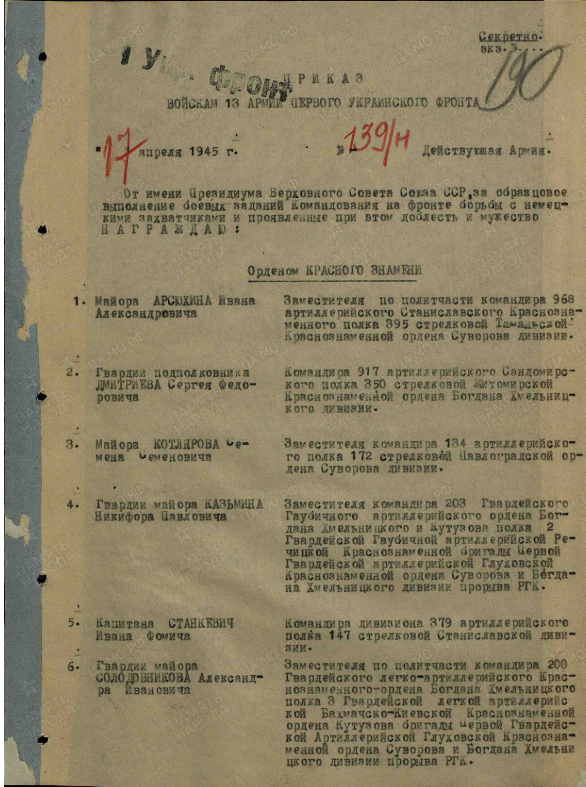
Russian original – transcription
Секретно. Экз. …
ПРИКАЗ
ВОЙСКАМ 13 АРМИИ ПЕРВОГО УКРАИНСКОГО ФРОНТА
«17» апреля 1945 г. № 139/н
Действующая Армия.
От имени Президиума Верховного Совета Союза ССР, за образцовое выполнение боевых заданий Командования на фронте борьбы с немецкими захватчиками и проявленные при этом доблесть и мужество
НАГРАЖДАЮ:
Орденом КРАСНОГО ЗНАМЕНИ
1. Майора АРСЮХИНА Ивана Александровича — Заместителя по политчасти командира 968 артиллерийского Станиславского Краснознаменного полка 395 стрелковой Таманской Краснознаменной ордена Суворова дивизии.
2. Гвардии подполковника ДМИТРИЕВА Сергея Федоровича — Командира 917 артиллерийского Сандомирского полка 350 стрелковой Житомирской Краснознаменной ордена Богдана Хмельницкого дивизии.
3. Майора КОТЛЯРОВА Семена Семеновича — Заместителя командира 134 артиллерийского полка 172 стрелковой Павлоградской ордена Суворова дивизии.
4. Гвардии майора КАЗЬМИНА Никифора Павловича — Заместителя командира 203 Гвардейского Гаубичного артиллерийского ордена Богдана Хмельницкого и Кутузова полка 2 Гвардейской Гаубичной артиллерийской Речицкой Краснознаменной бригады Первой Гвардейской артиллерийской Глуховской Краснознаменной ордена Суворова и Богдана Хмельницкого дивизии Прорыва РГК.
5. Капитана СТАНКЕВИЧ Ивана Фомича — Командира дивизиона 379 артиллерийского полка 147 стрелковой Станиславской дивизии.
6. Гвардии майора СОЛОДОВНИКОВА Александра Ивановича — Заместителя по политчасти командира 200 Гвардейского легко-артиллерийского Краснознаменного ордена Богдана Хмельницкого полка 3 Гвардейской легкой артиллерийской Бахмачско-Киевской Краснознаменной ордена Кутузова бригады Первой Гвардейской Артиллерийской Глуховской Краснознаменной ордена Суворова и Богдана Хмельницкого дивизии Прорыва РГК.
English translation
Secret. Copy …
ORDER
TO THE TROOPS OF THE 13TH ARMY, FIRST UKRAINIAN FRONT
17 April 1945, no. 139/н
Army in the Field.
On behalf of the Presidium of the Supreme Soviet of the Union of Soviet Socialist Republics, for exemplary performance of the command’s combat missions on the front against the German invaders, and for the valour and courage displayed, I award:
THE ORDER OF THE RED BANNER
1. Major Ivan Aleksandrovich ARSYUKHIN — deputy commander for political affairs of the 968th Stanislav Red Banner Artillery Regiment, 395th Taman Red Banner Rifle Division, Order of Suvorov.
2. Guards Lieutenant Colonel Sergei Fyodorovich DMITRIYEV — commander of the 917th Sandomierz Artillery Regiment, 350th Zhytomyr Red Banner Rifle Division, Order of Bogdan Khmelnitsky.
3. Major Semyon Semyonovich KOTLYAROV — deputy commander of the 134th Artillery Regiment, 172nd Pavlograd Rifle Division, Order of Suvorov.
4. Guards Major Nikifor Pavlovich KAZMIN — deputy commander of the 203rd Guards Howitzer Artillery Regiment, Orders of Bogdan Khmelnitsky and Kutuzov, within the 2nd Guards Rechitsa Red Banner Howitzer Artillery Brigade, 1st Guards Glukhov Red Banner Artillery Breakthrough Division of the Reserve of the High Command, Orders of Suvorov and Bogdan Khmelnitsky.
5. Captain Ivan Fomich STANKEVICH — battalion commander in the 379th Artillery Regiment, 147th Stanislav Rifle Division.
6. Guards Major Aleksandr Ivanovich SOLODOVNIKOV — deputy commander for political affairs of the 200th Guards Light Red Banner Artillery Regiment, Order of Bogdan Khmelnitsky, within the 3rd Guards Bakhmach-Kyiv Light Red Banner Artillery Brigade, Order of Kutuzov, 1st Guards Glukhov Red Banner Artillery Breakthrough Division of the Reserve of the High Command, Orders of Suvorov and Bogdan Khmelnitsky.
Sources and notes
- Олег Кожухарь, «Двойной Алексей Иванович», Герои страны: Biography and the saved webpage supplied by the user. Describes an unnamed colonel’s capture on 22 February 1945 and the award of 17 April 1945. Its stated sources are “Подвиг народа” documents and a biographical dictionary of holders of the Order of Glory, Moscow 2000.
- «Город Форст», strona 10 / Seite 10 / page 10: Supplied scan of a Soviet account containing operational report no. 010 of the 342nd Guards Rifle Regiment headquarters, dated 25 February 1945. No complete archival reference was supplied. Reproduction bearing the “Память народа” watermark.
- Приказ № 139/н, 13-я армия, 17.04.1945: Supplied first page of the order. Visible entries 1–6 concern the Order of the Red Banner and do not name Dvoinoi.
- Kwerenda Fundacji Rokita / Recherche der Stiftung Rokita / Rokita Foundation research: Earlier findings concerning a German report of Glase missing on 22 February 1945 and a command change in Grenadier-Regiment 698. Full verification requires the original diary and archival reference. This information is not attributed to the Russian documents.