
Not a simple pyramid, but several overlapping layers
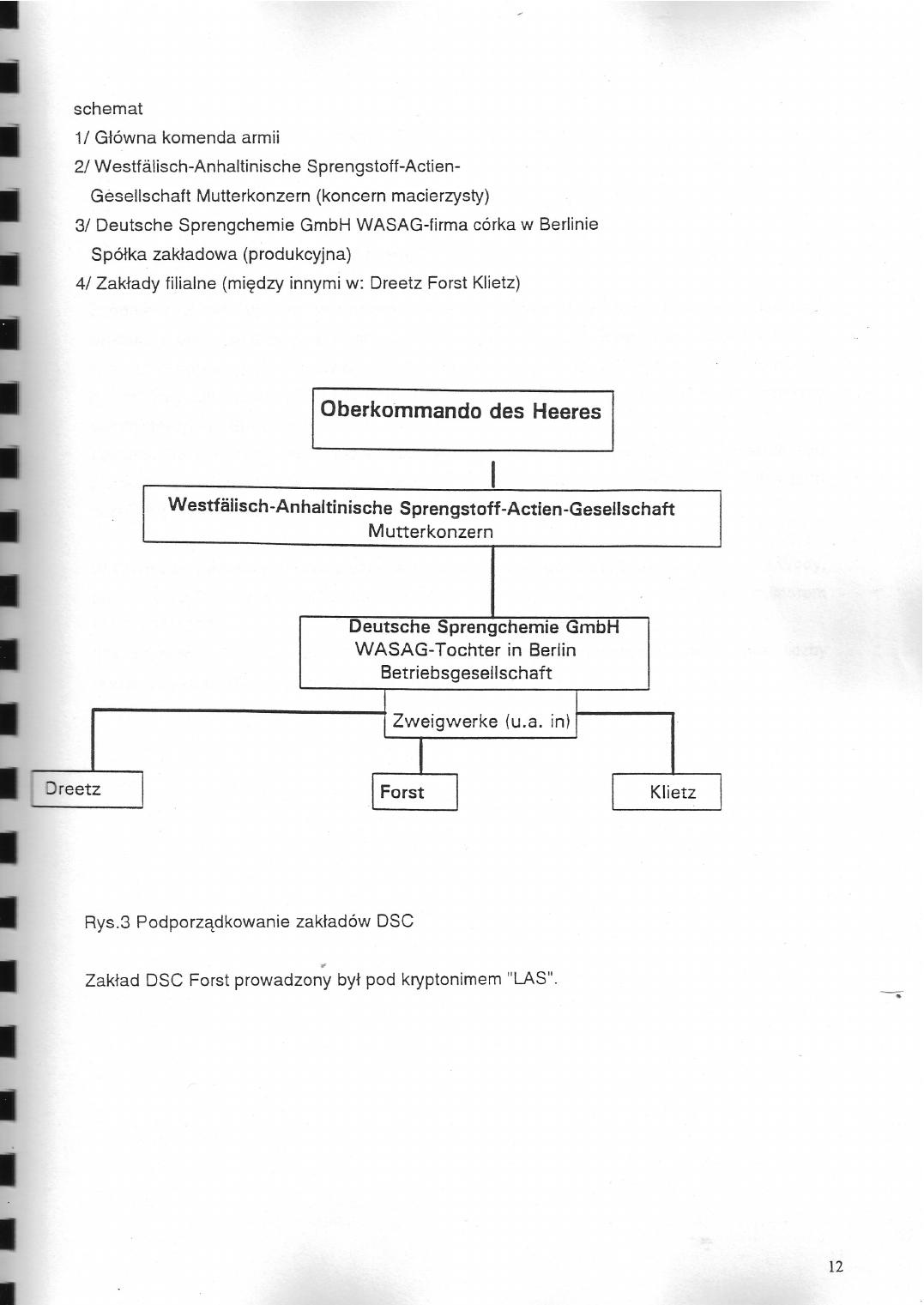
The 1995 G.E.O.S. report gives a clear production chain for Forst: Oberkommando des Heeres → WASAG → Deutsche Sprengchemie GmbH → the branch plants Dreetz, Forst and Klietz. This is crucial local evidence, but it does not by itself explain who owned the land and buildings.
That missing layer is the Verwertungsgesellschaft für Montanindustrie GmbH, usually called MONTAN. Under the Montan scheme, plants financed by the Reich could be transferred to MONTAN and then leased to operating companies. The state retained control of fixed assets while private industry supplied technical knowledge, specialists and day-to-day organisation.
orders, planning, funding and supervision
property, trusteeship, leasing, asset control
technology, construction, industrial organisation
operator of a network including Forst-Scheuno
What does the Bundesarchiv confirm?
BArch R 8135/7252, an audit of DSC for the financial year ending 31 March 1941, names MONTAN, the connection with WASAG and branch plants at Torgelow, Klietz, Kraiburg, Moschwig, Oderberg, Forst, Dreetz and Wolfratshausen. Forst was therefore part of a network rather than an isolated “secret factory”.
A company founded in 1916 became a tool of concealed rearmament
MONTAN was established in Munich on 3 February 1916. Its original purpose concerned mining rights and industrial holdings. In the 1930s the existing corporate shell was brought under structures linked to the Army Ordnance Office. The state could thus appear in commercial transactions through a formally civilian company rather than directly as the army or the Reich.
The arrangement served several purposes. It reduced the investment risk for private firms, helped give armaments plants priority access to raw materials, energy and labour, and made the real scale of state control less visible. Research on comparable facilities indicates that 119 operations had been established by the end of the war under this or closely related arrangements.
MONTAN also left tangible property records east of the Oder-Neisse line. The State Archive in Zielona Góra lists a land register file for Grünberg Neustadt, folio 139, in the name of Verwertungsgesellschaft für Montanindustrie GmbH München. It is not a Forst-Scheuno file, but it demonstrates how the system was embodied in real property and legal records.
The industrial side of the system
WASAG, founded in 1891, developed plants at Sinsen, Coswig and Reinsdorf and became an important manufacturer of explosives, nitrocellulose and propellants. Armaments production expanded massively in the First World War. After Versailles, Reinsdorf retained a special place among the limited facilities allowed to continue selected military production. That technical experience later formed part of the foundation for renewed rearmament.
Deutsche Sprengchemie GmbH was created in 1934. In the Forst sources it appears as an operating company linked to WASAG. Other archival and Nuremberg material states that DSC was owned by the German Reich. These facts are compatible: private industrial management and state capital or property control could exist at the same time. That duality is a defining feature of the Montan system.
Karinhall: from Göring's meetings to the plan of 12 July 1938
Carinhall, Hermann Göring's estate in the Schorfheide, was also a venue for political and industrial meetings. The Harvard Nuremberg Project preserves minutes of Göring's conference with aircraft manufacturers on 8 July 1938. Economic historians also describe a “dramatic session” involving Göring, Paul Körner, Wilhelm Löb and Carl Krauch, in which Krauch persuaded Göring to revise Four Year Plan industrial policy.
On 12 July 1938 the “Military Economic New Production Plan” was drawn up. It became known as the Krauch or Karinhall Plan. It covered synthetic fuel, Buna rubber, light metals, steel, gunpowder, explosives and chemical warfare agents. For 1 October 1940 the target was approximately 12,000 tons of gunpowder, 19,000 tons of explosives and 4,000 tons of chemical warfare agents per month. Nuremberg evidence also records that shortages of machinery, foreign exchange, raw materials and labour prevented the targets from being reached on schedule.
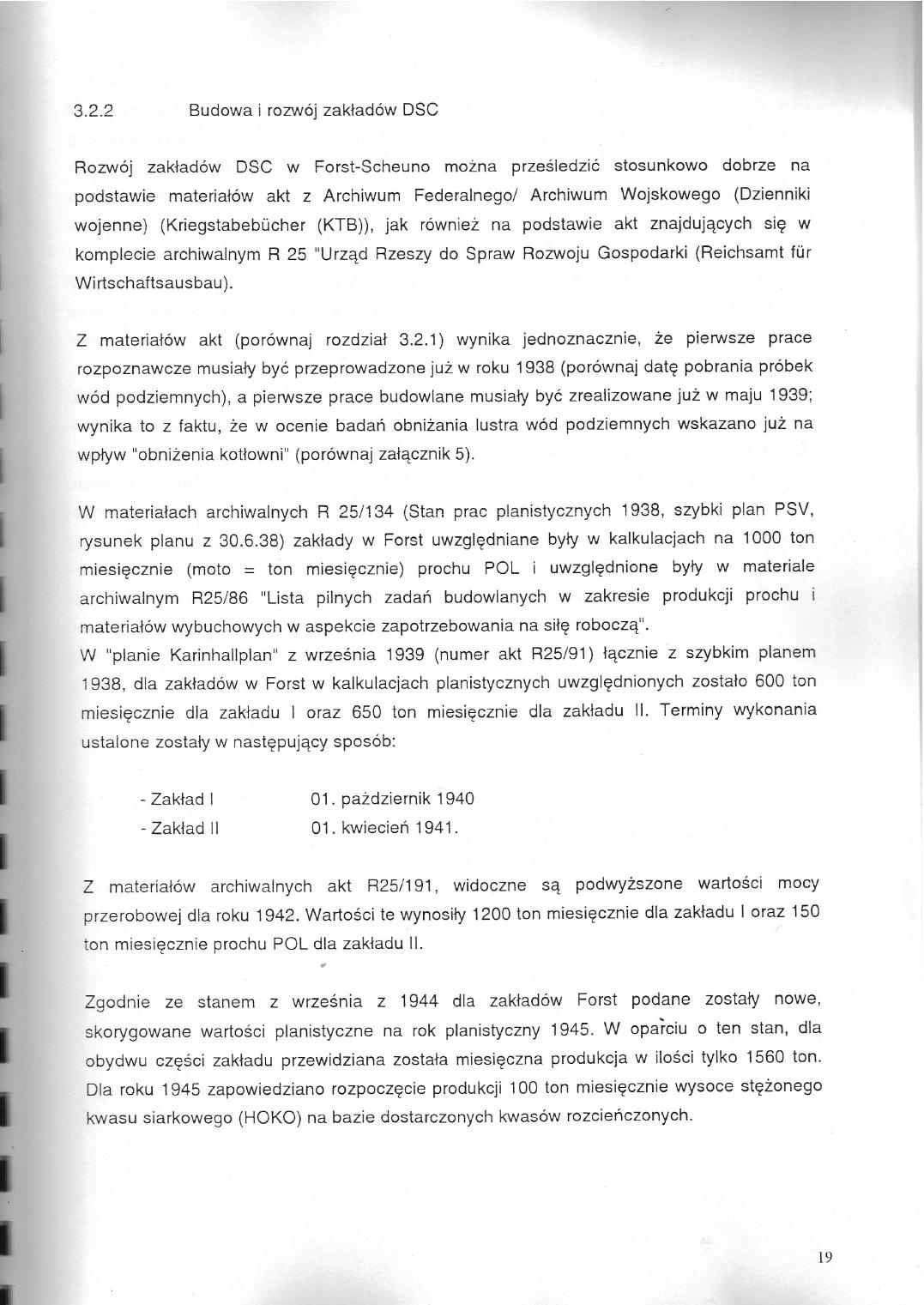
The timing is highly relevant to Forst. Hydrogeological investigation and site preparation began in 1938, exactly when the chemical armaments programme accelerated. G.E.O.S. records local Forst estimates of about 1,000 tons of powder per month initially, later 600 tons for Plant I and 650 tons for Plant II. These local plant figures must not be confused with the Reich-wide Karinhall targets.

How the system took physical form in the forest by the Neisse
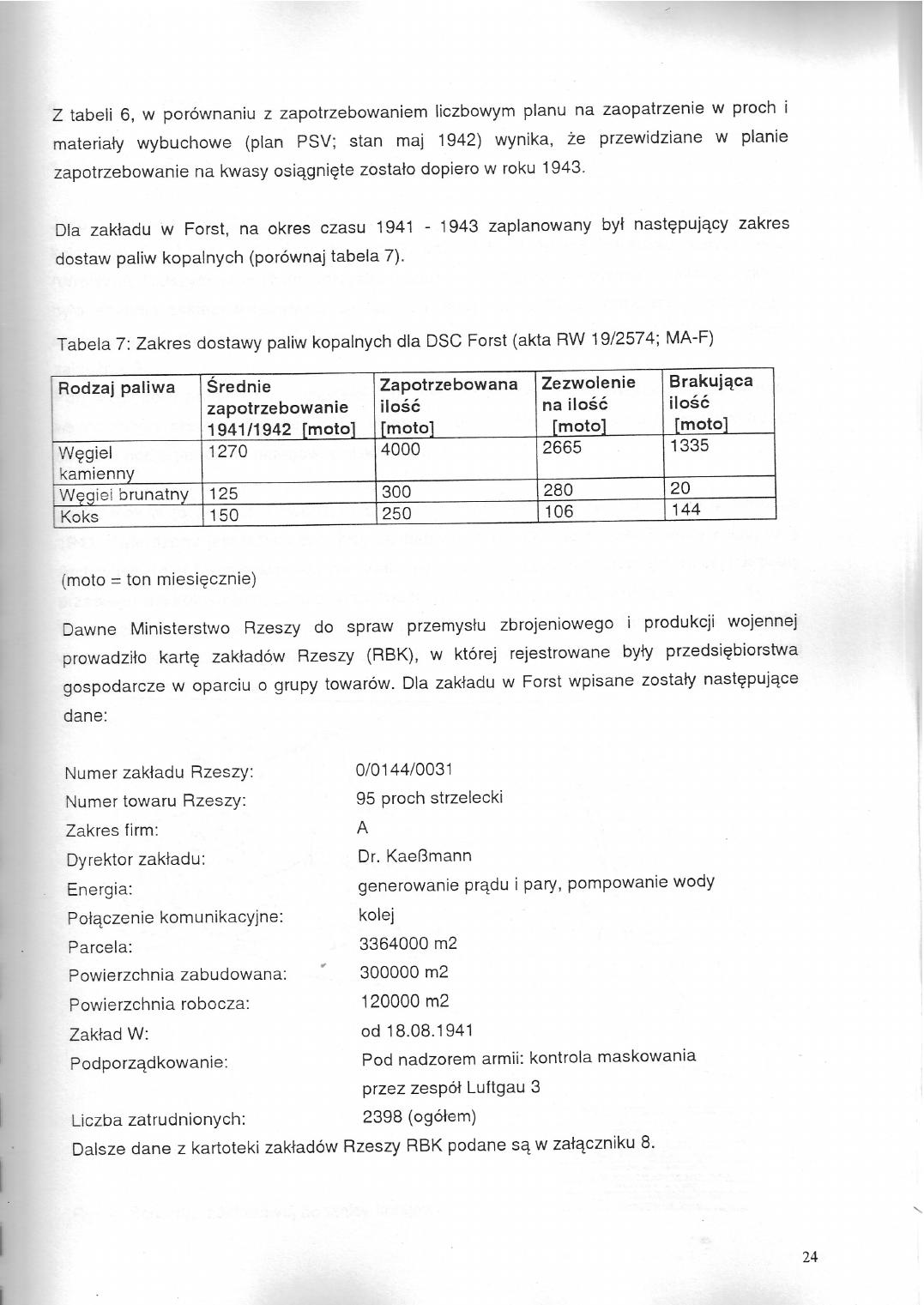
Forst was not one factory hall but a dispersed industrial landscape: two large production sections, four nitration zones, its own water supply, power and boiler facilities, workshops, laboratories, firing range, storage areas, sewage treatment, a works railway and a dense road system. Dispersion limited the effects of accidental explosions and air raids and made aerial reconnaissance more difficult.
The technical system was also dependent on coerced labour. Wartime records quoted by G.E.O.S. already show serious labour shortages in 1940. Foreign forced labourers and prisoners were later employed around the works. The corporate structure must therefore be read not only as a history of property and contracts but also as part of the forced mobilisation of people and resources.
German, Polish and Russian archives
R 121/5408 MONTAN annual reports; R 3112/88 Karinhall Plan; R 8135/7252 DSC audit; R 154/10673 direct files on Deutsche Sprengchemie Werke Forst, 1938-1944.
I 417 WASAG Coswig 1914-1947, including technical drawings and foreign-worker records.
Collection 89/1299/0 on DSC Forst and land-register file 89/45/0/4.5.21/1519 for MONTAN München.
Searches in “Память народа” and the Electronic Library of Historical Documents did not reveal a direct corporate file for MONTAN-WASAG-DSC Forst. That absence is stated rather than filled by inference.
Main sources
- G.E.O.S. Ingenieurgesellschaft mbH, Forst report, 30 Nov 1995.
- BArch R 121/5408.
- BArch R 3112/88.
- BArch R 8135/7252.
- Landesarchiv Sachsen-Anhalt I 417.
- Nuremberg document 2353-PS.
- Carinhall conference, 8 July 1938.