
A railway serving the forest
During the twentieth century, a forest railway operated in the extensive woodlands of the former Forst–Pförten estate, owned by the von Brühl family. This little-known transport system served forestry operations in the area between present-day Brody, Tuplice and the land east of Forst. It formed part of the estate’s economic infrastructure rather than a public passenger railway.
According to regional historical accounts, the railway opened in 1923 and its network reached approximately 40 kilometres in length. It covered the forests between Tuplice (Teuplitz), Brody (Pförten), Forst–Berge and Mehlen. Its principal task was to carry timber and materials used in forestry work.
Narrow tracks and small steam locomotives
This was a narrow-gauge railway with a track gauge of 600 mm. Regional accounts mention the use of Brigadelok steam locomotives – small engines associated with Germany’s military field railways during the First World War. The light track construction made it possible to run lines through forest areas and adapt the network to changing transport requirements.
A connection to Jagdstern
The railway also reached Jagdstern, a former woodland meeting and hunting site with a hunting lodge, a forester’s house and outbuildings. The existence of a connection to this location is confirmed in the City of Forst’s official historical account, “Auf den Spuren des Grafen Brühl”.
Reading the historical map
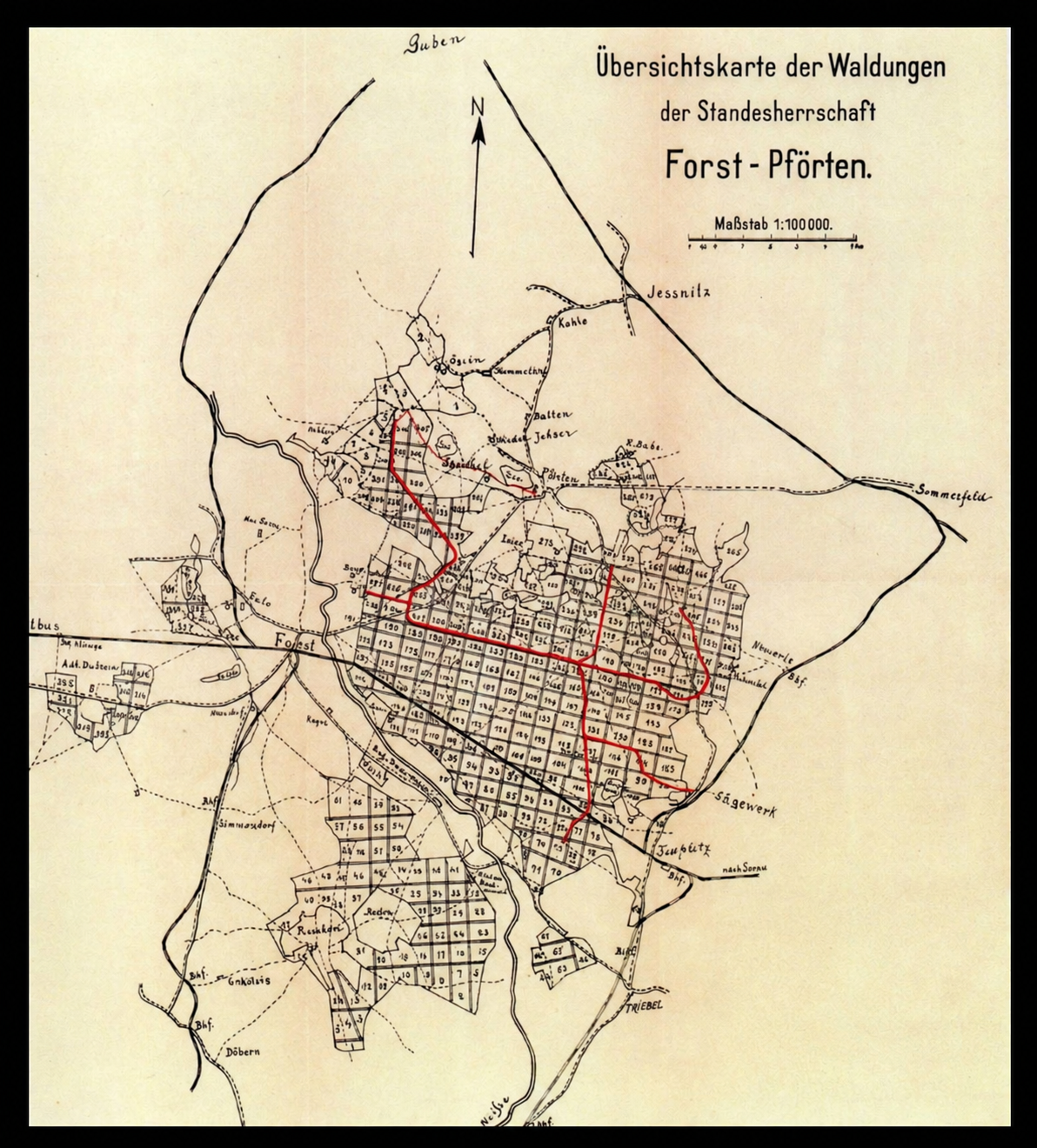
On the supplied historical map of the Forst–Pförten estate’s forests, red lines mark the routes of the forest railway according to the description provided with the material. The network branches into different parts of the woodland, revealing the scale of the former transport system. The map provides a starting point for comparing the old routes with modern maps and digital terrain models.
Few visible traces of the railway survive. Regional researchers report that stretches of former routes and transshipment sites can still be identified in the landscape. Identifying them reliably, however, requires detailed fieldwork and analysis of cartographic sources.
The Rokita Foundation documents forgotten elements of the history of Brody, Forst and the former communities along the Lusatian Neisse. Research into the forest railway helps explain how the von Brühl estates’ extensive woodlands were used and developed before 1945.
Sources and further reading
- Zeitzeugen Forst/Lausitz, “Die Waldeisenbahn in der großen Pförtener Heide” – the regional source cited in the supplied account for the opening year of 1923, approximately 40 km of track, 600 mm gauge, Brigadelok locomotives and surviving traces. When the link was rechecked on 28 October 2026, the forum content was not publicly accessible.
- City of Forst (Lausitz), “Auf den Spuren des Grafen Brühl”, “Jagdstern” section – confirmation that the railway reached this location.
- Friedemann Tischer, Die Eisenbahn Weißwasser–Muskau–Teuplitz–Sommerfeld und die Waldbahn der Standesherrschaft Forst–Pförten, Weißwasser 2022 – a specialist publication cited in the regional bibliography.
- “Bahngeschichte im westlichen Kreis Sorau” – a historical compilation drawing, among other sources, on Friedemann Tischer’s work.
Sources and notes
- Stadt Forst (Lausitz): Auf den Spuren des Grafen Brühl, Jagdstern
- Zeitzeugen Forst/Lausitz: Die Waldeisenbahn in der großen Pförtener Heide
- Friedemann Tischer: Die Eisenbahn Weißwasser–Muskau–Teuplitz–Sommerfeld und die Waldbahn der Standesherrschaft Forst–Pförten
- Bahngeschichte im westlichen Kreis Sorau