Fundacja Rokita Home Discover Brody Municipality Discover Brody Municipality
DSC Forst “Wald” · industrial heritage hidden in nature
PL DE EN
f Follow us on Facebook

DSC Forst connections - plants, Alfred Nobel, I.G. Farben and contractors

DSC Forst-Scheuno in the Deutsche Sprengchemie network: MONTAN, WASAG, Dynamit-AG, I.G. Farben, Christianstadt, private contractors and source assessment.

8 plants eight DSC branches named in the audit record
1934 WASAG and Dynamit AG jointly create DSC
1939 trial records place DSC on the WASAG side
19 Sep 1942 regional record of a "Stabilit" shipment from I.G. Farben Uerdingen
The key correction

One factory, several different layers of control and cooperation

DSC Forst-Scheuno cannot be described accurately by a single sentence such as "it belonged to I.G. Farben" or "it was Alfred Nobel's factory". The sources show a layered system: the state asset structure of MONTAN, the private operator Deutsche Sprengchemie, the industrial backing of WASAG, the older corporate lineage of Dynamit-AG, and a highly concentrated chemical and explosives market in which I.G. Farben played an important role.

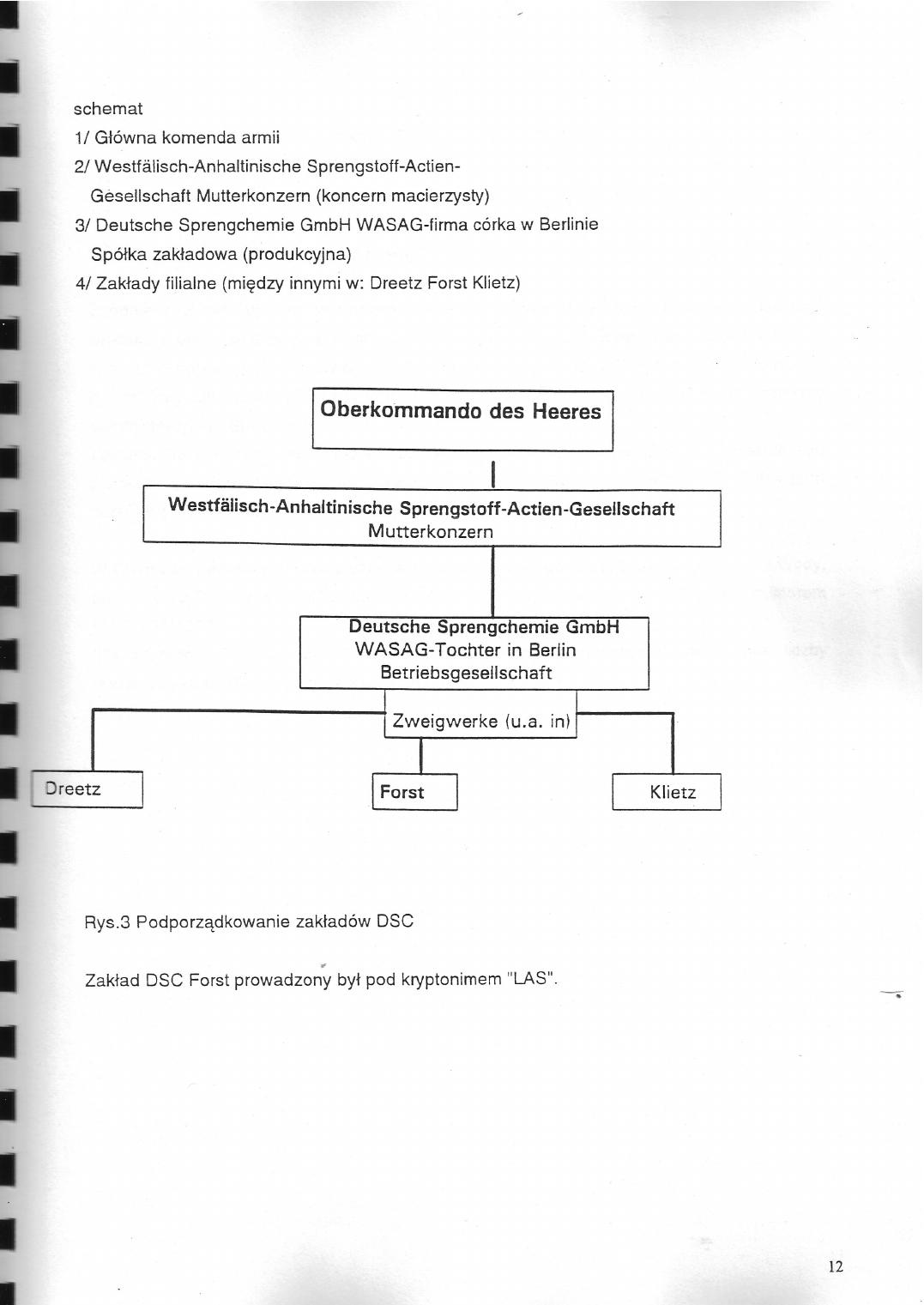
The 1995 G.E.O.S. study places Forst in an organisational chain running from the Army High Command through WASAG to Deutsche Sprengchemie and its branch plants. Bundesarchiv audit records show Forst as one site within a network, while Nuremberg trial material helps separate DSC/WASAG from Verwertchemie/DAG over time. This makes it possible to distinguish the asset owner, plant operator, corporate group, supplier and contractor instead of merging them into one entity.
Roles

Who did what?

Four distinct functions need to be kept apart.

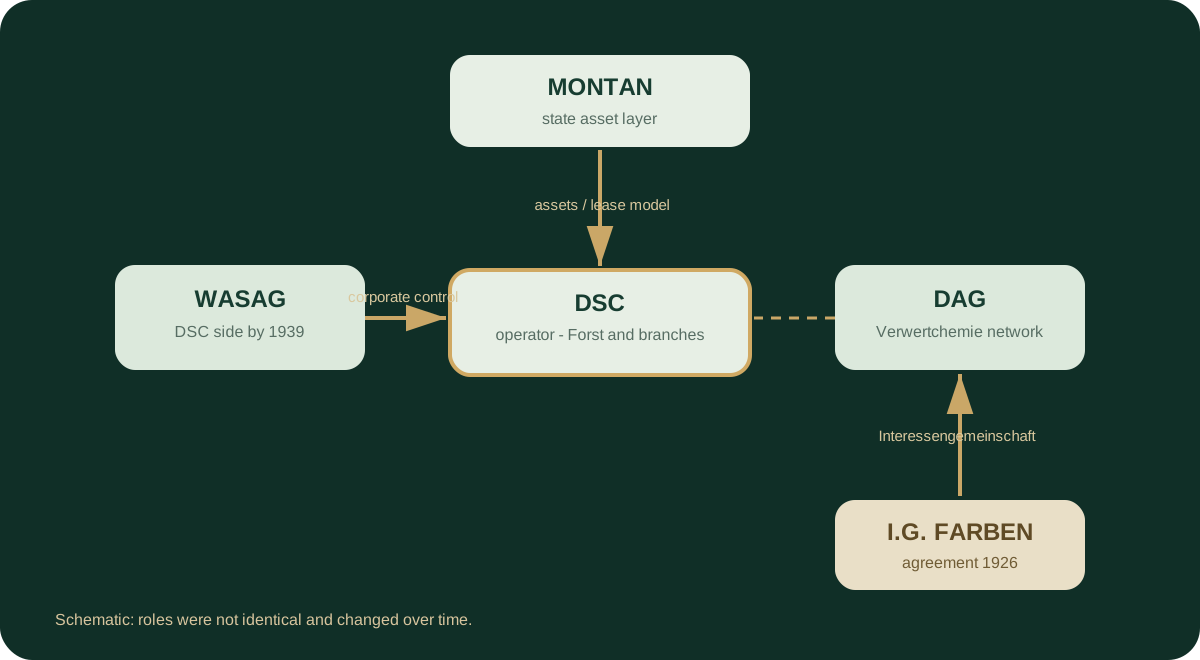
Diagram of the relationships between MONTAN, WASAG, DSC, DAG and I.G. Farben
Original Fundacja Rokita diagram. The arrows represent different types of relationship, not one simple ownership chain.
MONTANThe state asset and organisational layer. Armaments plants could be financed and held for the Reich and then leased to specialist industrial operators.
Deutsche Sprengchemie GmbHThe operator of Forst-Scheuno and other propellant plants. This is the company named in the G.E.O.S. study and in audit records for the branch network.
WASAGThe principal private corporate environment of DSC. Nuremberg material indicates that by 1939 DSC had moved fully to the WASAG side, even though the company had been founded jointly with Dynamit AG.
DAG / VerwertchemieDynamit-AG helped create DSC but later developed a parallel operator network through Verwertchemie. A shared origin does not make wartime Forst a DAG factory.
The DSC network

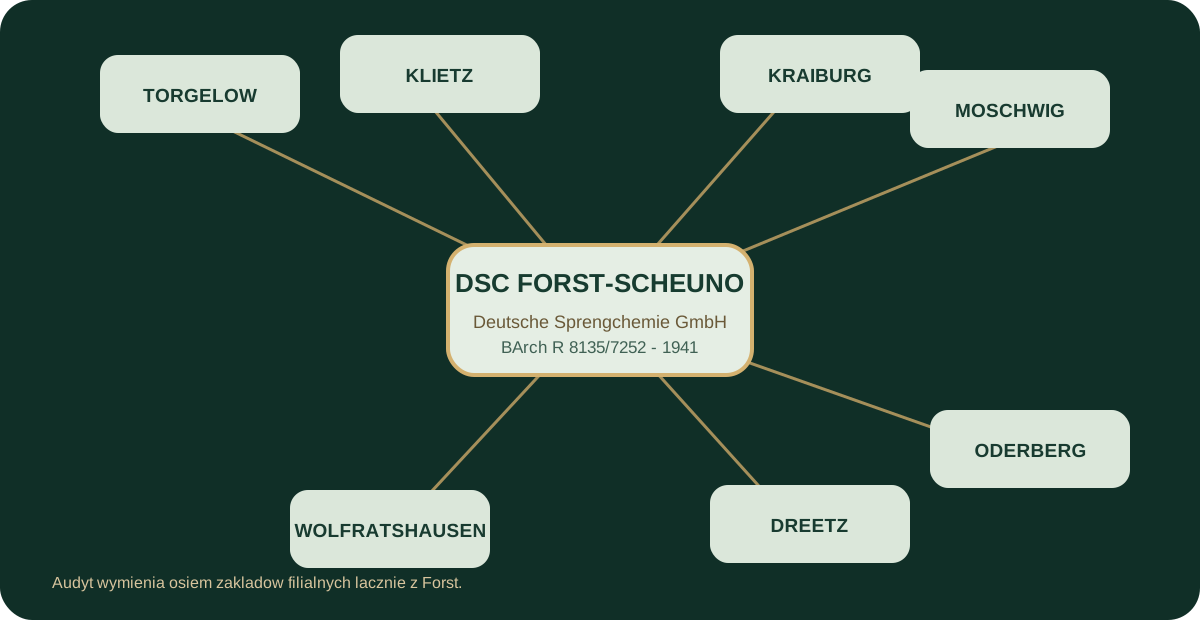
Forst was one of eight branches named in the 1941 audit record

Bundesarchiv file BArch R 8135/7252, covering the annual statement to 31 March 1941, lists Torgelow, Klietz, Kraiburg, Moschwig, Oderberg, Forst, Dreetz and Wolfratshausen. This is strong evidence that Forst was one node in a dispersed industrial organisation rather than an isolated project.

Diagram of eight Deutsche Sprengchemie branch plants listed in the 1941 audit
The list follows the Bundesarchiv record directly. Later compilations may add other plants; differences depend on date and scope.
Torgelow

North-eastern DSC branch named in the audit.

Klietz

An early plant and an important comparison point for DSC history.

Kraiburg

Bavarian plant; later official records show MONTAN as asset owner and DSC as operator.

Moschwig

DSC branch that also appears in technical and water-related records.

Oderberg

Brandenburg branch named in the same audit context as Forst.

Forst-Scheuno

The plant east of the Lusatian Neisse, brought into operation in stages from 1941.

Dreetz

Brandenburg DSC site with substantial surviving project files; G.E.O.S. also used Dreetz as a comparison.

Wolfratshausen / Geretsried

A useful example of the neighbouring DSC/WASAG and Verwertchemie/DAG systems.

Alfred Nobel and DAG

The connection is real, but it is a corporate genealogy

Alfred Nobel founded Alfred Nobel & Co. in Hamburg in 1865. By 1877 the business operated as Dynamit-Actien-Gesellschaft vormals Alfred Nobel & Co. Nobel died in 1896, decades before Forst-Scheuno was built. There is no basis for presenting him as the initiator, wartime owner or participant in the Forst project.

The relevant link is corporate continuity. Dynamit-AG grew out of Nobel's German company and in 1934 took part, together with WASAG, in creating Deutsche Sprengchemie. The operating lines were later more clearly separated: DSC belonged to the WASAG side and Verwertchemie to the DAG side. Nuremberg trial records are especially useful for this distinction.

1865 Alfred Nobel & Co.
1877 Dynamit-AG vorm. Alfred Nobel & Co.
1896 Alfred Nobel dies
1926 DAG/RWS agreement with I.G. Farben
1934 WASAG + DAG create DSC
1939 DSC on the WASAG side
I.G. Farben

An important industrial environment, but not the operator of Forst

Precision matters here. Capital, cartel and supply links are documented. A simple statement that I.G. Farben directly ran DSC Forst is not supported by the sources used for this page.

confirmed

DAG and I.G. Farben

The industrial history of Troisdorf documents the 17 September 1926 interest-community agreement between DAG/RWS and I.G. Farben. It coordinated fields of activity and competition. This is an important corporate bridge, but it is not proof that I.G. Farben operated Forst.

confirmed in a regional source

Shipment from Krefeld-Uerdingen

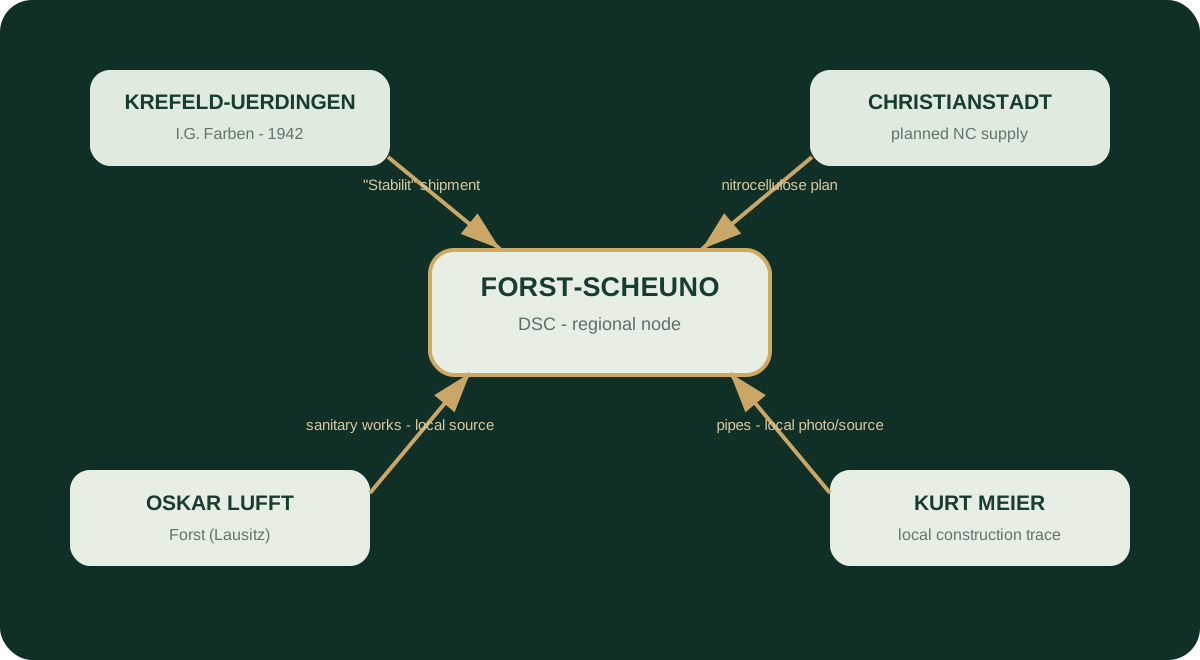
A regional publication describes a freight note dated 19 September 1942 for 45 drums of "Stabilit" sent from the I.G. Farben plant at Krefeld-Uerdingen to Forst. This is a concrete supply link. Because the current evidence is the regional publication rather than a direct inspection of the original freight note, the page labels it accordingly.

requires nuance

WASAG and I.G. Farben

Nuremberg testimony refers to I.G. participation in WASAG capital while also stressing the organisational separation of the WASAG and DAG sides. Shareholdings and agreements changed over time. The safest conclusion is strong corporate interconnection, not a timeless single ownership formula.

not confirmed

"I.G. Farben owned Forst"

The sources used here do not support this wording. Forst is identified as a Deutsche Sprengchemie plant and the asset model runs through MONTAN. I.G. Farben belongs in the story as a major corporate and supply connection, not as the straightforward landowner and operator.

Regional chain

Christianstadt and logistics: the factory was not a self-sufficient island

One of the strongest regional connections leads to Christianstadt, today's Krzystkowice. Documentation on that project describes a planned nitrocellulose plant intended to supply the expanding works near Forst. Christianstadt belonged to the parallel Verwertchemie/DAG system. The planning itself therefore linked several locations into a larger production chain.

G.E.O.S. also describes the plant railway and the connection with the Forst-Bademeusel-Sorau line. Raw materials, fuel, construction materials and finished products moved through a much larger network. That resolves an apparent contradiction: the factory was concealed in forest, but logistically it was tightly integrated with the region and the wider Reich economy.

Diagram of regional and commercial links of DSC Forst-Scheuno
The evidence is not equally strong: Christianstadt is supported by source-based documentation; Lufft, Meier and the "Stabilit" shipment are currently known mainly through regional publications.
Private contractors

Large companies still depended on builders and installers

A complex of hundreds of buildings required outside contractors. The Forst list remains incomplete, so local claims are separated from well-documented comparison cases elsewhere in the same industrial system.

company confirmed, job locally reported

Oskar Lufft, Forst (Lausitz)

An official City of Forst publication confirms the history of the Oskar Lufft company and its work in heating and building services. A regional Bunkerwald publication attributes sanitary installations in DSC social buildings to the firm. No original DSC/MONTAN contract has yet been located in the digital research.

regional lead

Kurt Meier - building contractor

Regional material publishes a photograph described as showing builder Kurt Meier with Polish forced labourers unloading pipes on DSC premises near Groß Bademeusel. It is a concrete lead, but the extent of his firm's contract still requires independent confirmation in invoices, registers or construction files.

comparison: Dreetz

Wayss & Freytag; Dyckerhoff & Widmann

Documentation on forced labour at the DSC Dreetz plant names these companies in concrete, earth and road works. This does not prove they worked at Forst; it demonstrates the broader model in which DSC construction relied on major private contractors.

regional comparison

Wollstein-Kuppers and Christianstadt

Sources on Christianstadt identify private firms in construction work for the DAG/Verwertchemie complex. Again, state asset structures, industrial operators and contractors appear as distinct parts of one wartime system.

Forced labour is not a side note. Sources for Dreetz and Christianstadt connect private construction work with the labour of people deprived of freedom. The regional Forst material linked to Kurt Meier also shows Polish forced labourers. A technical history that omitted this context would be incomplete.
Source balance

What can be stated with high confidence today?

Claim Status Reason
Forst was part of the DSC network confirmed The Bundesarchiv audit lists Forst among eight branches.
DSC was created in 1934 by WASAG and DAG confirmed The Zielona Góra archival fonds description states this; later trial sources show subsequent separation.
By 1939 DSC was on the WASAG side confirmed Nuremberg records distinguish DSC/WASAG from Verwertchemie/DAG.
Alfred Nobel personally took part in the Forst project false simplification Nobel died in 1896; the connection is corporate genealogy.
I.G. Farben directly operated Forst not confirmed The operator named in the sources is DSC; I.G. appears in corporate and supply relationships.
Christianstadt was planned to supply nitrocellulose to Forst confirmed Source-based documentation of the Christianstadt project states this function.
Oskar Lufft and Kurt Meier worked at DSC different evidence strength Regional sources name both; Lufft's company and business profile are independently confirmed, while the exact contracts still require primary files.

Research update 4 September 2026: project sources and internet-accessible archival and institutional materials were rechecked, including Bundesarchiv/DDB, the State Archive in Zielona Góra, Nuremberg trial sources, the Bundestag, Landesarchiv Sachsen-Anhalt, the City of Forst and regional publications. The search was also extended to library and image catalogues such as SLUB Dresden / Deutsche Fotothek. Only material directly supporting a specific statement was included.

Sources

Materials used in this version

  1. G.E.O.S. Ingenieurgesellschaft mbH, "Ekspertyza dotycząca obiektu: Zakłady przemysłu zbrojeniowego - Fabryka amunicji i materiałów wybuchowych Forst", Berlin/Hennigsdorf, 30.11.1995. Primary source for the local Forst-Scheuno layout and the OKH–WASAG–DSC relationship. project source
  2. Archiwum Państwowe w Zielonej Górze, zespół 89/1299/0 "Fabryka Materiałów Wybuchowych Sp. z o.o. Zakład w Zasiekach". The fonds description states that DSC was founded in 1934 by WASAG and Dynamit AG. archive Open
  3. Deutsche Digitale Bibliothek / Bundesarchiv, BArch R 8135/7252, "Deutsche Sprengchemie GmbH, Berlin: Bd. 3". The annual report audit lists eight branch plants, including Forst. archive Open
  4. Harvard Law School Library, Nuremberg Trials Project, hearings of 30 April and 6 May 1947. Testimony and documents clarify the separation of DSC/WASAG and Verwertchemie/DAG and show that the ownership structure changed over time. trial source Open
  5. Kunststoff Museum Troisdorf, "Historische Entwicklung an der Mülheimer Straße". Chronology of Alfred Nobel & Co., Dynamit-AG and the 1926 community-of-interest agreement with I.G. Farben. institutional Open
  6. Jonas Scherner, Jochen Streb, "Wissenstransfer, Lerneffekte oder Kapazitätsausbau?", Zeitschrift für Unternehmensgeschichte 53/1 (2008), s. 100-122. Analysis of eight DSC plants from 1937 to 1943. scholarly Open
  7. Deutscher Bundestag, Drucksache 11/6972. The list of former owners and operators at Geretsried/Wolfratshausen and Kraiburg shows the MONTAN–DSC model and the parallel MONTAN–Verwertchemie model. official Open
  8. "Geheime Reichssache" Christianstadt. Study of the planned nitrocellulose plant intended to supply raw material to the expanding works near Forst. source-based study Open
  9. Stadt Forst (Lausitz), economic-history material on Oskar Lufft / Forster Heiztechnik. It confirms the company and its installation profile but does not by itself prove a DSC contract. official Open
  10. GedenkstättenForum, study of forced-labour camps; for Dreetz and Christianstadt it identifies private contractors and links construction work with forced labour. scholarly / memory Open
  11. Landesarchiv Sachsen-Anhalt, I 417 WASAG Coswig, 1914-1947. Archive fonds for further research into WASAG’s corporate network. archive Open

Editorial rule: confirming that a company existed does not automatically prove a DSC contract. Regional claims are labelled as regional until an original contract or equivalent primary record is found.

Documents concerning the network

Source document or photograph
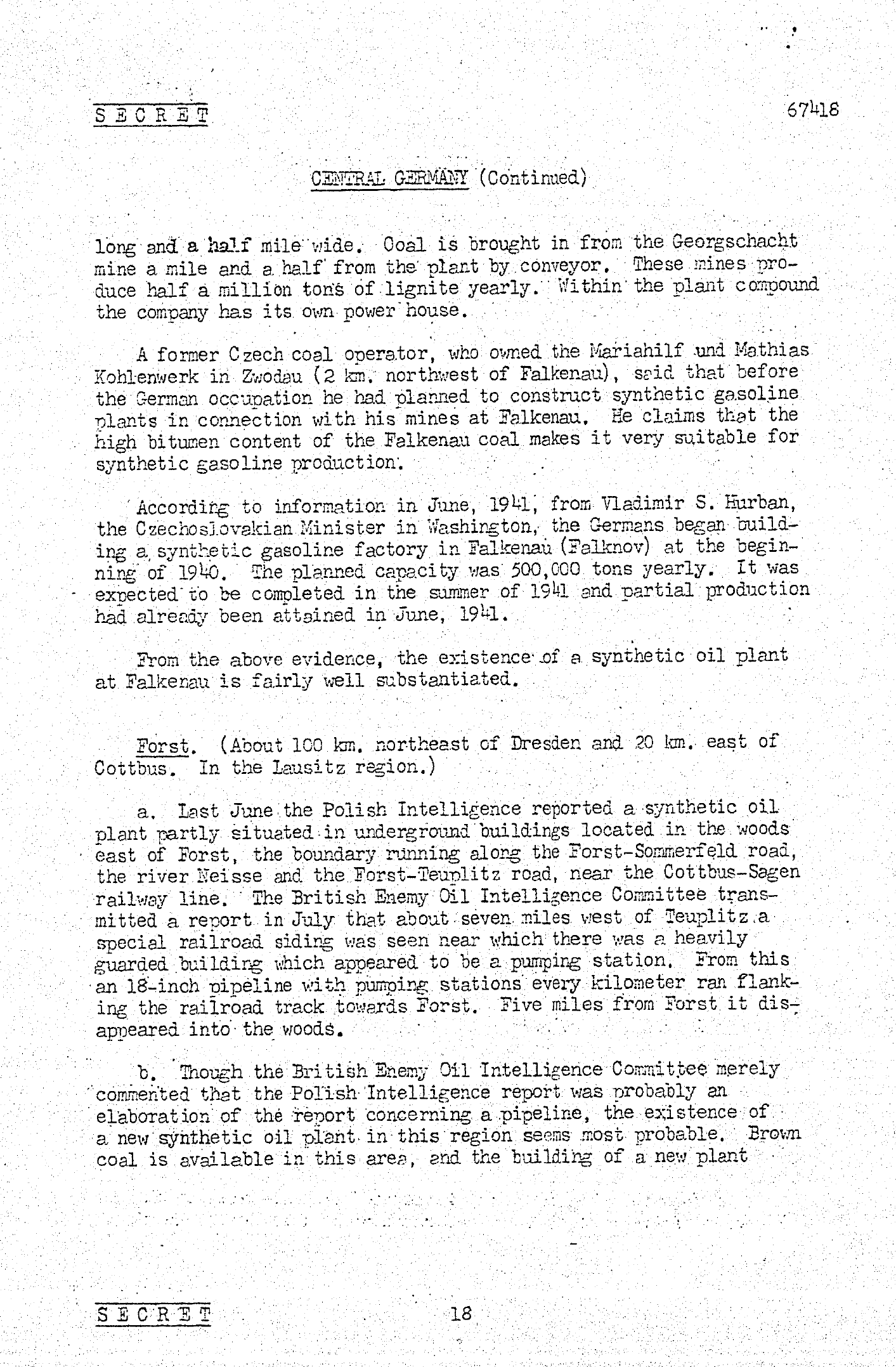
Western intelligence report: source evidence concerning DSC Forst.
Source document or photograph
Excerpt from the G.E.O.S. study showing the organisational structure.
Source document or photograph
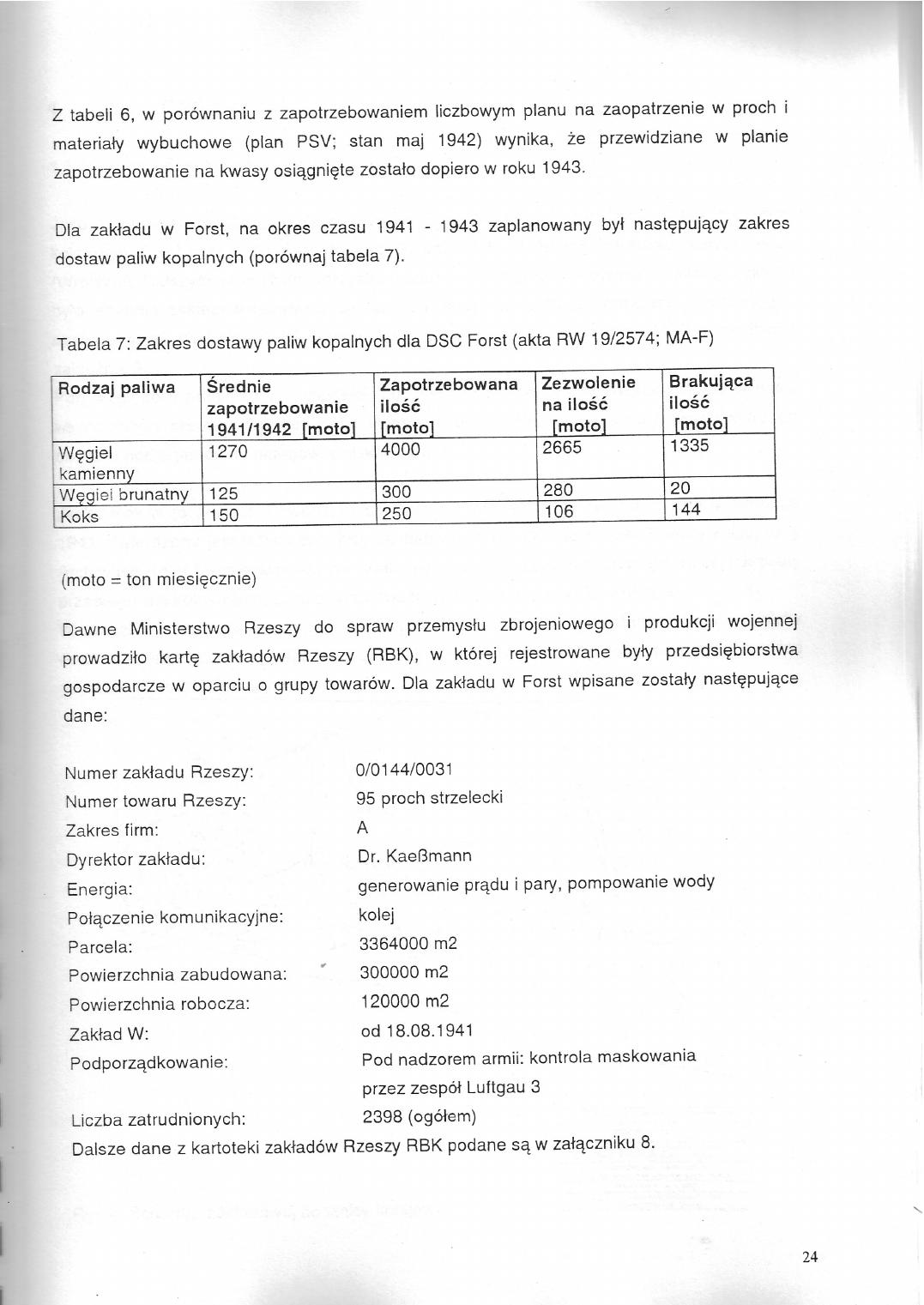
Excerpt from the G.E.O.S. study on requirements and organisation.