
Fundacja Rokita Home Discover Brody Municipality Discover Brody Municipality
DSC Forst “Wald” · industrial heritage hidden in nature
PL DE EN
f Follow us on Facebook

POL powder production at DSC Forst-Scheuno

Historical reconstruction of solventless POL powder production at DSC Forst-Scheuno based on the 1995 G.E.O.S. report: Oilbergs, raw mass, rolling, forming, drying and quality control.

Regional History · DSC Forst · POL powder production
Primary source · 1995

First: how do we know this?

This page is based primarily on the G.E.O.S. study dated 30 November 1995. Its authors combined German archival records, military files, aerial photographs, field inspection and the earlier 1994 reconstruction by Johannes Preuß and his team. That earlier work is confirmed in the official bibliography of Johannes Gutenberg University Mainz: 141 pages, 36 building descriptions and a 1:5,000 plan.

The commissions should not be conflated: the 1994 reconstruction was prepared for G.E.O.S. Freiberg. The 1995 G.E.O.S. report used here was commissioned by the Brandenburg state administration.
Not one hall, but a chain of dispersed zones

Both halves of the plant repeated similar functional groups. Hazardous stages were separated among individual buildings, earthworks and safety zones. Roads, railways and water, energy and technical networks connected the widely spaced production areas.

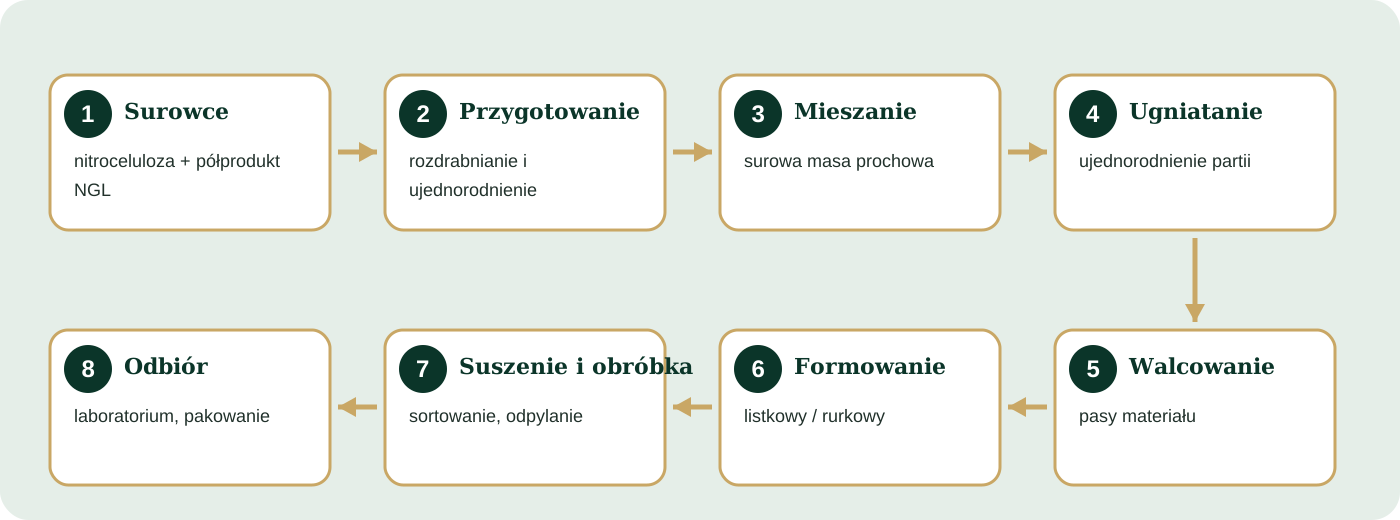
Diagram of the eight main functional stages of POL powder production
Authorial simplified diagram. It shows functions, not operational parameters.

From nitrocellulose to raw powder mass

Source-confirmed

Nitrocellulose

The report describes nitrocellulose as an incoming raw material prepared on site before further processing. It was broken down and homogenised, its moisture was checked and it was prepared for the next stages. These functions were housed separately from mixing and kneading.

Evidence + G.E.O.S. reconstruction

Oilbergs and the NGL intermediate

Four installation groups are referred to as “Nitro Hills” or “Oil Hills”; the Fundacja site uses the name Oilbergs. They produced a liquid energetic intermediate used in POL manufacture. During the war, parts of the plant were adapted to an alternative raw-material route within the same technological family.

G.E.O.S. reconstructs the internal sequence of this branch partly by analogy. The key point for understanding the ruins is therefore functional: an Oilberg was not simply a store, but a group of sequential, spatially separated operations.

Mixing, kneading and rolling

Mixing

Prepared nitrocellulose was combined in dedicated mixing buildings with the liquid intermediate and technological additives to produce a reasonably uniform raw mass.

Kneading

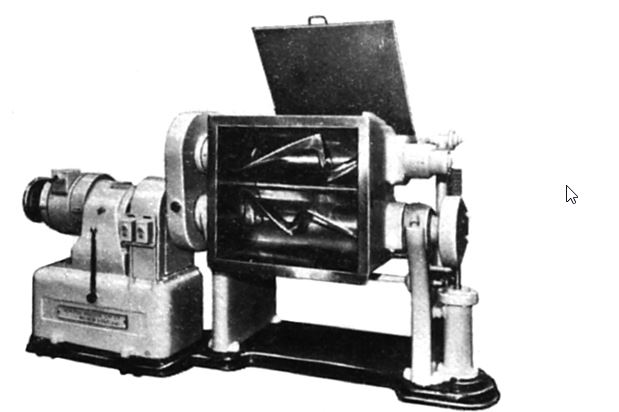
The next stage further homogenised the material and formed part of batch quality control. G.E.O.S. identifies dedicated kneading buildings.

Rolling

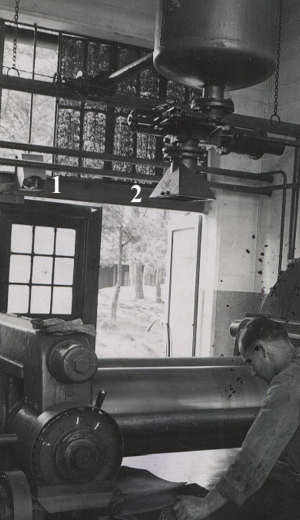
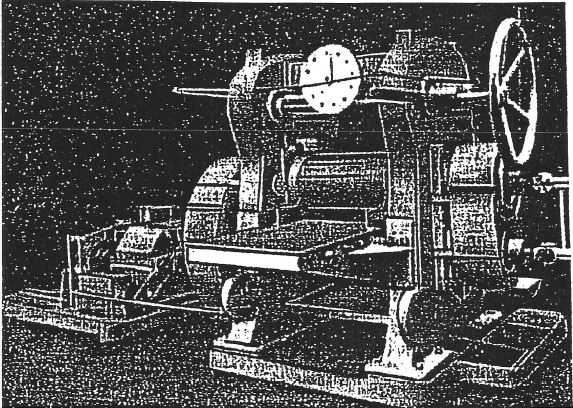
The mass was first pre-rolled and then rolled more finely. This reduced water, compacted the material and produced bands suitable for later shaping.

94 pre-rolling machines identified by G.E.O.S.
26 rollers for the later, finer stage
2 plant halves with recurring production blocks

Two main routes of later shaping

High-probability reconstruction

Flake powder

After rolling, the material passed through cutting and punching, followed by batch mixing, sorting, surface treatment, sieving and dust removal. G.E.O.S. notes that some cutting and punching buildings could not be identified with certainty at Forst, so this page does not present those locations as established facts.

Source-confirmed

Tubular powder and pressing

The other branch involved pressing, subsequent batch mixing and drying. The study identifies large groups of presses and separate drying buildings. Its summary also mentions further product forms, including rod powder and pressed rocket propellant forms.

Quality control did not end with packing

Laboratory

The plant had its own laboratory. G.E.O.S. links it with the analysis of intermediates and with the wider powder quality-assurance system.

Factory firing range

The complex also included a test firing range where safety and performance-related trials were carried out. The report describes dedicated laboratory, measuring and support buildings associated with this facility.

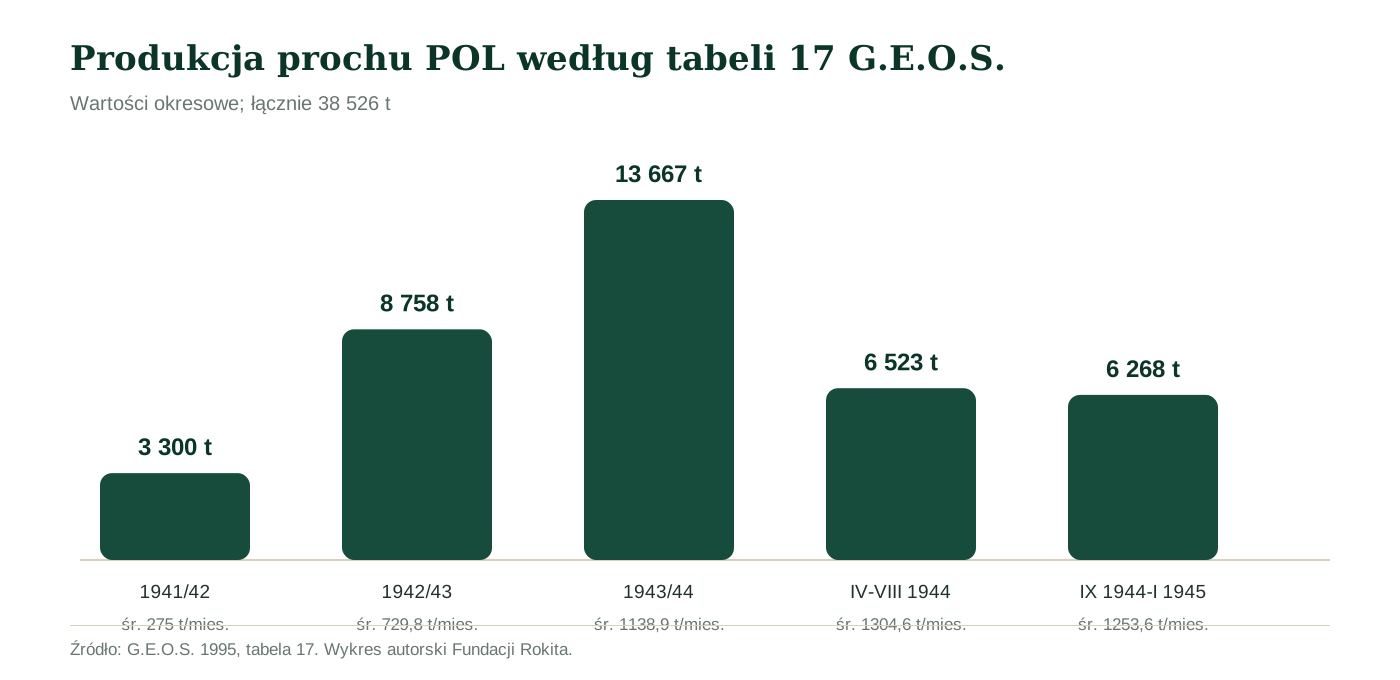
Scale: 38,526 tonnes in the surviving production table

Table 17 of the G.E.O.S. study shows a steep rise in output. From about 3.3 thousand tonnes in 1941/42, average monthly output rose above 1.3 thousand tonnes during part of 1944. The total of the listed periods is 38,526 tonnes.

Chart of POL powder production at DSC Forst from 1941 to early 1945
Values from G.E.O.S. 1995, Table 17. The periods differ in length; monthly averages are shown beneath the bars.

The invisible production infrastructure

Acids and HOKO

Spent acid mixtures were sent to separate treatment and recovery areas. The HOKO complex formed part of this acid-management system and later became important in contamination studies.

Water and energy

Both plant halves had their own energy supply. The water system relied on 28 wells documented in the records.

Transport

Factory railways, roads, loading points and internal vehicles connected the dispersed production zones into a single functioning plant.

Production also meant people under coercion

Wartime records cited by G.E.O.S. show labour shortages during commissioning and the presence of foreign workers and prisoners of war. A technical reconstruction should not obscure the coercive labour system behind the armaments economy; the Fundacja addresses that subject in separate historical sections.

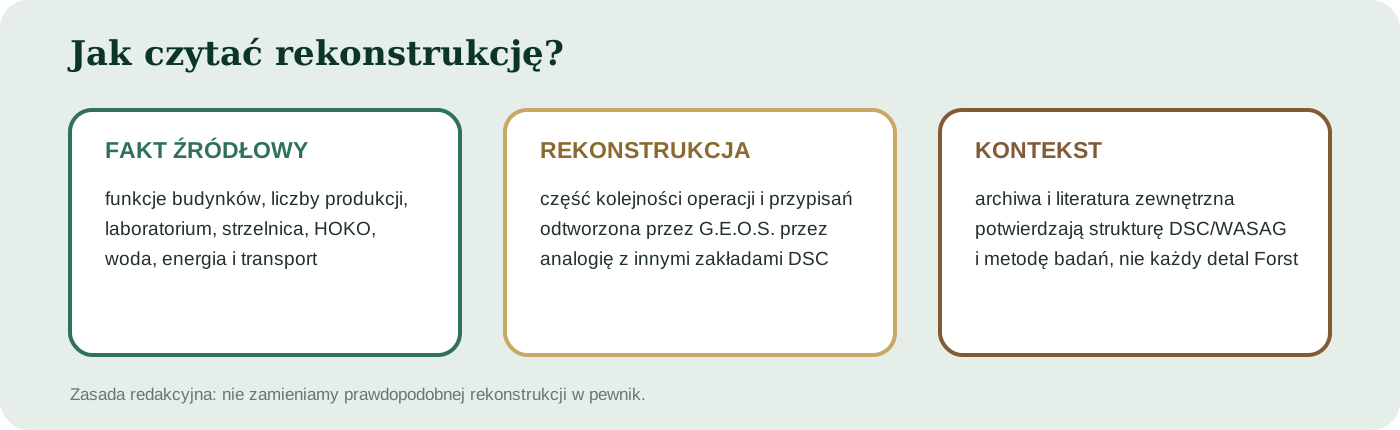
What is established - and what is reconstructed?

Diagram separating source-confirmed facts, reconstruction and external context
The graphic is labelled in Polish; the three categories correspond to source-confirmed fact, reconstruction and external context.

Source-confirmed

The functional layout, Oilbergs, rollers, presses, dryers, laboratory, firing range, HOKO, supporting infrastructure and production figures are directly grounded in the documentation assembled by G.E.O.S.

Reconstruction

Part of the detailed process sequence and some building assignments were reconstructed by G.E.O.S. through analogy with other DSC/WASAG plants.

External context

JGU Mainz, the Bundesarchiv, the State Archive in Zielona Góra and the State Archive of Saxony-Anhalt confirm the plant, its corporate network and the research context, but not every technical detail at Forst.

Sources and verification

The page separates source-confirmed information, the G.E.O.S. reconstruction and external comparative context. External sources are not used to claim details they do not themselves document.

G.E.O.S. Ingenieurgesellschaft mbH, „Ekspertyza dotycząca obiektu: Zakłady przemysłu zbrojeniowego - Fabryka amunicji i materiałów wybuchowych Forst”, Berlin/Hennigsdorf, 30.11.1995. Primary source for Forst-Scheuno, especially section 4.4 and Table 17. Open →
Johannes Gutenberg-Universität Mainz - bibliografia Johannesa Preußa. Confirms the unpublished 1994 Forst reconstruction: 141 pages, 38 tables, 12 illustrations, 36 building descriptions and a 1:5000 plan; commissioned by GEOS Freiberg. Open →
Archiwum Państwowe w Zielonej Górze, zespół 89/1299/0. Confirms the Zasieki works as a Deutsche Sprengchemie branch and the DSC–WASAG/Dynamit AG–MONTAN relationship; the collection mainly holds workers’ passes. Open →
Bundesarchiv, BArch R 8135/7252 - Deutsche Sprengchemie GmbH, Berlin: Bd. 3. The annual audit lists Forst among DSC branch plants; it is an organisational source, not a technical operating manual. Open →
Landesarchiv Sachsen-Anhalt, I 417 WASAG Coswig, 1914-1947. Context for WASAG history and archival holdings. Open →
HLNUG, Handbuch Altlasten, Band 4: Rüstungsaltstandorte, Teil 1-2 (1996). Confirms the historical-descriptive method used to reconstruct former armaments sites and the use of records on historical production processes. Open →

Machinery documented in photographs

Source document or photograph
Roll mill with sprinkler system and photoelectric cell — full original frame.
Source document or photograph
Roll mill: material from the Fundacja Rokita collection.
Source document or photograph
Kneading machine: material from the Fundacja Rokita collection.